


How to adjust client macros - the decision rules that beat a calculator.
Knowing how to adjust client macros is what separates a coach from the calculator that set the numbers. A calculator produces a target; a coach decides how long to wait, how big a change to make, which macro to move, and what to check before touching anything at all. This guide is those decision rules, in order - the exact checks and small, deliberate steps that turn a stalled diet back into a moving one without throwing away your clean data.
By Markus Evers · Updated August 2026
the short version
To adjust a client's macros well, run four checks in order. First, confirm the client is actually hitting the target and the data is clean - if not, fix adherence, not the number. Second, wait for a two to three week trend rather than reacting to a single weigh-in. Third, change by a small, readable step, commonly 5 to 10 percent of calories, moving one variable at a time. Fourth, hold protein and move carbs or fat instead. Do that and every adjustment stays legible, leaves you somewhere to go next, and asks the least of a client who is already working hard.
What do you check before you touch a target?
The most common macro mistake is not the size of the change or the choice of macro - it is adjusting when you should not have adjusted at all. Before you move a single calorie, three things have to be true, and if any one of them is false the answer is to fix that, not the target. This is the check that separates a coach from a calculator: a calculator will happily spit out a new number on demand, but a coach knows that a new number solves nothing when the old number was never the problem.
Check one: is the client actually hitting the targets? Adherence is the input; the macros are only meaningful if they are being followed. Check two: is the data clean enough to trust? That means consistent logging, weigh-ins under the same conditions, and enough days that daily water, sodium and scale noise have averaged out. Check three: has enough time passed? A single weigh-in, a travel week, or the first days after a diet change are not a signal. Only when all three hold do you have a reason - and the clean baseline - to adjust. If you want to read those signals properly, the wider habit of assessing nutrition progress beyond a number on the scale is what feeds this decision.
The four rules for how to adjust client macros.
1. How long to wait: read the trend, not the day.
Change the target only when a trend tells you to, and a trend takes two to three weeks to appear. Daily bodyweight swings from water, sodium, sleep and the menstrual cycle routinely fake a stall or a whoosh that is not real fat change, so a single weigh-in is noise, not information. Review the targets at every check-in - looking is free - but change them only when two to three weeks of clean data point the same direction. If weight and measurements are moving at a sensible pace and adherence is high, the correct action is to hold and do nothing, which is the hardest instruction for both coach and client to follow.
2. How big a change: the smallest step that restarts progress.
When you do adjust, make a small, deliberate move - commonly 5 to 10 percent of current calories, which for most clients lands somewhere around 100 to 250 calories. A small step keeps the change readable: move calories by a large chunk and you can no longer tell whether the new rate of progress came from your adjustment or from something in the client's week, and you have spent your adjustment room in a single move. The smallest change that gets the trend moving again is always the right one, because it leaves you room to go further next time and asks the least of a client who is already in a deficit. Big cuts feel decisive and read as impatience.
3. Which macro to move: hold protein, adjust carbs or fat.
Protein is the target you protect. It defends muscle in a deficit and drives satiety, so hold it roughly steady - a common working range is about 1.6 to 2.2 g per kg of bodyweight - whether calories go down or up. That means almost every adjustment is a carb or fat change. In a cut, pull the calories from whichever of carbs or fat costs the client the least in training quality and adherence, often trimming fat while protecting the carbs that fuel hard sessions, but never dropping fat so low that hormones and palatability suffer. In a gaining phase, add the calories back mostly as carbs, the cheapest fuel for training volume. The one macro you almost never sacrifice first is protein.
4. Change one variable, then wait again.
Adjust one thing at a time. If you cut calories, tighten tracking and swap the plan in the same week, a fortnight later you will have no idea which move did the work - and if progress stalls again you will be guessing in the dark. One change, a modest amount, then back to rule one: wait for the trend before the next step. This is the discipline that compounds. A coach who moves a single readable variable every two to three weeks always knows where they are; a coach who changes three things at once every time a client is impatient is just stirring, and will run out of room fast.
Four situations that cover almost everything.
Most of what you will see at a check-in maps onto one of four cases. The rules above stay the same; only the direction and the diagnosis change.
Fat loss has stalled on good adherence.
This is the textbook adjustment. Two to three weeks of solid tracking, weight flat, measurements flat - now you trim calories in a small step, protect protein, and pull the reduction from carbs or fat. Confirm it is a true stall first, though: a real plateau is at least two to three weeks of no change on clean data, not one quiet week. A diet break or a few maintenance days can also restart progress without cutting further, and is often the kinder call for a client who has been dieting a long time.
Weight is dropping too fast.
Faster is not better. Aggressive loss on a lean or hard-training client costs muscle, tanks recovery and rarely holds, so a too-quick drop is a reason to add calories back, not to celebrate. Nudge intake up in a small step - again mostly carbs, protein held - and re-read the trend. The goal is the sustainable rate the plan was built around, not the fastest number the scale can produce.
A gaining client is not gaining.
In a lean gaining phase the logic flips: two to three weeks of flat weight on good adherence means add calories, in the same small step, mostly as carbs. Watch that the added weight comes on at a controlled pace - a modest, steady rise, not a rapid jump that is mostly fat. If the scale is climbing too fast, hold or trim slightly rather than feeding the gain.
The numbers are not being hit at all.
Do not adjust the target. A number nobody follows tells you nothing, so a new one changes nothing. Loosen the tracking tier, simplify the plan, or solve the real-life obstacle behind the miss - the schedule, the skill, the weekend pattern - then let clean data come back before you decide whether the target itself needs to move. Adjusting macros to paper over poor adherence is the most common way a coach mistakes activity for progress.
Every adjustment is only as good as the data you read it from.
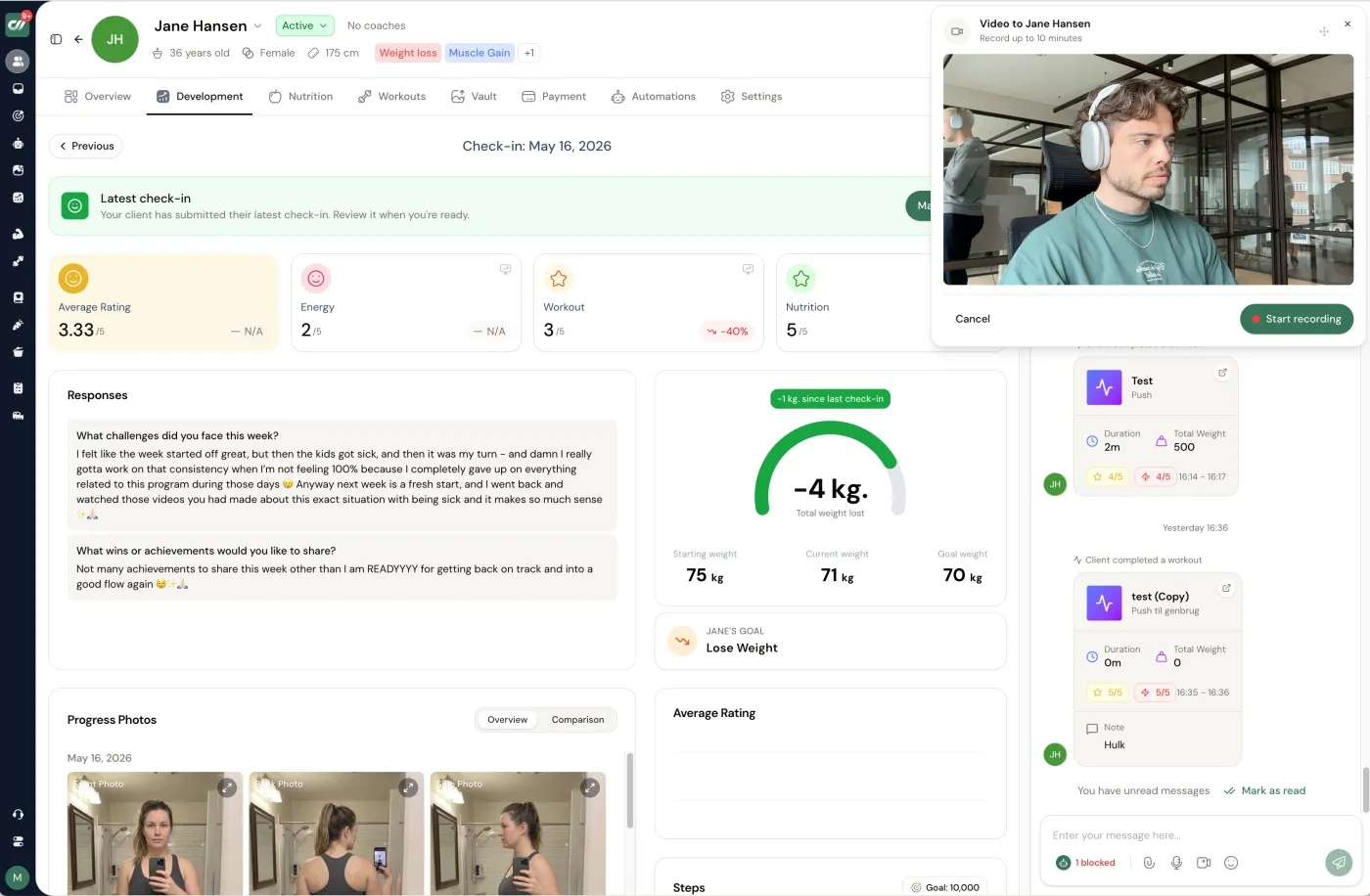
These rules all depend on one thing: seeing a client's adherence and weight trend clearly, in one place, at the moment you decide. When the target lives in a spreadsheet, the client logs in an app you cannot see into, and the weight trend is a screenshot pasted into chat, the two to three week signal you need is scattered across three tools - and premature, noise-driven adjustments are the natural result. In Coachway the loop closes: you set per-client, per-weekday macro targets, the client logs against them with macro rings that move as they eat, and their adherence lands next to the weight trend and progress photos on your check-in review, so the decision to hold or move a number is made from clean data rather than a guess. It is built on knowledge from working with 150 online coaches over 6+ years, and it costs EUR 69 a month including your first 5 clients, then EUR 9 per additional client. The 14-day free trial starts with a card and cancels under Billing before it renews - or book a demo and see the check-in review first. For the wider method these rules sit inside, the full macro-coaching method covers setting targets and matching tracking depth to each client.
Frequently asked questions about adjusting client macros.
How do you know when to adjust a client's macros?
You adjust when a two to three week trend on good adherence says the current targets are no longer producing the change you want - not when a single weigh-in moves. Before you touch a number, confirm three things: the client is actually hitting the targets you set (if not, the target is not the problem), the data is clean enough to trust (consistent logging, same weigh-in conditions, enough days to average out water and sodium noise), and enough time has passed for a real signal. If fat loss has clearly stalled on solid adherence across two to three weeks, that is your green light. If the numbers are being missed, or you only have a few days of data, or last week was a travel week, hold the target and fix the input first. Most premature adjustments are a coach reacting to noise, and each unnecessary change throws away the clean baseline you need to read the next one.
How much should you change a client's macros at once?
A small, deliberate step - commonly 5 to 10 percent of current calories, which for most clients is somewhere around 100 to 250 calories. The point of a small change is that it keeps the adjustment readable: move calories by a big chunk and you cannot tell whether the new rate of progress came from the change or from something in the client's week, and you have also burned through your adjustment room in one move. Change one variable, by a modest amount, then wait for the trend before the next step. The smallest change that restarts progress is always the right one, because it leaves you somewhere to go next time and it asks the least of a client who is already dieting.
Which macro should you adjust first?
Hold protein, then move carbs or fat. Protein is the target you protect - it defends muscle in a deficit and drives satiety, so keep it roughly steady around 1.6 to 2.2 g per kg of bodyweight whether calories go up or down. That means an adjustment is almost always a carb or fat change. In a fat-loss phase, pull calories mostly from whichever of carbs or fat the client can lose with the least disruption to training and adherence - often trimming fat while protecting the carbs that fuel hard sessions, though a very low-fat plan should keep enough fat for hormones and palatability. In a gaining phase, add the calories back mostly as carbs, since they are the cheapest fuel for training volume. The macro you should almost never sacrifice first is protein.
Should you adjust macros if the client is not hitting their targets?
No. A target nobody follows tells you nothing, so changing it just replaces one number the client is missing with another. When adherence is the real problem, the fix is upstream of the macros: loosen the tracking tier, simplify the plan, solve the actual obstacle - a schedule, a skill gap, a food they hate, a weekend pattern - and then let two to three weeks of clean data come back before you decide whether the target itself needs to move. Adjusting macros to compensate for poor adherence is the most common way coaches convince themselves they are coaching while the client quietly drifts. Fix the input, restore the signal, then read it.
How do you adjust macros during a reverse diet or a move to maintenance?
The same rules apply, only the direction and the goal change. Coming out of a deficit, add calories back in small steps - again mostly as carbs, with protein held - and watch the trend rather than a single weigh-in, aiming to raise intake while keeping weight roughly stable or rising only slowly. A day or two of scale bounce after adding carbs is water and glycogen, not fat, so do not panic and reverse the change on week-one noise. The wait-for-the-trend and small-step principles matter even more here, because the whole point of a careful reverse is to find how many calories the client can hold at a stable weight, and that number only shows up across weeks, not days.
Adjusting is the back half of a loop that starts with the numbers themselves: how you calculate TDEE and set macros gives you the baseline, and the full macro-coaching method ties setting, tracking and adjusting into one system a coach can run at scale.
Keep reading
all guidesHow to Adjust a Workout Program During a Cut (2026)
Adjusting a client's training program during a cut comes down to four decisions made against a shrinking recovery budget: keep intensity heavy so the muscle has a reason to stay, drift volume toward maintenance, pick lower-fatigue exercises, and deload more often.
Read the guideMacro coaching: how to set, track and adjust client macros
Macro coaching means coaching to targets, not a fixed menu. How to set client macros from energy needs, match tracking depth to each person across four tiers, adjust on a two to three week check-in cadence, and run the whole loop without spreadsheets.
Read the guideHabit Coaching Frameworks for Online Coaches
A habit coach wins on adherence, not information. The five evidence-based frameworks - the habit loop, habit stacking, tiny habits, minimum viable behaviors and if-then plans - and how to operationalize each as a repeatable client task and a weekly check-in.
Read the guideSee what Coachway can do for your coaching business
Coachway was built on knowledge from working with 150 online coaches over 6+ years, who all hit the same wall - slow platforms, clunky workflows, wasted hours. Start your 14-day free trial and see what we fixed - the whole platform, no charge today, cancel anytime under Billing.


