


Client progress report template for coaches. Eight sections, one page, filled from check-in data, sent every four weeks.
Coaches who asked r/personaltraining why clients leave heard the same first reason: "They didn't feel like they were making progress even if they were." A one-page report every four weeks is the cheapest fix. The template is below, complete, with four prompts that fill it from your check-in data without inventing anything, and the review call that follows it.
By Markus Evers · Published 6 September 2026 · Updated September 2026
the short version
A client progress report is a one-page summary sent every four weeks with eight sections: the number that mattered, adherence, training, nutrition, body trend, the client's own words, next month's one focus and a two-line coach note. The template below is complete; four ChatGPT prompts fill it from anonymised check-in data and draft the summary in your voice.
What should a client progress report include?
A client progress report should include eight sections on one page: the number that mattered this month, adherence as percentages, training with one or two anchor lifts, nutrition against target, the weekly average weight trend, one sentence in the client's own words, next month's single focus, and a two-line coach note. Every number comes from the check-in data, the same numbers the client already logged, so the report never surprises them; it shows them what they did.
| Section | What it holds | Where the number comes from |
|---|---|---|
| 01The number that mattered | One result, with the change and the timeframe | Check-in data, chosen by you |
| 02Adherence | Sessions done of planned, check-ins sent of planned, as percentages | The check-in log |
| 03Training | Sessions done versus planned; trend on one or two anchor lifts | Workout logs |
| 04Nutrition | Average intake against target; one habit that held or slipped | Food log or weekly form |
| 05Body | Weekly average weight trend; measurements or photos only if used | Weekly averages, never single weigh-ins |
| 06In their words | One sentence the client wrote in a check-in this month | The check-in form |
| 07Next month's one focus | One behaviour, one number, one date | You |
| 08Coach note | Two lines you write yourself, never AI | You |
Why the report exists. In the 186-point r/personaltraining thread on structuring coaching so clients stay six months or more, the first reason clients gave for leaving was that they did not feel they were making progress even when they were, ahead of not feeling connected to the coach and not being able to justify the price. Visible progress at the end of each block answers all three, and the retention guide covers the other levers.
How often should a coach send a progress report?
Every four weeks, or at the end of each training phase. A coach with fourteen years of clients wrote on r/personaltraining that he sends a feedback form after every training phase, usually every three to six weeks, and that new clients read it closely for their first few months while long-term clients skim it. That is the right rhythm: often enough to show a trend, rare enough to write well, and tied to the phase structure in the training phases guide, where the phase-end review call is the retention lever. Weekly check-ins stay weekly; the report is the monthly summary of them.
What does the one-page progress report template look like?
The template is eight numbered sections with bracketed fields, about 250 words when filled. Copy it into your notes or your platform's document area once, then fill it from the check-in data each month; the first prompt below does the filling for you from an anonymised export.
Client progress report template (8 sections)
When to use it: Once a month, or at the end of each training phase, for every active client.
What to paste in: Nothing yet: copy it, keep it, and fill it by hand or with prompt 1 below.
CLIENT PROGRESS REPORT: [MONTH / PHASE NAME]
Client: [FIRST NAME]   Period: [DATE] to [DATE]   Coach: [YOUR NAME]

1. The number that mattered
[e.g. Squat working weight 60 kg to 70 kg over 4 weeks]

2. Adherence
Sessions: [DONE] of [PLANNED] ([PERCENT]%)   Check-ins: [SENT] of [PLANNED] ([PERCENT]%)

3. Training
Sessions done: [DONE] of [PLANNED]
Anchor lift 1: [LIFT] [START] to [NOW]   Anchor lift 2: [LIFT] [START] to [NOW]

4. Nutrition
Average intake: [KCAL] against a target of [KCAL]   Protein: [G] against [G]
Habit that held: [HABIT]   Habit to rebuild: [HABIT or "none"]

5. Body
Weekly average weight: [WEEK 1] to [WEEK 4] ([CHANGE], [PERCENT] of bodyweight)
Measurements or photos: [only if the client tracks them, otherwise "not tracked"]

6. In your words
"[ONE SENTENCE THE CLIENT WROTE THIS MONTH]"

7. Next month's one focus
[ONE BEHAVIOUR], [ONE NUMBER], by [DATE]

8. Coach note
[TWO LINES, WRITTEN BY YOU]
What is a client progress tracker, and how does it feed the report?
A client progress tracker is the running grid you keep between reports: one row a week per client, filled the day each check-in lands, so the four weeks are already sitting in one place when the monthly report is due. The report is the summary the client reads; the tracker is the source you never have to reconstruct from memory. Keep one client progress tracker per client, fill a row each week, then paste the four weeks straight into prompt 1 below. The grid uses the same fields as tracking progress beyond the scale, so weight is only one of nine columns.
Weekly client progress tracker (one row a week)
When to use it: Fill one row the day each weekly check-in lands, all month, for every active client.
What to paste in: This week's numbers from the check-in: weight average, sessions, steps, sleep, intake, the anchor lift, and one line the client wrote.
CLIENT PROGRESS TRACKER: [FIRST NAME]   (one row a week, then paste the four weeks into prompt 1)

Week | Weight avg | Sessions done/planned | Check-in | Steps avg | Sleep avg | Intake avg | Anchor lift now | One line the client wrote
-----|-----------|-----------------------|----------|-----------|-----------|------------|-----------------|--------------------------
1    | [KG]      | [DONE]/[PLANNED]      | [Y/N]    | [AVG]     | [HRS]     | [KCAL]     | [LIFT] [WEIGHT] | "[QUOTE]"
2    | [KG]      | [DONE]/[PLANNED]      | [Y/N]    | [AVG]     | [HRS]     | [KCAL]     | [LIFT] [WEIGHT] | "[QUOTE]"
3    | [KG]      | [DONE]/[PLANNED]      | [Y/N]    | [AVG]     | [HRS]     | [KCAL]     | [LIFT] [WEIGHT] | "[QUOTE]"
4    | [KG]      | [DONE]/[PLANNED]      | [Y/N]    | [AVG]     | [HRS]     | [KCAL]     | [LIFT] [WEIGHT] | "[QUOTE]"

Targets for the month: intake [KCAL], protein [G], sessions [N], check-ins [N]
Rule: fill one row the day each weekly check-in lands, never from memory. Leave a cell as "not tracked" if the client does not log it.
The tracker without the spreadsheet. The grid above works in any notes app, but a manual client progress tracker is one more file to keep per client. Coachway's client progress tracking keeps the weekly weight average, adherence, anchor lifts, check-ins and photos on one client screen with an export, so the four weeks are already the rows prompt 1 needs, no copying between apps.
How do you turn check-in data into a progress report with ChatGPT?
Paste four weeks of anonymised check-in data and the template into prompt 1; it fills the numbers and writes "not tracked" wherever there is no data. Prompt 2 drafts the client-facing summary in your voice from two of your own replies. Prompt 3 compares two months for you, not the client. Prompt 4 builds the review call agenda. Strip the client's name and anything about health before pasting; the client data guide has the anonymisation template.
Fill the report from four weeks of check-in data
When to use it: Once a month per client, after the fourth check-in is in.
What to paste in: Four weeks of anonymised check-in numbers, the anchor lifts, the targets, and the template.
You are helping me, an online fitness coach, fill in a client progress report. Below are four weeks of anonymised check-in data for one client (first name only, no health details). Fill in the template that follows using only the numbers I give you.

Rules:
1. Use only the data pasted. Do not estimate, round up, or invent a trend. If a section has no data, write "not tracked".
2. Report weight as the change between week 1 and week 4 weekly averages, as kilograms and as a percentage of bodyweight, to one decimal.
3. Adherence is done divided by planned, as a whole percentage.
4. Quote the client's own words exactly as written, one sentence, in section 6.
5. Leave section 7 (next focus) and section 8 (coach note) empty; I write those.
6. No adjectives, no praise, no "great job". Numbers and plain statements only.
7. Output the filled template and nothing else.

Data:
Week 1: weight average [KG], sessions [DONE]/[PLANNED], check-in sent [YES/NO], steps [AVG], sleep [HOURS], intake average [KCAL], client's words: "[QUOTE]"
Week 2: [SAME FIELDS]
Week 3: [SAME FIELDS]
Week 4: [SAME FIELDS]
Anchor lifts: [LIFT]: [START] to [NOW]; [LIFT]: [START] to [NOW]
Target intake: [KCAL], protein target [G]

Template:
[PASTE THE TEMPLATE ABOVE]
Write the client-facing summary in your voice
When to use it: After prompt 1, before you send the report.
What to paste in: The filled template and two check-in replies you wrote yourself.
Here is a filled-in client progress report (numbers only, first name only): [PASTE THE FILLED TEMPLATE]. Here are two check-in replies I wrote myself, so you can hear how I talk to clients: [PASTE REPLY 1] [PASTE REPLY 2].

Write the client-facing summary that goes at the top of the report, in my voice, under 120 words. Rules:
1. Open with the number that mattered, stated plainly, in the first sentence.
2. Name one thing they did that produced it, from the data, not a guess.
3. One sentence on the thing to rebuild next month, without blame.
4. End on their own words from section 6, quoted.
5. No "amazing", "crushed", "journey", "unlock"; no exclamation marks; no groups of three; no emoji unless my samples use them.
6. Do not mention anything medical, and do not promise a future result.
Output only the summary.
What changed between two months, and why (for you)
When to use it: Before the review call, when you have two reports for the same client.
What to paste in: Two filled reports, two months apart.
Below are two consecutive client progress reports for the same client, two months apart, numbers only: [PASTE REPORT 1] [PASTE REPORT 2]. Write one paragraph of 60 to 90 words for the coach (me, not the client) that says what changed between the two months and the single most likely reason, using only the numbers. Mark anything that is a guess with "(unsure)". Then list two questions I should ask the client on the review call. No recommendations about calories, medication or injuries.
The phase-end review call agenda
When to use it: The day before the call.
What to paste in: The filled report.
Build a 20-minute phase-end review call agenda for me, an online fitness coach, using this progress report: [PASTE]. Structure: 2 minutes for the number that mattered and how the client feels about it; 6 minutes walking through sections 2 to 5 with one question per section; 4 minutes on what made the month hard, in their words; 5 minutes agreeing next month's one focus (one behaviour, one number, one date); 3 minutes on what changes in the plan and when they will see it in the app. Output as a timed list with the question I ask at each step. No praise scripts, no upsell language.
What the prompts never do. They do not decide next month's focus, they do not write the coach note, and they do not touch calories, injuries or anything medical. If prompt 1 returns a number you did not paste, delete the draft and start again; the rules in how to make ChatGPT not sound like AI apply to the summary as well.
What goes in the phase-end review call?
Twenty minutes in five parts: the number that mattered and how the client feels about it (2 minutes), one question per section of the report (6 minutes), what made the month hard in their words (4 minutes), next month's one focus as a behaviour, a number and a date (5 minutes), and what changes in the plan and when they will see it in the app (3 minutes). The report is what they re-read afterwards; the call is where the next block gets agreed. Coaches with two- and three-year client retention on r/personaltraining name this call, not the programming, as the reason clients stay.
Where do the numbers in a progress report come from?
From the check-in form, the workout log and the weekly weight averages, never from memory and never from the model. A coach asking r/personaltraining for monthly reporting software was told by other coaches to export to a sheet, because the apps they used could not produce a clean monthly summary; the sheet is the template above. On Coachway the check-in data, charts and photos sit on one client screen with an export, so the four weeks paste into prompt 1 in one go. The check-in workflow guide covers the weekly side, and tracking progress beyond the scale explains the six signals the report draws on.
Ask for the same measurements and photos every week, and month-end is just reading.
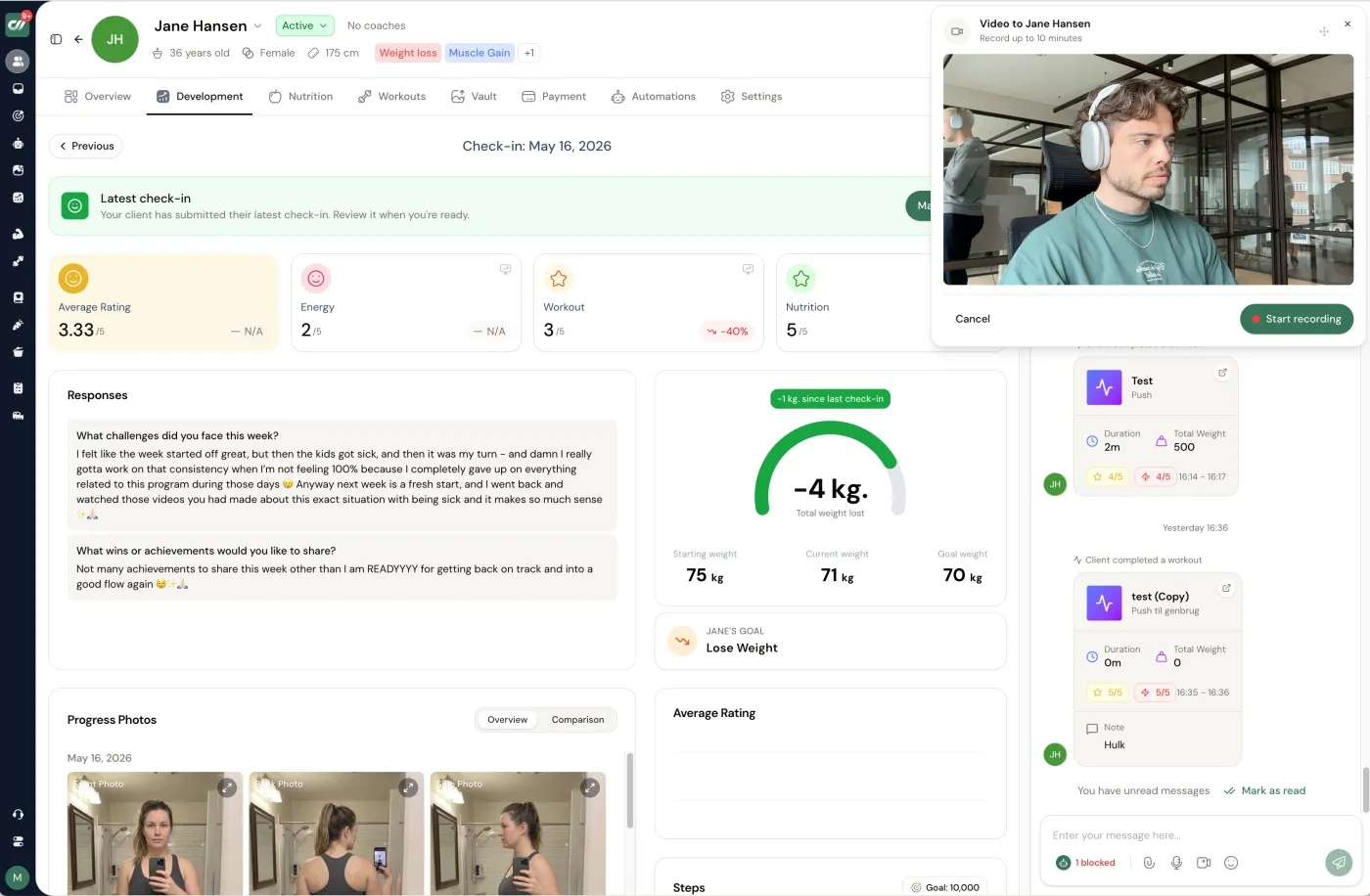
A report is only as good as the check-ins behind it: the same form, the same measurements and the same photo angles each week, so four weeks line up without chasing anyone. In Coachway you build that check-in form once with drag and drop, including photos and measurements, and the measurements chart themselves. The Power Panel adds the training log and latest messages beside the numbers and photos, so the month reads in one place; anything you still paste into ChatGPT stays anonymised, with no health details.
Frequently asked questions about client progress reports.
What is a client progress report?
A client progress report is a one-page summary a coach sends every four weeks, or at the end of a training phase, that shows the client what changed in numbers and in their own words: adherence, training, nutrition, the weekly weight trend, one quote from their check-ins and the single focus for the next block. It exists because the most common reason clients leave, in coaches' own words on r/personaltraining, is that they did not feel they were making progress even when they were.
How often should I send progress reports to clients?
Every four weeks, or at the end of each training phase if your phases are three to six weeks long. Weekly is too often to show a trend and too much to write; quarterly is too late to catch a client who is drifting. Coaches on r/personaltraining who send a feedback form after every phase report that new clients read it closely for the first few months and long-term clients skim it, which is fine: the report is for the client who is deciding whether to stay.
What metrics go in a fitness progress report?
Eight sections: the one number that mattered this month, adherence as a percentage of planned sessions and check-ins, training (sessions done versus planned and the trend on one or two anchor lifts), nutrition (average intake against target and one habit), body (the weekly average weight trend and measurements or photos only if the client uses them), the client's own words, next month's single focus, and a two-line coach note. Numbers come from the check-in data, never from memory.
Can ChatGPT write client progress reports?
It can fill the template from anonymised check-in data and draft the client-facing summary in your voice, and it should do nothing else. The rules in the prompts below: use only the numbers pasted, write "not tracked" where a section has no data, never invent a trend, leave the coach note empty, and strip the client's name and health details before anything is pasted. You read it, add one thing only you know, and send it from your platform.
Should progress reports include photos?
Only if the client already takes them and has said they want to see them side by side. A report that opens with a photo comparison for a client who did not ask for one reads as judgement. Lead with adherence and the anchor lift; put photos last, and never generate, enhance or crop them with an AI tool.
How long should a client progress report be?
One page: about 250 to 350 words plus a small table. If the client-facing summary is longer than 120 words, it is a letter, not a report. The phase-end review call is where the longer conversation happens; the report is what the client re-reads.
One page, eight sections, every four weeks. The client sees what they did; you see who is drifting before they say so.
Keep reading
all guidesClient Progress Tracker: How to Track Beyond the Scale
A client progress tracker that only reads the scale misleads you about half your clients. The multi-metric method good coaches run: six signals read together on a fixed cadence, so a flat morning never overrules a month of real change.
Read the guideChatGPT Prompts for Client Check-In Replies: 10 Prompts + Tone Training
Ten ChatGPT prompts that turn a stripped check-in form into a reply in your voice, each locked to the acknowledge, assess, one adjustment, one ask structure, plus a tone-training prompt that builds a style card from five of your own replies, the paste-in and keep-out rules, and a slipping-client prompt that gives bullet points instead of a message.
Read the guideHow to Set Up Training Phases for Online Coaching Clients (2026)
The setup, not the theory: 4-week blocks (three weeks of overload, one deload), the 12-week arc of movement quality, accumulation and intensification, one variable per phase, two or three anchor lifts, phases that end on a check-in, the phase-1 results review as the retention lever, and a copyable 4-week block template.
Read the guideFree tools for this: Weight Trend Reader · Lift Progression Reader · Client Check-in Reader
Ready-made template: AI Prompt Pack for Online Coaches
Where the report's numbers already live
Check-ins, charts, photos and the plan on one client screen, with an export. Start the 14-day free trial and send one client their first report: cancel any time under Billing.


