The best social media for personal trainers - pick one platform and go deep.
Most guides tell you to be everywhere. That is why so many coaches are forgettable on four platforms instead of magnetic on one. This is the decision the others skip: not what to post, but where to plant yourself - Instagram, TikTok, YouTube or LinkedIn - chosen by your niche, your real time budget and the client you actually want to work with.
By Markus Evers · Updated August 2026
the short version
The best social media for personal trainers is the one platform you can post to consistently for six months without burning out - not the one with the biggest reach on paper. Choose it against three filters: your niche, the hours you can genuinely protect each week, and the client you want. Instagram is the safe default for most general fitness and body-composition coaches; TikTok is the fastest way to get found from zero followers; YouTube compounds hardest for education-led niches with a slow buying decision; LinkedIn quietly reaches higher-paying professional clients almost nobody else is talking to. Pick one, go deep for two quarters, and only repurpose to a second channel once the first one works.
Which platform should a personal trainer actually be on?
The question that keeps coaches stuck is "which platform is best". The better question is "which one platform can I be visibly good on". Every network has its own format, rhythm and unwritten rules, and getting fluent in any of them takes more consistency than most people expect. Split yourself evenly across Instagram, TikTok, YouTube and LinkedIn in your first three months and you post too little on each to build momentum anywhere - the single most common reason a coach's content "never works". Being magnetic on one channel gets you more clients than being forgettable on four.
So this guide is not a ranking. It is a filter. Read each platform against your own niche, your honest weekly time budget and the client you want to attract, and the right answer usually becomes obvious - it is the platform where those three things line up, not the one with the largest theoretical audience. Every platform below also has its own full playbook on this site; treat this page as the map, and the deep-dives as the terrain.
| Platform | Best for | Main format | What it does best |
|---|---|---|---|
| Most general fitness and body-composition coaches | Reels, carousels, Stories | Keeps discovery, visual proof and DM conversations in one app | |
| TikTok | Coaches starting from zero with no audience | Short video | Shows you to strangers by interest, so a new account gets seen fast |
| YouTube | Education-led niches with a slow buying decision | Long video plus Shorts | Builds deep, evergreen trust that keeps working for years |
| Professional, executive and corporate clients | Text posts and carousels | Reaches higher-paying buyers with almost no coach competition |
Is Instagram still the best platform for personal trainers?
For most general fitness, fat-loss and body-composition coaches, yes - it is the safe default because it does three jobs in one place. Reels handle discovery, carousels and Stories build trust, and the DMs are where a warm follower actually becomes a conversation and then a booked call. That end-to-end path, from stranger to client without leaving the app, is Instagram's real edge. The trade-off is that it is crowded and the account rewards you for treating your profile like a landing page and posting to attract the exact client you want, not just chasing reach. If you already have followers and enquiries happening here, the honest move is almost always to get better at Instagram rather than jump ship - the full channel funnel is in how to get coaching clients on Instagram.
When is TikTok the better choice?
When you are starting from a standing start with no audience. TikTok shows a video to strangers based on what they watch rather than who already follows you, so a brand-new account can be seen in a way a brand-new Instagram rarely is - that is why it is the fastest route to getting found. The catch coaches miss is that TikTok is superb at discovery and poor at closing: it fills the top of your funnel but never makes the sale on its own, so it only works if you have a deliberate way to catch that interest and move it toward a conversation. If reach-from-zero is your problem, start here and follow the discovery-plus-funnel playbook in TikTok for fitness coaches.
Who should build on YouTube?
Coaches in education-heavy niches with a longer, more considered buying decision - think strength and rehab-adjacent work, nutrition science, physique coaching, or any niche where clients research hard before they commit. YouTube rewards depth over frequency, and its videos are searchable and evergreen, so a single strong upload can bring in leads for years rather than disappearing in a day like a story. That compounding is the reason to choose it, and the reason it is slow to start: you are building credibility over time, not chasing a viral spike. It also pairs neatly with short video - the clips you cut for TikTok or Reels can live on as YouTube Shorts. The full case, format and cadence are in YouTube for fitness coaches.
Should a personal trainer use LinkedIn?
If your client is a busy professional, an executive or someone whose fitness problem is really a stress-and-schedule problem, LinkedIn is the most under-used platform in the whole list. The people who can comfortably afford premium coaching are already there for work, and almost no fitness coaches are posting to them, so the competition for their attention is a fraction of what it is on Instagram. It is a text-and-carousel network with a slower, more professional rhythm - you win with insight and consistency, not aesthetics - which suits coaches who would rather write than dance to a trending sound. If premium professional clients are your target, the connect-comment-DM sequence is laid out in how to get coaching clients on LinkedIn.
How do I choose the right one for me?
Run yourself through three questions in order, and stop at the first clear answer.
1. Where is my niche already paying attention?
The platform is downstream of the client. Aesthetics, fat-loss and lifestyle audiences live on Instagram and TikTok; research-minded, education-led buyers lean YouTube; professionals and corporate clients are reachable on LinkedIn. Go where the person you want to coach already spends their scroll, not where you personally enjoy posting.
2. What can I honestly sustain every week?
A platform you post to for six months beats one you launch on and abandon in six weeks. If you can hold three to five short videos a week, short video on Instagram or TikTok fits. If you can only manage one serious piece a week but can go deep, YouTube or LinkedIn rewards that better. Choose for the version of you that is tired and busy, not the motivated version reading this now.
3. Do I need reach from zero, or trust with a warm audience?
If nobody knows you yet, prioritise the discovery engine - TikTok, or Reels on Instagram - to get in front of strangers. If you already have followers and enquiries, prioritise the trust-and-conversion layer where you are: carousels, Stories, DMs and a clean path to a call. Different problems, different platforms. And if you would rather not build on rented land at all, there is a whole approach in how to get coaching clients without social media.
What does a platform actually cost a coach?
Not money - all four are free to post on. The cost is time and attention, and that is exactly why spreading across all of them is so expensive. Every extra platform multiplies the format learning, the posting cadence and the mental load of showing up, while dividing the consistency that any one of them needs to gain traction. Going deep on one is not the modest option; it is the efficient one. It concentrates your limited hours where they compound, and it is the only realistic way a solo coach keeps content going alongside actual client work. Once your primary platform reliably produces leads, repurposing the same clips to a second channel becomes cheap - a bonus, not a second job. That is the correct order: earn the second platform, do not start with it. Batching helps enormously here, and the mechanics are in content batching and repurposing for coaches.
Whatever platform you pick, the interest has to land somewhere.
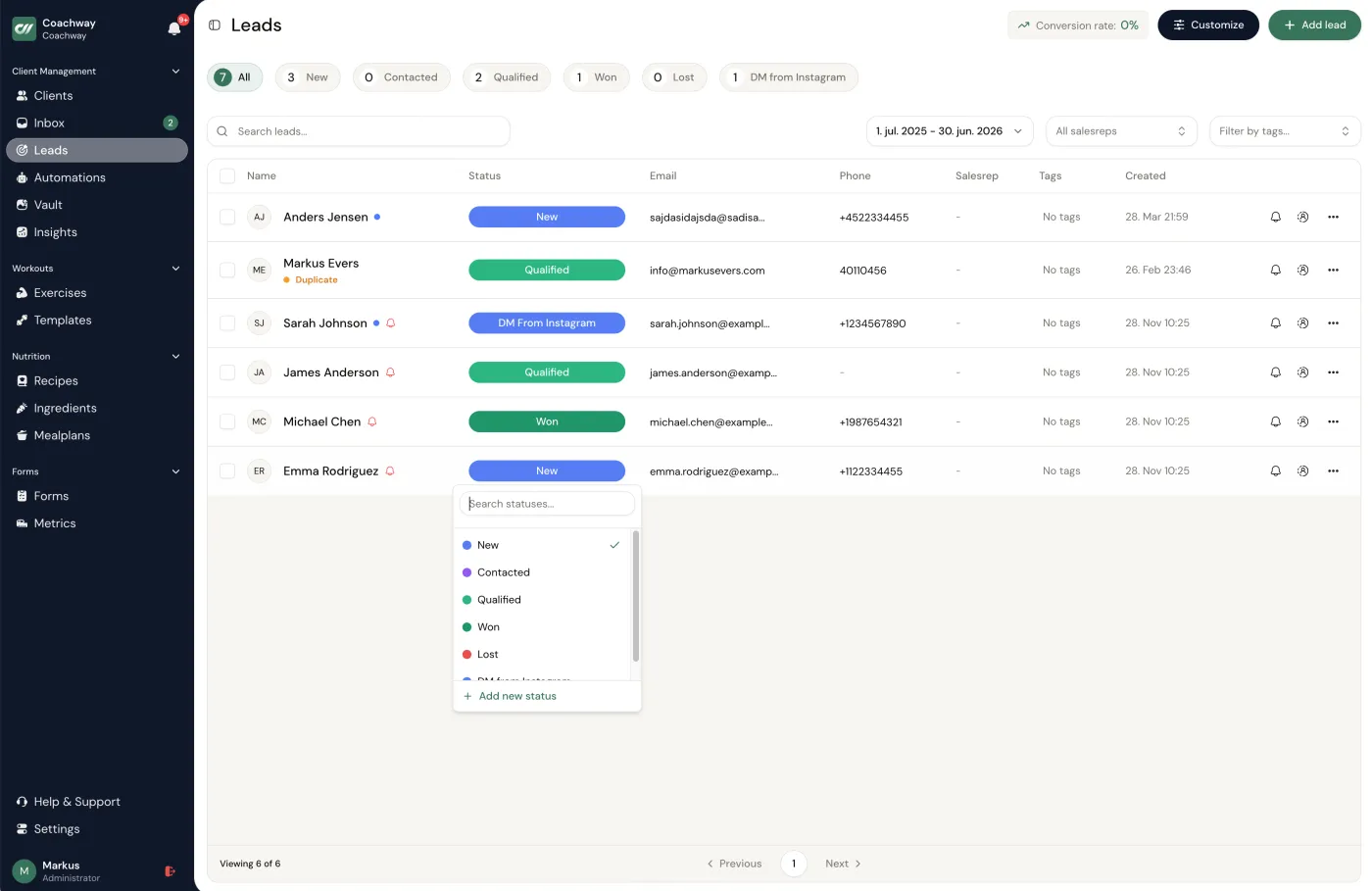
Every platform on this page is a discovery engine, and not one of them closes the sale by itself. The comment, the saved Reel, the DM, the profile-link click - all of it is only worth something if it lands in one place where you can move a person from curious to booked. When that catching happens across DMs, a notes app and a payment link, the warm leads your best content earned quietly leak. In Coachway the whole chain lives in one pipeline: an embeddable lead form that captures the full source trail so you can see which platform is actually working, visible stages from new to contacted to qualified to won, and a one-click convert that hands a new client the branded app, the onboarding sequence and a subscription billed through your own Stripe. It is built on knowledge from working with 150 online coaches over 6+ years, and it costs EUR 69 a month including your first 5 clients, then EUR 9 per additional client, every feature included. Prefer to see the pipeline before you commit? Book a demo. The 14-day free trial starts with a card held by Stripe and cancels under Billing before it renews.
Frequently asked questions about social media for personal trainers.
What is the best social media platform for personal trainers?
There is no single best platform for everyone - the best social media for personal trainers is the one you will actually post to for six months without burning out, chosen against three things: your niche, the hours you can protect each week, and the kind of client you want. As a starting rule, Instagram is the safe default for most general fitness and body-composition coaches because it holds discovery and trust in one place; TikTok is the fastest way to get found from a standing start with zero audience; YouTube compounds hardest for education-led niches with a long buying decision; and LinkedIn is where higher-paying professional and executive clients are reachable with almost no other coach competing for their feed. Pick the one that matches your niche and your realistic cadence, then go deep on it for two full quarters before you judge it. One platform posted to consistently beats four posted to occasionally every time.
Should a personal trainer be on Instagram or TikTok?
If you already have followers, warm leads and DMs happening, stay on Instagram and get better at it - it keeps discovery, proof and conversation in one app, which shortens the path from stranger to booked call. If you are starting from zero with no audience, TikTok usually wins, because it shows your video to strangers based on what they watch rather than who already follows you, so a brand-new account can be seen. The honest answer for most coaches is not either-or over time: pick the one that fits where you are today, get good at making short video once, then repurpose the same clips to the other platform. What you must not do is split your first three months evenly across both and go shallow on each - that is the slowest possible way to build either.
Do fitness coaches need to be on multiple social media platforms?
No, and trying to is the most common reason coaches stall. Being visibly good on one platform gets you more clients than being forgettable on four. Every platform has its own format, rhythm and unwritten rules, and doing any of them well takes more consistency than most coaches expect - so spreading yourself across all of them usually means posting too little on each to build momentum anywhere. The efficient path is to go deep on a single primary platform until it produces a steady flow of leads, and only then repurpose that same content to a second channel as a bonus, not a second job. Multi-platform is an outcome you earn once the first one works, not a starting strategy.
Which social media is best for finding high-paying coaching clients?
For higher-priced coaching aimed at busy professionals, executives and corporate clients, LinkedIn is the most under-used option, because the exact people who can comfortably afford premium coaching are already there for work, and almost no fitness coaches are posting to them. For premium clients in mainstream fitness, aesthetics and lifestyle niches, a well-run Instagram still converts best, since it carries the visual proof and the personal trust that a high-ticket decision needs. YouTube supports high-ticket differently: it builds the deep, over-time credibility that makes a bigger price feel earned by the time someone reaches out. Price is set more by your positioning and your niche than by the platform - but if the client you want wears a suit, do not overlook LinkedIn.
How often should a personal trainer post on social media?
Often enough to stay in the algorithm's good graces and build a habit, but never more than you can sustain for months. A realistic, holdable cadence for most solo coaches is three to five short posts a week on a single primary platform, plus daily light presence in Stories or comments where the platform rewards it. Consistency over quarters matters far more than volume in any single week: an account that posts four times every week for six months will out-perform one that posts fourteen times in a launch burst and then goes quiet. Choose the cadence you can protect around your actual client work, batch the content so a bad week does not break the streak, and treat the number you can genuinely sustain as the correct number - not the one a growth guru quotes.
Once you have picked your one platform, the work is channel-specific: the funnels for Instagram and TikTok, and the wider marketing system that turns any of them into booked clients.
Keep reading
all guidesAI Sales Assistant for Online Coaches: An Honest 2026 Guide
An honest look at AI sales assistants for online coaches: what they actually do, the real trade-offs, and the line where a human has to take over to close. Coachway does not sell one; here is the truthful role it plays instead.
Read the guide10 Fitness YouTube Channels Coaches Should Study in 2026
Ten verified fitness YouTube channels worth studying as craft: what each does exceptionally, the one lesson a coach can steal, and the honest caveat that what works at five million subscribers does not transfer 1:1.
Read the guideHow to coach clients with PCOS (2026 guide)
Your real lane when a client has PCOS: consistent training and general habits, when to refer to the care team, and why symptom and weight-loss promises stay off the table.
Read the guideFree tools for this: Free Trial Conversion Calculator · Discovery Call Calculator · No-Show Cost Calculator
See what Coachway can do for your coaching business
Coachway was built on knowledge from working with 150 online coaches over 6+ years, who all hit the same wall - slow platforms, clunky workflows, wasted hours. Start your 14-day free trial and see what we fixed - the whole platform, no charge today, cancel anytime under Billing.