YouTube for fitness coaches - how to turn views into clients in 2026.
YouTube for fitness coaches is the long game: it pays off slower than short-form, but a single video keeps working for years because YouTube is a search engine, not just a feed. It is the strongest channel a coach has for building deep trust and being found by people already looking for help. The trap is expecting TikTok speed. This is the honest playbook for the parts most guides skip - the effort it really takes, what to film, and the funnel that catches a viewer before the interest cools.
By Markus Evers · Updated September 2026
the short version
YouTube for fitness coaches is the slowest social channel to pay off and the one that keeps paying longest, because a single video is a search result that surfaces for years, not a post that dies in a day. It is where you build the deep trust that closes, and where searchers actively looking for help find you. Post one well-made long-form video a week that does one of three jobs - get found in search, build trust, or start a conversation - weighted toward searchable how-to, and expect three to six months before it returns clients. Then build a short path off the platform: every video points to one link, that link goes to a lead form, and a free consultation closes the sale. The part that breaks most coaches is chasing follow-up out of comments and their inbox. Route every interested viewer into one pipeline instead, and YouTube becomes the most durable client channel you own.
Does YouTube actually work for fitness coaches?
It works, on two jobs no other platform does as well: search and trust. YouTube is a search engine that happens to play video, and it is owned by Google, so the tutorial you film today can surface in both YouTube and Google search for years - answering the same question for a new stranger every month long after you have moved on. Short-form disappears in a day; a good YouTube video is an asset that keeps working. That is the first reason it belongs in a coach's plan: a library of ten honest how-to videos becomes a machine that finds people who are already typing their problem into a search bar, which is the warmest kind of stranger there is.
The second reason is trust. A scrolling viewer gives a short clip two seconds; a searcher who clicked your video will give you ten minutes, and ten minutes of watching you explain your craft does more to sell coaching than a hundred quick tips. By the time that person enquires, they already trust you - which is why YouTube leads tend to arrive warmer and closer to buying than any other channel. The honest catch is speed. YouTube does not hand out fast reach the way TikTok can, and most coaches quit before the compounding starts, usually around the three-to-six-month mark. Treat it as the long game, keep the payoff realistic, and build the catch before you chase the reach - because the failure is almost never the videos, it is quitting early or having nowhere for the trust to go.
What should a fitness coach post on YouTube?
Think in jobs, not topics. Every video you film should do one of three things - get found in search, build deep trust, or start a conversation - and the mix should lean hard toward the first, because search is what makes YouTube compound. Searchable content answers a question a potential client is already typing: how to fix knee pain when squatting, what to eat to lose fat without tracking every meal, a genuinely good beginner dumbbell workout. Trust content is the client transformation, the honest method breakdown, the day in the life of an online coach that turns a first-time viewer into someone who believes you can help them specifically. Conversation content is the direct ask - the video that ends with a clear reason to book a free consultation. Film only the trust videos your subscribers already love and no new searcher finds you; chase only entertainment and you pull views but never the right person.
| Content type | The job it does | How it reaches new clients | Effort |
|---|---|---|---|
| How-to / problem tutorial | Get found in search | High - ranks and compounds for years | Medium |
| Beginner workout / follow-along | Get found in search | High - evergreen search demand | Medium |
| Client transformation / case study | Build deep trust | Medium - converts warm viewers | Medium |
| Method breakdown / day in the life | Build deep trust | Medium - holds the ones who stay | Medium |
| Direct offer / consultation call-out | Start a conversation | Low - aimed at people who already watch | Low |
The best part is reuse: film the deep explanation once for YouTube, then cut the strongest ninety seconds into the short-form that carries your Instagram content and your TikTok. That is how one filming session feeds three channels, and the sane way to keep it running as a working coach is the batch-and-repurpose approach rather than a fresh idea every week.
How often should a fitness coach post, and how long until it pays off?
One well-made long-form video a week is plenty, and the honest expectation is three to six months before it meaningfully returns clients. YouTube is not the volume game short-form is. A single ten-minute video that answers a real question well beats five rushed uploads, because search rewards the video people actually watch to the end and quietly buries the ones they click away from. So the goal early on is not to post more - it is to make each video genuinely worth ranking, and to keep going long enough for search to notice.
That is the real tradeoff, and no honest guide should hide it: a YouTube video costs far more to plan, film and edit than a short clip, and it pays off far slower - but it keeps sending you viewers for years after you publish, which short-form never does. You are trading upfront effort and patience for durability. The sustainable way to hold a weekly rhythm as a busy coach is batching: script and film two or three videos in one focused session, then edit and schedule them out, so a fully booked week does not go dark. If weekly is genuinely unrealistic while you are still delivering to clients, one strong video every two weeks that you sustain for a year beats a burst of ten you abandon in a month. Consistency you can hold is the entire strategy - the coaches who win on YouTube are almost always the ones who simply did not quit at month three.
How do you turn YouTube views into coaching clients?
You build a short path off the platform and end it at a real conversation. YouTube earns trust and attention; the sale happens somewhere you own. The reliable route has four steps: every video points to one link, that link goes to a simple lead form instead of a busy homepage, the form captures who the viewer is and which video sent them, and a free consultation turns warm interest into a decision. Each step exists to stop a person who just spent ten minutes with your content from going cold before you ever speak - which, on a slow-burn channel like this, is the only way you really lose a YouTube lead. Building and running that capture path well is the heart of lead generation for personal trainers, whichever platform sends the traffic.
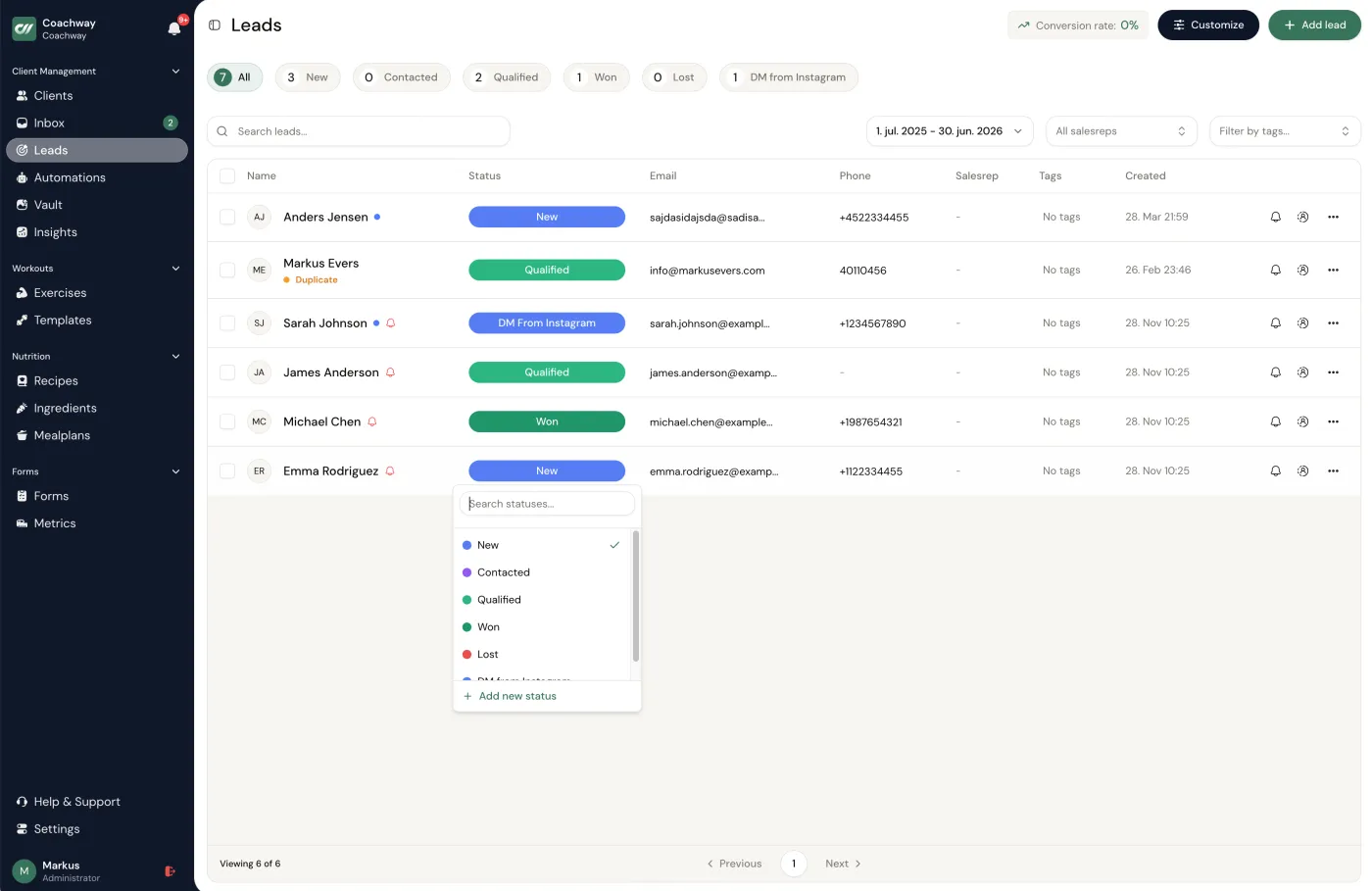
The step that breaks coaches is the follow-up, run by hand. When a video finally ranks and twenty people reach out across a week through comments and the description link, chasing every thread from your own inbox collapses fast, and motivated people cool off while you are asleep or coaching. Replying faster is not the fix; capturing first is. Route every interested viewer into one place where the whole pipeline is visible - new, contacted, qualified, won - so nobody falls through a gap. That is exactly what Coachway's lead engine does: an embeddable lead form you drop behind your link captures the full source trail, including the video and campaign a lead came from, a visible pipeline moves each person toward a booked consultation, and a one-click convert hands a new client the client app, the onboarding sequence and a subscription billed through your own Stripe account - Coachway never holds your money. It is built on knowledge from working with 150 online coaches over 6+ years, and it costs EUR 69 a month including your first 5 clients, then EUR 9 per additional client, with every feature included. The 14-day free trial starts with a card and cancels under Billing before it renews - or book a demo and see the pipeline first.
The conversation itself still has to be human. YouTube warms a lead further than any other channel, so the natural next step is a real discovery call rather than a written pitch, and honest client testimonials become your best on-video proof once the first results come in.
You have no channel yet. What do you do this month?
Build the catch before you chase the reach, and set your patience for months, not weeks. Four moves, in order:
1. Set up the destination first.
Before you film anything, put a lead form behind the link you will use in every description and pinned comment, and make sure it captures a name, a goal and which video the person came from. A ranking video with nowhere for viewers to land is the most painful YouTube mistake a coach can make. If the catch is not ready, the reach is wasted.
2. Pick five questions your clients actually ask.
Write down the five questions you answer most often for clients and prospects, then plan one searchable how-to video for each. These are the topics real people are already typing into search, which is exactly what makes a new channel findable. Do not chase production quality; chase a clear, honest answer and a title that matches what someone would search.
3. Batch-film, then post weekly and wait.
Film two or three videos in one session, then release one a week and let search do its slow work. Do not judge the channel by month one - YouTube usually takes three to six months to start compounding. End every video with the same clear next step: book a free consultation through the link below.
4. Answer every comment, capture every lead.
Early on your comments are your first leads and a real ranking signal. Reply like a human, and when someone signals genuine interest, send them to the form, not into a thread you will lose track of. From the very first interested viewer, capture before you converse - it is a habit that scales, and manual chasing is a habit that breaks the moment a video finally travels.
Frequently asked questions about YouTube for fitness coaches.
Does YouTube actually work for fitness coaches?
Yes, but slowly and as a trust-and-search channel, not a viral one. YouTube is the only major platform where a single video keeps working for years, because it is a search engine as much as a feed - people type a problem, your tutorial answers it, and it surfaces again next month, next year, to someone who has never heard your name. That makes it the strongest platform a coach has for building deep trust and for being found by people actively looking for help. What it does not do is pay off fast. Short-form can hand you reach in a week; YouTube usually takes months of consistent posting before search picks a video up and it starts compounding. Coaches quit YouTube not because it fails but because they expected TikTok speed from a channel that rewards patience. Treat it as the long game that keeps paying after you stop filming, and it becomes the most durable client channel you own.
What should a fitness coach post on YouTube?
Post videos that do one of three jobs: get found in search, build deep trust, or start a conversation. Search content is the how-to that answers a question a potential client is already typing - how to fix lower back pain when squatting, what to eat to lose fat without tracking, a beginner dumbbell workout. This is what compounds, and it is most of what you post. Trust content is the client transformation, the honest method breakdown, the day in the life of an online coach that turns a first-time viewer into someone who believes you can help them specifically. Conversation content is the direct ask - the video that ends with a reason to book a free consultation or click the link below. The mistake is filming only trust content your subscribers already love and no new searcher ever finds, or chasing entertainment that pulls views but never the right person. Weight toward searchable how-to, keep every video honest, and give each one a clear next step.
How often should a fitness coach post on YouTube, and how long until it pays off?
One well-made long-form video a week is enough, and most coaches should expect three to six months before it meaningfully returns clients. YouTube is not a volume game the way short-form is; a single ten-minute video that answers a real question well beats five rushed uploads, because search rewards the one people actually watch to the end. The honest tradeoff is effort against durability: each video costs more to plan, film and edit than a short clip, but it can keep sending you viewers for years after you post it, which short-form never does. The sustainable rhythm is batching - script and film two or three videos in one focused session, then edit and schedule them out - so a fully booked coaching week does not mean a dead channel. If weekly is genuinely unrealistic, one strong video every two weeks that you can sustain for a year beats a burst of ten you abandon in a month.
How do you turn YouTube views into coaching clients?
You build a short path off the platform and end it at a real conversation. YouTube earns trust and attention; the sale happens somewhere you control. The reliable route is: every video points to one link, that link goes to a simple lead form rather than a busy homepage, the form captures who the viewer is and which video sent them, and a free consultation turns the interest into a decision. The biggest leak is trying to run the follow-up out of comments and your inbox. When a video finally travels and twenty people reach out across a week, manual chasing collapses and warm people go cold while you sleep or coach. The fix is not replying faster; it is routing every interested viewer into one pipeline where you can see the whole thing - new, contacted, qualified, won - and move each person forward on purpose. Capture first, converse second, and never make someone who just watched ten minutes of your content hunt for how to work with you.
YouTube or Instagram for a fitness coach - which is better?
They do different jobs on different clocks, so many coaches run both, but they start with whichever they can sustain. Instagram and TikTok are discovery engines: they hand a small account reach quickly and are where a casual buyer is comfortable messaging you, which is what you need for momentum in the first months. YouTube is a trust-and-search engine: it takes longer to pay off, but a video ranks in both YouTube and Google search and keeps returning viewers for years, and long-form lets a stranger spend ten minutes with you before they ever enquire, so the leads it sends tend to arrive far warmer and closer to buying. The efficient play is not either-or: film the deep explanation once for YouTube, then cut the strongest ninety seconds into short-form for the other channels. If you only have energy for one while starting out, pick the format you can actually keep posting - the channel you sustain beats the theoretically better one you abandon.
YouTube is one mouth of a wider funnel this guide only points at: the same filming session feeds your TikTok, and every channel ends at the same place - a booked conversation and an offer, which is the whole of getting online coaching clients.
Keep reading
all guidesHow to start and run a corporate wellness coaching business (2026)
Corporate wellness is the B2B side of coaching: companies pay you to coach their teams. How to package the offer, find and pitch decision-makers, price it, and deliver at scale.
Read the guideHow to build a client referral program for your coaching business (2026)
Referrals are the cheapest, highest-trust clients you can get. How to build a structured referral program: when to ask, what to offer, how to make it easy, and how to track it without it feeling salesy.
Read the guideBest strength and conditioning coach certifications (a coach's guide, 2026)
The strength and conditioning certifications worth holding, compared fairly: who each suits, what they cover, and how they fit an online coaching career. General information, not professional advice.
Read the guideFree tools for this: Ad Spend Breakeven Calculator · Email List Value Calculator for Coaches · Free Trial Conversion Calculator
See what Coachway can do for your coaching business
Coachway was built on knowledge from working with 150 online coaches over 6+ years, who all hit the same wall - slow platforms, clunky workflows, wasted hours. Start your 14-day free trial and see what we fixed - the whole platform, no charge today, cancel anytime under Billing.