


What is a personal exercise programme - and what separates a good one from a list of exercises?
A personal exercise programme is a training plan built around one person: their goal, their schedule, their experience, and a progression that moves them forward. This guide defines what a programme is, lays out the six parts a good one contains, gives you a worked three-day example you can read straight off the page, and shows the one thing a template can never do for you - the part that makes it personal.
By Markus Evers · Updated September 2026
the short version
A personal exercise programme is a structured training plan built for one person's goal, schedule and experience, setting out which exercises to do, how many sets and reps, at what effort, and how the load climbs from week to week. A good one names six things - a single goal, a weekly frequency, the exercises, the sets and reps, the effort, and a progression rule with a deload - so the training moves toward an outcome instead of being a fresh workout each time. The structure can come from a template; what makes it personal is fitting it to the real person and progressing it from their actual results.
What a personal exercise programme actually is.
A personal exercise programme is a plan of training organised around one specific person and one specific goal. It answers, in advance, four questions that a loose gym routine leaves open: what you train each session, how often you train, how hard each set should be, and how the plan gets harder over time. That last part is what turns a set of workouts into a programme. Repeating the same session forever is not a programme; a plan that has you doing measurably more from one week to the next is.
The word personal is not decoration. The same six exercises can be an excellent programme for one person and a poor one for another, purely because of frequency, volume and progression. A plan built for a 40-year-old beginner training three mornings a week before work looks nothing like one built for an experienced lifter with five training days and a full barbell setup, even when both of them want the same thing - to get stronger and leaner. A programme is personal when its structure has been shaped by who is following it, not just by what looks good on paper.
This guide is written for both people who search this phrase. If you are building your own plan, it gives you the parts to include and a worked example to copy from. If you are a personal trainer or online coach writing programmes for clients, it is the shared vocabulary you can hand a client plus the jump-off point into the deeper coaching method for how to create a workout program for a client, step by step.
Programme, program, workout plan - the same thing.
One quick note on wording, because it trips people up. Program and programme are the same word: American English drops the extra letters, British and Commonwealth English keeps them, so a "personal exercise program" and a "personal exercise programme" mean exactly the same thing. Workout plan, training plan, training programme and exercise programme are all used interchangeably too. This page uses the British spelling throughout, but every point applies whichever version you searched for.
What a good personal exercise programme contains.
A complete programme names six things, in this order, because each one decides the next. Skip any of them and you are left with a workout list rather than a plan that carries you forward. The table below is the checklist; the sensible defaults are a starting point you then fit to yourself.
| Component | What it decides | A sensible default |
|---|---|---|
| Goal | Everything downstream | One primary goal; the rest maintained |
| Frequency and split | How the week is organised | 3 to 4 days for most; full body or upper-lower |
| Exercise selection | Which lifts, by movement pattern | Compound lifts first, isolation around them |
| Sets and reps | Volume and rep range | Strength 1 to 5, muscle 6 to 12, endurance 12+ |
| Effort (RIR) | How hard each set is | 1 to 3 reps in reserve on working sets |
| Progression and deload | How the plan climbs and recovers | Add a little each week; a lighter week every 4 to 8 |
Two of these have a free calculator that does the maths for you. To set your starting loads for a strength goal, work back from your best lift with a one-rep max calculator, then train the main lifts at a sensible percentage of it. To keep effort honest rather than grinding every set to failure, a reps-in-reserve calculator turns "how hard did that feel" into a number you can programme against. Get these six parts down on paper and you have a real programme; the rest of this guide is making it fit you and keeping it moving.
A three-day full-body programme you can read off the page.
Here is what the six parts look like assembled into one plan. This is a general strength-and-muscle programme for someone who can train three non-consecutive days a week - the setup that fits the most people and is forgiving of a missed session. Every important movement pattern gets trained across the week, compound lifts lead each day, and the numbers follow the goal.
| Day | Session | Exercises (sets x reps) |
|---|---|---|
| Day 1 | Full body A | Back squat 3x5, bench press 3x6-8, barbell row 3x8-10, Romanian deadlift 2x10, plank 3x30-45s |
| Day 2 | Full body B | Deadlift 3x5, overhead press 3x6-8, lat pulldown 3x8-10, split squat 2x10, hanging leg raise 3x10-12 |
| Day 3 | Full body C | Front squat 3x6-8, incline dumbbell press 3x8-10, seated row 3x10-12, hip thrust 3x10, face pull 3x15 |
Rest a day between sessions. Take most working sets to one to three reps in reserve - hard, but not to failure. And add the progression: each week aim to add a small amount of load or a rep to the main lifts while your form holds, which is the whole point of the plan. That is a genuine personal exercise programme on three lines. What it is not yet is your programme, and that gap is the next section. If you would rather generate a structured split from your own days, goal and experience than copy this one, a free workout plan builder does exactly that in seconds.
How to personalise it - and why a template is only the frame.
A template gives you a proven structure, which beats a blank page every time. What it cannot know is you: your training age, the days you honestly have, the equipment in front of you, the shoulder that does not love overhead pressing, and how your body responds once the plan meets reality. Personalising is the work of closing that gap, and it is where a plan stops being generic and starts being a programme built for one person.
Fit the frequency to your real week.
A four-day plan you manage twice fails on adherence, not logic. Set the days you can genuinely repeat for months, not the days you wish you had, and pick the split that fits them. Three consistent days beat five you abandon.
Swap lifts for your body and kit.
Keep the movement pattern, change the exercise. No barbell becomes dumbbells; a cranky knee turns a deep squat into a box squat or a leg press. A lift you can load and progress safely beats a textbook-perfect one you cannot.
Set the starting load to you.
A template says 3x5; it cannot say at what weight. Start lighter than your ego wants, leave two or three reps in reserve for the first fortnight while the movement settles, then let the numbers climb from a base you actually own.
Progress from your results, not the plan's.
The template's progression is a guess about an average person. Yours comes from your log: add when a session moves easily, hold when it grinds, back off when a lift stalls for two weeks running. This is the loop a template can never run for you.
This last point is why a coach earns their fee. Anyone can hand over a template; the value is in reading the results and adjusting the plan before progress stalls, block after block. Doing that well over months is periodisation - the deliberate sequencing of phases and deloads so the plan keeps working long after the easy early gains are gone. Personalising is not a one-time edit at the start; it is the ongoing job of keeping the programme fitted to a person who is changing.
Building personal programmes for clients at scale.
Writing one personal exercise programme is straightforward. Writing fifteen a week, each genuinely fitted to a different person, and keeping every one progressing off real check-in data, is the actual job of an online coach - and it is where doing it in a spreadsheet quietly falls apart. The method does not change from the sections above; the deeper coach-facing version, with exercise selection and set-and-rep logic laid out step by step, is in how to create a workout program for a client. The efficiency comes from not starting each one from a blank page: a set of reusable workout templates for personal trainers gives you the proven frames, and the personalising in the section above is then the only per-client work left.
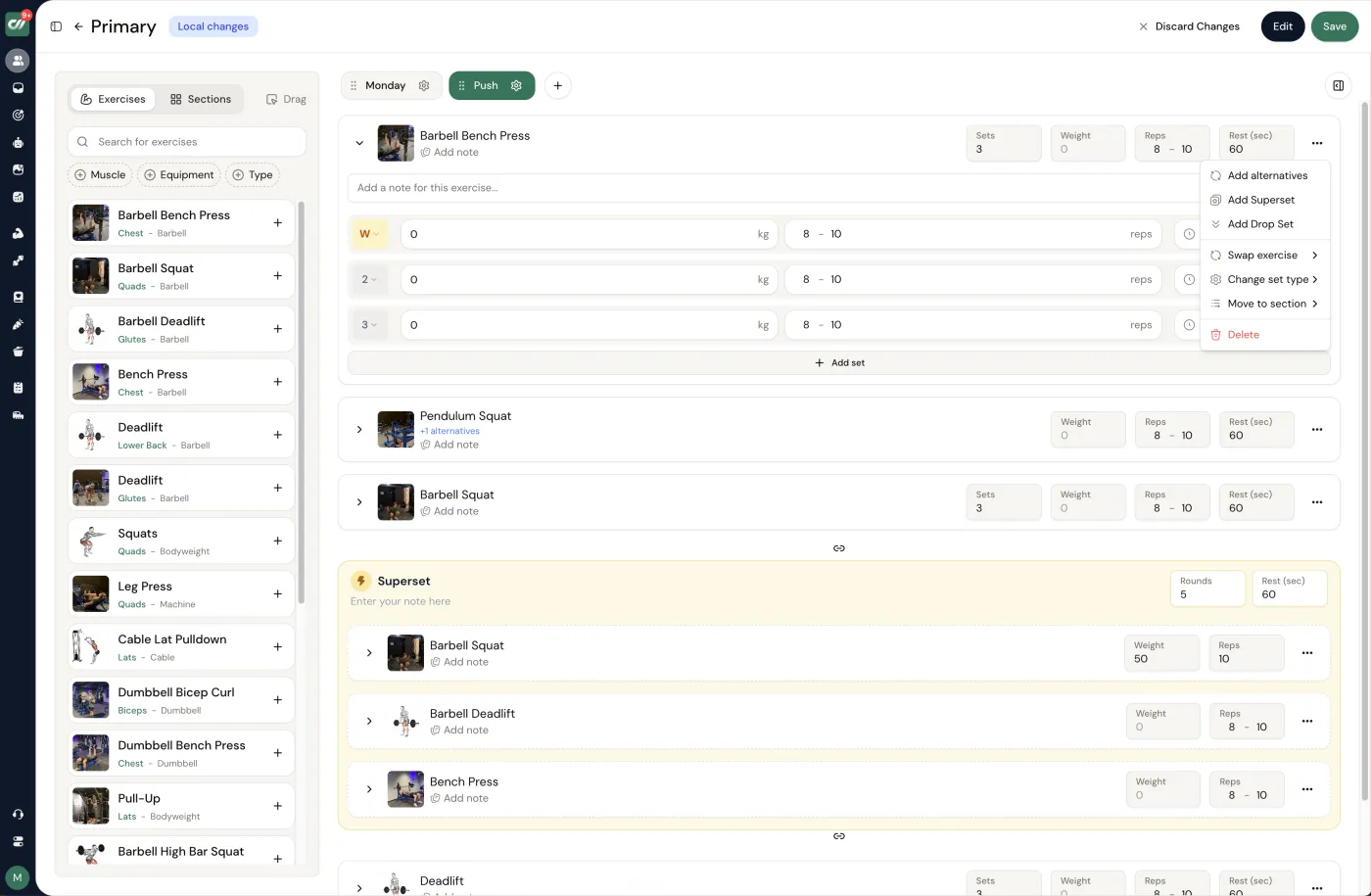
This is the case for building programmes inside a coaching platform rather than a spreadsheet. In Coachway the workout builder puts the programme next to a library of 1,800+ exercises with demo videos, so exercise selection is a search rather than a hunt. You build one client's block, save the good parts as a template, and adapt it to the next person - which keeps the per-client work down to the personalising, not the rebuilding. It lands in the client app with the demos attached, and their logged sessions come back so you can progress the plan against real data. Coachway costs EUR 69 a month including your first 5 clients, then EUR 9 per additional client, with every feature included and no tiers. The coach dashboard is in English; the client app is available in English, Danish, Norwegian, Swedish, Finnish and German. It is built on years of working with online coaches - or book a demo and see the builder first. The 14-day free trial starts with a card held by Stripe and cancels under Billing before it renews.
Frequently asked questions about personal exercise programmes.
What is a personal exercise programme?
A personal exercise programme is a structured training plan built for one person's goal, schedule and experience. It sets out which exercises to do, how many sets and reps, at what effort, and how the load climbs from week to week - so the training is not a random collection of workouts but a plan that moves toward a defined outcome. The word personal is doing real work: the same set of exercises becomes a good programme or a bad one depending on whether the frequency, volume and progression fit the actual person following it. A programme built for a 40-year-old beginner training three mornings a week looks nothing like one built for an experienced lifter with five days and a barbell, even if both want to get stronger.
What should a personal exercise programme include?
A complete personal exercise programme names six things. First a single primary goal, because a plan can only be optimised for one outcome at a time. Second a weekly frequency and a split that fits the days available. Third the exercises, chosen by movement pattern with compound lifts leading each session. Fourth the sets and reps, which follow from the goal - low reps for strength, moderate for muscle, higher for endurance. Fifth the effort target, usually one to three reps in reserve on working sets. Sixth a written progression rule and a planned deload, so the load climbs over time and fatigue gets a scheduled release. A plan missing any of these is a workout list, not a programme.
Is a personal exercise programme the same as a workout plan or program?
Broadly yes. Program and programme are the same word - American English drops the extra letters, British and Commonwealth English keeps them - so a personal exercise program and a personal exercise programme mean the same thing. Workout plan, training plan, training programme and exercise programme are all used interchangeably for the same idea: a structured plan of what to train and how it progresses. The only distinction worth drawing is between a genuine programme, which has a goal and built-in progression, and a single workout or a loose list of exercises, which does not carry a person forward over weeks.
Can I just use a template as my personal exercise programme?
A good template is a strong starting point, not the finished job. A template gives you a sensible structure - a proven split, sensible exercise choices and rep ranges - which is far better than a blank page. What a template cannot do is know your training age, your schedule, your equipment, your injury history or how your body responds week to week. Personalising a template means adjusting the frequency to the days you actually have, swapping any lift that does not suit your equipment or joints, setting the starting load to your own strength, and then progressing it from your real results rather than the plan's assumptions. The template is the frame; the personalising is the programme.
How often should a personal exercise programme change?
Change the progression every week and the programme itself every four to eight weeks. Inside a block the exercises stay stable while the load, reps or sets climb a little each week, because you cannot progress on a lift you only see once. After roughly four to eight weeks - once progress on the main lifts genuinely stalls or the phase ends - you rebuild the next block from where you actually are, keeping what worked and changing what did not. Constant novelty is not the goal. A stable programme you can measurably beat week after week is what drives progress; swapping exercises every session just resets the clock.
If you coach, the natural next reads are the full method for how to create a workout program for a client, the reusable workout templates for personal trainers that speed it up, and periodisation for keeping programmes progressing across months. To draft a plan or set the numbers, the free workout plan builder, one-rep max calculator and reps-in-reserve calculator do the maths for you.
Keep reading
all guidesWhat Is Kinesthetic Awareness? A Coach's Guide (2026)
Kinesthetic awareness is the felt sense of where your body is and how it moves without looking. How it differs from proprioception, why external cues beat internal ones, and how coaches build it in clients remotely.
Read the guideWhat Are Forced Reps? Meaning, Risks and When Coaches Use Them
Forced reps are reps completed past failure with a spotter lifting a fraction of the load. How they differ from cheat and drop sets, what the evidence honestly supports, and why online coaches rarely program them.
Read the guideWhat Is the Stretch Reflex? The Myotatic Reflex (2026)
The stretch reflex is your body's automatic guard against overstretch: lengthen a muscle fast and it fires back to resist. How the mechanism works, and where lifters meet it in squats, plyometrics and stretching.
Read the guideFree tools for this: Coaching Rate Calculator · Personal Trainer Income Calculator · Coaching Business Health Check
Ready-made template: Workout Program Template
See what Coachway can do for your coaching business
Coachway was built on knowledge from working with 150 online coaches over 6+ years, who all hit the same wall - slow platforms, clunky workflows, wasted hours. Start your 14-day free trial and see what we fixed - the whole platform, no charge today, cancel anytime under Billing.


