


How to set protein targets for clients - protein is the macro you set first.
To set protein targets for clients you choose a per-kilogram range from the client's goal and training age, base it on the right bodyweight, then round to one clean daily number and split it across the day so it actually gets eaten. This guide is that decision, in order: the gram-per-kilogram ranges for fat loss, muscle gain and maintenance, when to use lean or goal weight instead of the scale, how to spread protein across meals, and why protein is locked before carbohydrate and fat.
By Markus Evers · Updated August 2026 · General coaching information, not medical or dietetic advice
the short version
Set protein by a gram-per-kilogram range chosen from the client's goal and training age. For most training clients, 1.6 to 2.2 grams per kilogram of bodyweight a day covers muscle gain and general body composition; push to 1.8 to 2.4 grams in a fat-loss phase to protect lean mass and control hunger; sit at 1.4 to 1.6 grams for a general-health client. Base the number on lean or goal weight for anyone carrying a lot of fat, round it to one clean daily figure, and split it across three to five meals of about 0.4 grams per kilogram each. Lock protein first, then let carbohydrate and fat fill the remaining calories - and coach it to what the client will actually eat.
Why is protein the macro you set first?
Once you have set the client's calorie target, protein is the first macro you pin, because it does more distinct jobs than the other two and it is the one you least want to leave to chance. It supplies the raw material for building and repairing muscle, it is the most protecting macro in a deficit, and it is the most filling gram-for-gram - which makes it the single biggest lever you have over how a diet feels day to day. Carbohydrate and fat are largely interchangeable fuel that you can split by preference; protein is the structural minimum you meet on purpose.
So the order of operations is fixed: set calories, set protein, then let carbohydrate and fat divide whatever calories are left in whatever ratio suits the client's training and taste - the same priority order laid out in Eric Helms' nutrition pyramid for coaches. That is why a protein target is worth getting right on its own rather than reading it off a generic macro split - it is the number that most decides whether the client keeps muscle, stays full and actually sticks to the plan. The rest of this guide is how to choose it for the person in front of you, not the average.
What gram-per-kilogram range do you start from?
Start from the goal. For a client who trains and wants to build or hold muscle, a daily intake of about 1.6 to 2.2 grams of protein per kilogram of bodyweight is the workhorse range that the evidence keeps landing on, and most clients do well somewhere in its middle. In a fat-loss phase you move up, not down: roughly 1.8 to 2.4 grams per kilogram, and toward the very top for a lean client dieting hard, because a deficit is exactly when muscle is most at risk and when appetite most needs managing - the protein floor Dr Bill Campbell leans on to preserve muscle during rapid and GLP-1-assisted weight loss. For a general-health client who is not training seriously and just wants a sensible floor, 1.4 to 1.6 grams per kilogram is plenty.
Two honest notes keep this from becoming dogma. First, the differences inside these bands are small in practice - a client who lands at 1.9 instead of 2.1 grams per kilogram is not leaving results on the table, so do not agonise over the decimal. Second, eating far above the top of the range is not dangerous for a healthy person, but it rarely adds anything and it crowds out the carbohydrate that fuels hard training, so there is no reason to prescribe it. Pick a range from the goal, then narrow it with the client factors in the next step.
| Client goal | Protein per day | Why |
|---|---|---|
| Fat loss, in a calorie deficit | ~1.8 to 2.4 g/kg bodyweight | Protects lean mass and controls hunger while calories are low |
| Muscle gain or a lean surplus | ~1.6 to 2.2 g/kg bodyweight | Supplies building material; extra beyond this adds little |
| Maintenance while training | ~1.6 to 2.0 g/kg bodyweight | Holds muscle and keeps meals satisfying at maintenance |
| General health, not training hard | ~1.4 to 1.6 g/kg bodyweight | A sensible floor above the basic dietary minimum |
What moves the target for this specific client?
Body-fat level: scale weight or lean weight
This is the factor coaches get wrong most often. Scaling protein to total bodyweight is fine for a client at a reasonable body-fat level, but for someone carrying a lot of fat it overshoots badly - fat tissue has almost no protein demand, so 2 grams per kilogram of a high scale weight prescribes far more than the muscle needs. For that client, base the target on lean body mass or, simpler and needing no measurement, on a realistic goal weight. The gram-per-kilogram range does not change; you only choose which bodyweight you multiply it by, and goal weight keeps you honest without calipers or a scan.
Training age and how lean the client wants to get
A more advanced lifter chasing a genuinely lean physique sits at the top of the range, because the closer someone is to their muscular ceiling and the leaner they push, the more protein earns its place in protecting hard-won muscle. A newer client with plenty of room to grow does well in the middle of the range and gains little from the top of it - their results are driven far more by training and total calories than by squeezing protein higher. Match the number to where the client actually is, not to the intake an elite competitor would run.
Older clients and the protein floor
Muscle in an older client responds less readily to a given dose of protein, so a masters client benefits from sitting toward the upper half of the range and from slightly larger per-meal doses than a younger one. If you coach an older population, treat the top of the band as the sensible default rather than the exception - the cost of a little extra protein is nothing, and the payoff in preserved muscle and strength as clients age is real - the case Dr Gabrielle Lyon's protein guidance for coaches makes at length. A general-health floor that is fine for a 25-year-old is often a touch low for a 60-year-old.
Plant-based and mixed diets
A client eating mostly or entirely plant proteins can hit the same daily target, but the practical advice shifts: plant sources are generally lower in leucine and less complete, so nudging the daily number toward the upper end and leaning on higher-protein staples such as soy, seitan, legumes and a protein supplement makes the target reachable. The gram-per-kilogram range is the same; you are just acknowledging that the food is less protein-dense, which is a portion-size and planning issue more than a physiology one. Set the target, then help the client build a day of meals that actually reaches it.
How should the client spread protein across the day?
The default is to split the daily target across three to five meals, each carrying a meaningful dose of roughly 0.4 grams of protein per kilogram of bodyweight - about 25 to 40 grams for most clients, a division a protein per meal calculator works out in seconds and flags when a meal falls short. That spread keeps muscle protein synthesis topped up through the day, and it does something just as useful for adherence: it turns one intimidating daily number into four ordinary meals. A client asked to eat 160 grams over four 40-gram meals will manage far more reliably than one told to hit 160 grams however they like, which usually collapses into a protein-light day and a giant dinner that never quite closes the gap.
Keep the distribution advice light-handed, though, because total daily protein is the main driver by a wide margin and meal timing is a small optimisation on top of it. If a client's schedule realistically allows only two solid protein meals, hitting the daily total across those two still does most of the work - do not let a distribution rule cost you the total. Protein around training is a real but minor detail worth its own read; the practicalities of timing sit in the guide to protein timing. Meet the daily number first; refine the spread once that is a habit.
How do you turn a target into a number the client actually hits?
A protein target only exists once the client eats it, so the last step is translating grams-per-kilogram into something a person can hit without a spreadsheet. Round the daily figure to a clean number - 150 or 160 grams, not 157 - because a tidy target is easier to remember and to build meals around. Then anchor it to food the client already eats: a portion of chicken, fish or lean meat, a scoop of protein, a serving of Greek yoghurt or eggs, each landing near the per-meal dose. Most clients hit their target far more consistently when they think in a handful of repeatable protein portions than when they chase an exact gram count at every meal.
This is also where the adherence-first principle earns its keep. A target of 1.8 grams per kilogram that the client reaches five days out of seven beats a "textbook" 2.4 grams they hit twice and abandon. If a client is missing the number, the fix is usually a structural one - a protein-anchored breakfast, a default lunch, a shake as a reliable backstop - not a sternly worded reminder to eat more. Set the target with the person's real week in mind, watch the food log for where protein actually falls short, and adjust the plan around that, exactly as you would when assessing nutrition progress. A reachable target followed is worth more than an ideal one ignored.
Where the protein target lives, and where you see it get hit.
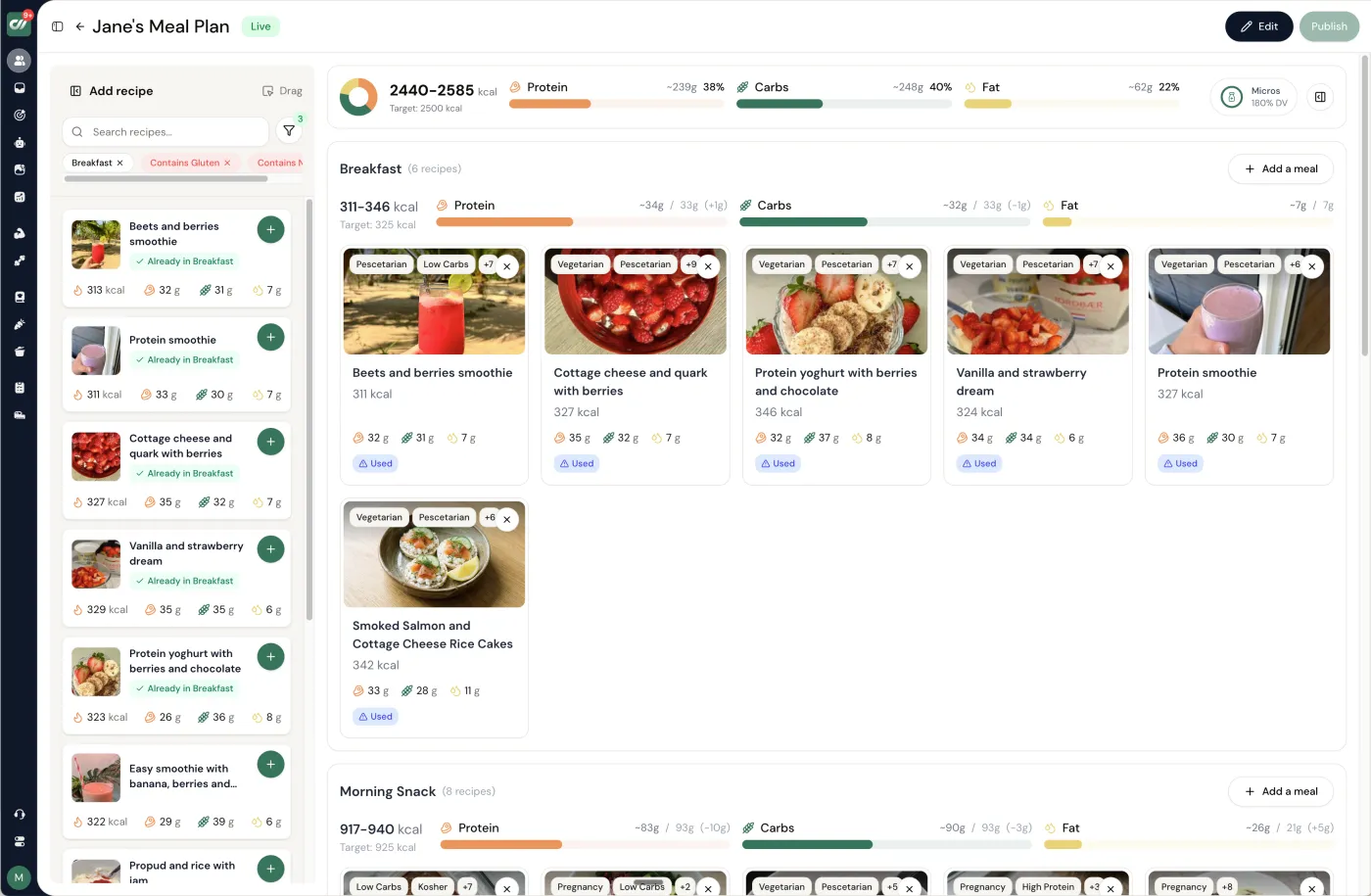
A protein target is only as good as the client's ability to hit it, which is why setting it and watching it land want to live in the same place. In Coachway you set calorie and macro targets per client and per weekday, with date exceptions for phase work like a diet block or a heavier training week, so a client's protein can sit higher on training days if you want it to. The client then logs food against that target - by barcode, photo or a quick manual add - and macro rings move as they eat, so both of you can see at a glance whether the protein number is actually being met rather than assumed. Every feature is included at EUR 69 a month with your first 5 clients, then EUR 9 per additional client, and the platform is built on knowledge from working with 150 online coaches over 6+ years. The 14-day free trial starts with a card held securely by Stripe and cancels under Billing before it renews, or you can book a demo and see the nutrition screens first.
Frequently asked questions about setting client protein targets.
How do you set a protein target for a client?
Pick a per-kilogram range from the client's goal and training age, base it on the right bodyweight, then round to a clean daily number they can hit. For most clients who train and want to build or hold muscle, roughly 1.6 to 2.2 grams of protein per kilogram of bodyweight a day covers it; a client in a fat-loss phase sits toward the top of that range, often 1.8 to 2.4 grams per kilogram, because more protein protects lean mass and blunts hunger while calories are low. Base the number on a lean or goal bodyweight for anyone carrying a lot of fat so you are not prescribing protein for tissue that is not muscle. Then set it as one clear daily target, ideally split across three to five meals, and treat protein as the macro you lock first before carbohydrate and fat fill the rest of the calories.
How much protein per kilogram should a client eat?
For a client who trains, a daily intake of about 1.6 to 2.2 grams of protein per kilogram of bodyweight is the workhorse range that covers muscle gain, strength and general body composition. Push toward the upper half - roughly 1.8 to 2.4 grams per kilogram - in a fat-loss phase, for a leaner client chasing a hard look, and for an older client whose muscle responds less readily to protein. Drop toward 1.4 to 1.6 grams per kilogram for a general-health client who is not training hard and just wants a sensible floor. Eating well above the top of the range is not harmful for a healthy person, but it rarely adds anything and it crowds out carbohydrate that fuels training, so there is little reason to prescribe it.
Should protein be based on bodyweight or lean body mass?
For a client at a reasonable body-fat level, total bodyweight is fine and simpler to coach. For a client carrying a lot of fat, scaling protein to total bodyweight overshoots, because fat mass has almost no protein demand - so base the target on lean body mass or on a realistic goal weight instead. A practical shortcut that avoids a body-composition measurement is to set protein against the weight the client is aiming for rather than the weight on the scale today: it lands close to a lean-mass calculation without needing calipers or a scan. The gram-per-kilogram ranges stay the same; you are only choosing which bodyweight you multiply them by.
How should a client spread protein across the day?
Splitting the daily target across three to five meals, each carrying a meaningful dose of roughly 0.4 grams of protein per kilogram of bodyweight (about 25 to 40 grams for most clients), is the sensible default for building and holding muscle. That spread keeps muscle protein synthesis topped up through the day and, just as importantly, makes a large daily number reachable - four meals of 40 grams is far easier to actually eat than one enormous serving. That said, total daily protein is the main driver by a wide margin. If a client's life only allows two solid protein meals, hitting the daily total across two feedings still does most of the work, so treat distribution as an optimisation, not a rule to enforce at the cost of adherence.
Does a client need more protein in a fat-loss phase?
Yes. When calories drop, protein does two extra jobs, so the target goes up rather than down. First, it protects lean mass: in a deficit the body is more willing to break down muscle, and a higher protein intake - often 1.8 to 2.4 grams per kilogram of bodyweight, and toward the very top for a lean client dieting hard - is the strongest dietary lever for holding onto it while fat comes off. Second, protein is the most filling macronutrient, so a higher target makes a hungry deficit far more liveable and improves adherence. This is why protein is set first and held steady while carbohydrate and fat absorb the calorie cut, not the other way around.
The protein number is one piece of the macro picture: the TDEE and macro maths that frames it, the macro method that turns targets into food, and the protein calculator that does the gram-per-kilogram arithmetic in a few seconds. Set protein first, base it on the right bodyweight, and coach it to what the client will actually eat.
Keep reading
all guidesTraining Frequency for Muscle Growth: How Often to Train
Training frequency is how often you train a muscle each week. At equal volume, twice a week tends to edge once - but total weekly volume, not frequency, is the real driver. How it interacts with your split, and how to program it.
Read the guideAlcohol and Fat Loss: What Coaches Need to Know
Alcohol affects fat loss mostly through calories, not magic - empty calories, a brief pause in fat burning, raised appetite, worse sleep. How coaches help clients fit drinking into a deficit with honest harm reduction.
Read the guideProtein Powder Guide: Whey, Casein & Plant Blends
What protein powder actually is, how whey, casein, and plant blends differ, whether your clients need it, and how to handle the question food-first without building an unnecessary supplement stack.
Read the guideFree tools for this: Protein Calculator · Carb Cycling Calculator · Macro Calculator by Body Type
See what Coachway can do for your coaching business
Coachway was built on knowledge from working with 150 online coaches over 6+ years, who all hit the same wall - slow platforms, clunky workflows, wasted hours. Start your 14-day free trial and see what we fixed - the whole platform, no charge today, cancel anytime under Billing.


