


The personal trainer cancellation policy that cuts no-shows and late cancellations.
A personal trainer cancellation policy is the short written rule that says how much notice a client owes before moving or cancelling a session, and what happens if they do not give it. Get it right and the awkward no-show conversation mostly disappears, because both sides agreed the rule before anyone missed anything. This is the practical version: what the policy should contain, the reminder and deposit system that prevents the cancellation before it happens, and wording you can lift straight into your own onboarding.
By Markus Evers · Updated September 2026
the short version
A good personal trainer cancellation policy is short, written and agreed before the first session. Set a 24-hour notice window, define a late cancellation and a no-show, and state the charge for each. Then prevent most misses before they happen: take a deposit or bill the block upfront so the slot is already paid for, and send a reminder the day before so no one forgets. When a miss does happen, apply the rule warmly and consistently. The fee protects your calendar; your judgement, and a written exception for real emergencies, protects the relationship.
What does a cancellation policy actually do?
A cancellation policy does one quiet, valuable thing: it moves the awkward conversation to a moment when nobody is upset. Without one, the first no-show turns into an on-the-spot negotiation where you either eat the lost hour or look like the villain for asking to be paid. With one, there is nothing to negotiate, because the rule was agreed at onboarding, when the client was keen and the relationship was warm. The policy is not really about the money on any single missed session. It is about protecting the time you blocked out, and about making the commitment visibly two-sided, so a client understands that their slot is a real thing you set aside for them and not a placeholder they can drop without cost.
For an in-person personal trainer, a no-show is an hour you cannot get back and often could have sold to someone else, and a no-show cost calculator turns that recurring leak into a yearly figure. For an online coach, the same problem wears different clothes: the missed video call, the check-in that never gets filled in, the client who quietly goes dark for two weeks. Both are cancellations in everything but name, and both respond to the same three levers - a clear written rule, a deposit that makes the commitment concrete, and a reminder that removes the honest "I forgot". Treat the policy as the last line of defence rather than the first, and most of the work happens long before anyone would ever have to enforce it.
What should a personal trainer cancellation policy include?
Five components, no more. Every extra clause is one the client will not remember, so keep each of these to a single plain sentence.
1. A notice window.
The amount of warning a client must give to move or cancel without a charge. A 24-hour notice window is the cleanest default: long enough for you to refill or reclaim the slot, short enough that a client planning their week can respect it. Busy in-person trainers sometimes go to 48 hours because same-day gaps are harder to fill; flexible online coaches sometimes drop to 12. Pick one number and hold it.
2. The difference between a late cancellation and a no-show.
A late cancellation is a session cancelled inside the notice window - the client told you, just too late to be useful. A no-show is a session missed with no message at all. Naming both in the policy matters, because you may treat them differently: many trainers charge half for a late cancellation and the full fee for a silent no-show, on the logic that a heads-up, even a late one, is worth something.
3. The consequence for each.
State the actual charge, in the actual currency, in advance. Charging for a no-show is what turns the policy from a polite request into a rule people plan around - a cancellation policy with no consequence is simply ignored the first busy week. The standard is the full session fee for a no-show and either the full fee or half for a late cancellation. The number is yours to set; the non-negotiable is that the client agreed to it before the miss.
4. How deposits and upfront payment interact.
If you take a deposit or bill a block of sessions upfront, say what a missed session draws down and what, if anything, is refundable. This is where the policy does its quietest work, because a slot that is already paid for is a slot a client is far less likely to skip. For online coaching, an upfront monthly subscription plays the same role for the whole relationship. Spell out the mechanics so nobody is surprised.
5. The exceptions you will honour.
Write in the grace you intend to give: genuine illness, family emergencies, one free reschedule a quarter, whatever feels fair to you. Naming the exception in advance keeps you from either being talked into an ad-hoc waiver you resent or refusing something reasonable and looking rigid. A written exception is you deciding your own generosity on a calm day rather than under pressure. It is also the clause that keeps a good long-term client from feeling like a policy number.
How do you stop the cancellation before it happens?
The best cancellation policy is the one you rarely have to use, and that is a matter of design, not luck. Three moves, in order of impact, remove most no-shows before the policy is ever tested.
Take a deposit, or bill the block upfront.
This is the single most effective tool, because it moves the decision to the moment of commitment. A deposit of one session, or the first month paid before coaching starts, removes most casual no-shows outright - people protect what they have already paid for, and the session stops being a fresh spending decision every week. It is not a penalty; it is a way of making the commitment concrete on day one, which is exactly when the client is most willing to make it. Handle deposits through your scheduling and payment setup so the money and the slot are booked in one step.
Send a reminder the day before.
A large share of misses are honest ones - the session fell out of a busy head, not out of commitment. A short reminder the day before removes that entire category and does it without any awkwardness, because it reads as a service, not a chase. Automate it so it goes out reliably rather than depending on you remembering to remember. For online coaching, the same principle applies to the weekly check-in: an automatic nudge the day it is due catches the client before they drift, which is the online equivalent of a no-show.
Put the policy in the agreement, not just the DMs.
A rule mentioned once in a chat is a rule nobody agreed to. Write the policy into the document a client signs at onboarding, so consent is explicit and dated. Our guide to the personal training contract covers where the cancellation clause sits alongside scope, payment and liability, and how to have it e-signed before the first session rather than chased afterwards.
A cancellation policy you can copy today.
Here is a plain-language policy you can lift into your onboarding as-is, then adjust the numbers to fit your practice. It is written to be read once and understood, which is the only kind of policy that gets followed. This is general good practice, not legal advice - have your own terms checked if you are unsure.
cancellation and no-show policy
Notice. Please give at least 24 hours' notice to move or cancel a session. Sessions changed with 24 hours' notice or more are free to reschedule.
Late cancellations. A session cancelled with less than 24 hours' notice is charged at 50% of the session fee.
No-shows. A session missed without any notice is charged at the full session fee.
Deposits. Sessions are paid for in advance. A missed session draws down from your paid block under the terms above.
Emergencies. Genuine illness and family emergencies are handled case by case, and you have one free late reschedule each quarter with no questions asked.
Where does the prevention system live for an online coach?
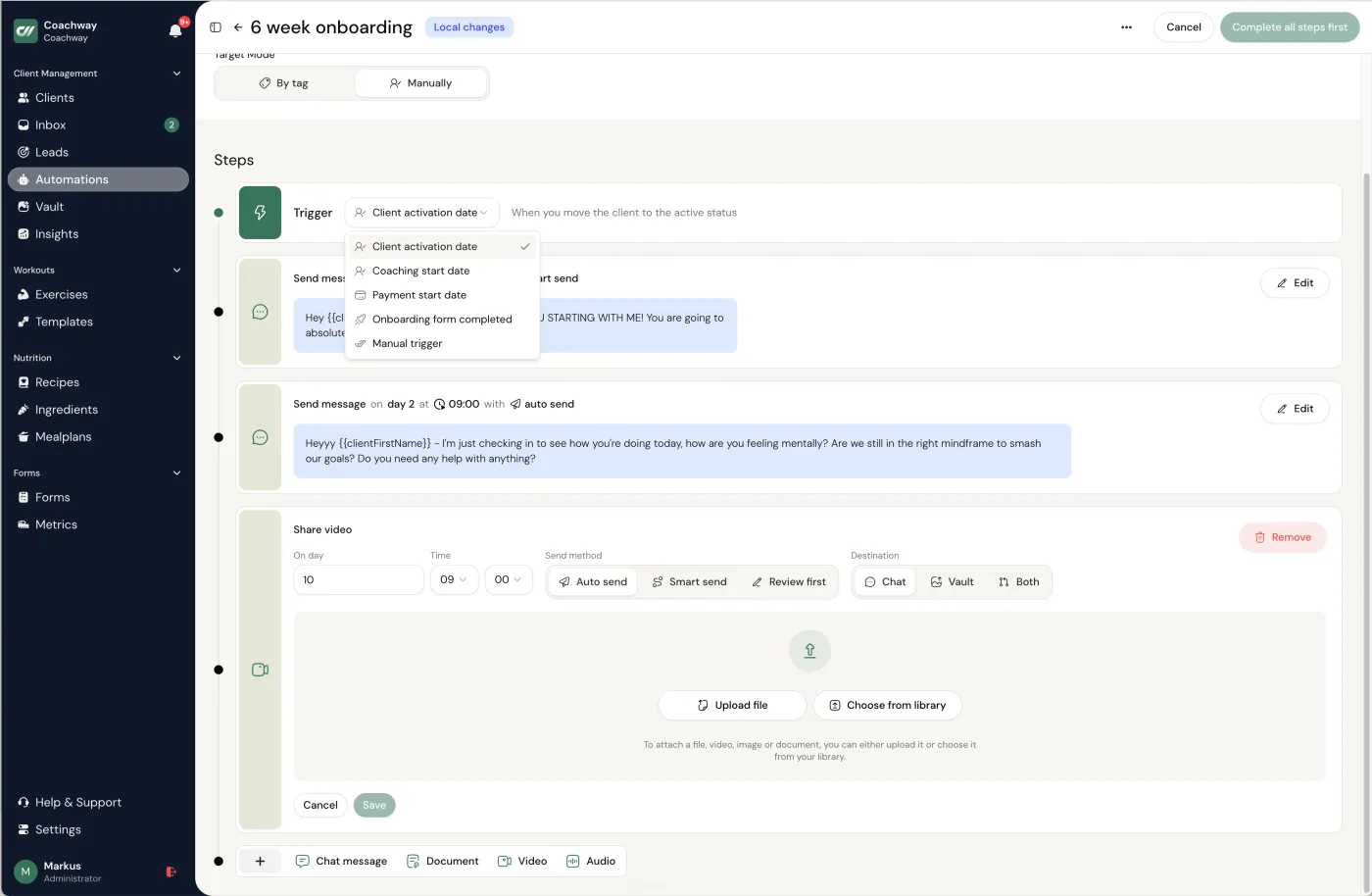
For an online coach, the no-show you actually lose clients to is rarely a missed calendar slot; it is the check-in that never gets filled in and the client who quietly goes dark. That is the version a coaching platform can prevent directly. In Coachway, the reminder side is automated: check-in reminders and follow-up sequences go out on their own schedule, so a client gets a nudge the day their check-in is due instead of drifting for a fortnight before you notice. The commitment side runs through your own payments. Coachway lets you bill clients on an upfront subscription or a payment plan through your own Stripe account - Coachway never holds your money - which is the online equivalent of the deposit that stops the miss before it happens. We build Coachway, and it is built on knowledge from working with 150 online coaches over 6+ years. It costs EUR 69 a month including your first 5 clients, then EUR 9 per additional client, with every feature included. Booking a live session slot is still a job for a dedicated scheduling tool, so pair the two rather than expecting one to do both. The 14-day trial starts with a card held by Stripe and cancels under Billing before it renews, or you can book a demo and see the reminder flows first.
Frequently asked questions about cancellation policies.
What should a personal trainer cancellation policy include?
Five things: a notice window, a definition of a late cancellation versus a no-show, the consequence for each, how any deposit or upfront payment interacts with it, and the exceptions you will honour. A personal trainer cancellation policy works when every one of those is written down before coaching starts, not improvised the first time a client misses a session. The cleanest version reads in four lines: sessions moved or cancelled with at least 24 hours' notice are free; inside 24 hours the session is charged in full; a no-show with no message is charged in full; genuine emergencies and illness are handled case by case. Keep it that short. A policy nobody can remember is a policy nobody follows, and the point is not to punish people, it is to make the rule so plain that both of you know where you stand before the awkward moment arrives.
How much notice should a cancellation policy require?
A 24-hour notice window is the cleanest default for one-to-one coaching. It gives you enough time to offer the slot to someone else or reclaim the hour for your own work, and it is long enough that a client planning their week can respect it without feeling trapped. Some trainers running back-to-back in-person sessions go to 48 hours because a same-day gap is harder to refill; some online coaches running flexible video calls drop to 12 because the slot costs them less. The number matters less than applying it the same way every time. A 24-hour rule you enforce consistently beats a 48-hour rule you waive whenever someone sounds apologetic, because the second one quietly teaches every client that the policy is negotiable.
Should personal trainers charge for no-shows and late cancellations?
Yes, and the policy is close to worthless if you do not. A cancellation policy with no consequence is just a request, and requests get ignored the moment a client's week gets busy. The standard structure is to charge the full session fee for a no-show with no message, and either the full fee or half for a cancellation inside the notice window, with your choice stated in advance. Charging is not about the money on any single missed session; it is about protecting the time you set aside and signalling that the commitment is real on both sides. The kinder framing, and the true one, is that the fee exists so you can keep serving the clients who do show up. What matters most is that the client agreed to the number before the miss, so enforcing it is you keeping a shared agreement rather than springing a surprise.
Do deposits reduce no-shows?
They are the single most effective prevention tool, because they move the decision to the moment of commitment instead of the moment of the miss. A deposit of one session, or the first month billed upfront, means a client has already put money behind the slot before they are ever tempted to skip it, and people protect what they have already paid for. For in-person personal training, taking payment for a block of sessions in advance removes most casual no-shows outright: the session is not a fresh spending decision each week, it is a plan already paid into. For online coaching, an upfront monthly subscription does the same job for the whole relationship. The deposit is not a penalty; it is a way of making the commitment concrete on day one, so the reminder and the policy rarely have to do any real work.
How do you enforce a cancellation policy without losing the client?
Set it at onboarding, in writing, and reference it warmly rather than defensively when a miss happens. Most of the discomfort of enforcing a policy comes from clients feeling ambushed, and that vanishes when the rule was clearly agreed before coaching started. When someone does miss, lead with the person and let the policy sit behind it: check they are okay, note the charge as the agreement you both signed up to, and keep your tone the same as always. A single missed session almost never ends a coaching relationship; a policy applied inconsistently or with obvious irritation is far more likely to. If a good long-term client has a genuine one-off emergency, honouring the exception you already wrote into the policy costs you nothing and buys real goodwill. The policy protects your calendar; your judgement protects the relationship.
A cancellation policy is one clause in a bigger operating system. It sits inside the personal training contract a client signs at onboarding, it overlaps with how you handle refunds and ending the relationship, and every no-show it prevents is a small deposit into your client retention rate.
Keep reading
all guidesFitness challenge ideas for coaches: 32 to run in 2026
The good ones are additive and built to run: 32 challenges grouped by the job each does - habits, training, nutrition, groups, seasons - with a duration, metric, who it suits, and the mistake that quietly kills it.
Read the guidePeriodization for online coaches (2026 guide)
How to run periodization across a remote client list you never see train - the three models in plain words, autoregulation by RPE and RIR, deload timing, and templating one mesocycle you reuse.
Read the guideWorkout templates for personal trainers (2026 guide)
Three ready-to-use workout templates plus the design principles behind them, and how to personalize any of them per client without starting from a blank page.
Read the guideFree tools for this: Coaching Business Health Check · Client Onboarding Builder · Client Capacity Calculator
Ready-made template: Coaching Contract Template
See what Coachway can do for your coaching business
Coachway was built on knowledge from working with 150 online coaches over 6+ years, who all hit the same wall - slow platforms, clunky workflows, wasted hours. Start your 14-day free trial and see what we fixed - the whole platform, no charge today, cancel anytime under Billing.


