How to get freelance personal trainer clients - build your own lead flow.
To get freelance personal trainer clients you have to build the pipeline a gym would otherwise hand you, because as a self-employed trainer there is no reception feeding you walk-ins. That means one repeatable lead flow of your own: a sharp niche so the right person recognises themselves, warm outreach to the people who already know you, referrals engineered on purpose, and content that shows your method - all captured in one place so no enquiry cools off in a forgotten DM. This 2026 guide walks the build, then what to do this week if your diary is empty.
By Markus Evers · Updated September 2026
the short version
A freelance personal trainer wins clients by owning a lead flow instead of borrowing the gym's foot traffic. Pick one specific person you coach and one clear result. Start with warm outreach, because your first clients are almost always people who already know you. Turn every happy client into referrals on purpose, not by luck. Add content on one platform to reach strangers over time, and only layer paid ads once the offer converts warm demand. Then move part of the delivery online so one trainer can hold more clients without adding hours - and catch every enquiry in one place so none of them quietly go cold.
Why is getting freelance clients different from working in a gym?
In a commercial gym, a large part of your client acquisition is done for you. The gym pays for the location, the marketing and the membership base, and a share of the people who walk past the floor become your clients. Go freelance and every one of those jobs lands on you. There is no reception, no walk-in traffic, no manager handing over a new starter to be shown around. The upside is that you keep the whole relationship and the whole fee; the cost is that lead generation becomes a permanent part of the work rather than something the building does in the background.
So the honest answer to how to get freelance personal trainer clients is not a single clever tactic. It is a system you run every week: attract the right person, capture their interest before it fades, follow up, and convert on a real conversation. Freelancers who struggle almost never have a talent problem - they have a consistency problem. They market hard when the diary is empty, land a few clients, get busy delivering, stop marketing, and hit the same cliff two months later. The trainers who build a stable book are the ones who kept the lead flow ticking over even while they were full, so there was never a cliff to fall off.
How do you build a freelance lead flow from scratch?
Five moves, in this order. The early ones are warm and fast; the later ones are colder and slower but compound. Do not skip to the bottom because ads feel like "real" marketing - the top of this list is where a solo trainer's first clients actually come from.
1. Get specific: one person, one result.
"Personal trainer for anyone who wants to get fit" is invisible, because it asks the reader to work out whether they qualify. A freelancer competing without a gym's brand behind them wins on specificity instead: name the exact person you coach and the exact result you help them reach - busy parents rebuilding strength, desk-bound professionals losing the last stubborn stone, returning lifters coming back from injury. A sharp niche makes every later channel easier, because outreach, referrals and content all get more precise. If you are still deciding, the niche-selection guide narrows it fast. You can widen later; you cannot get noticed as a generalist.
2. Work the warm list first.
Your first freelance clients are hiding in the people who already know you: friends, family, former gym members you trained, colleagues, the person at the desk next to your old job. Before you spend a penny on marketing, have direct, specific conversations with a couple of dozen of them. Not "I'm a PT now, let me know if you need anything" - that goes nowhere. Instead: "I now coach returning lifters back to full strength, do you know one person that fits?" Warm outreach out-converts cold content by a distance because trust is already there. This is also where a freelancer's first case studies come from, and case studies are what make every later client easier to win. Leaning on warm conversations and referrals like this is also the whole engine behind getting coaching clients without social media.
3. Engineer referrals on purpose.
Referrals are the highest-quality freelance channel there is, and most trainers leave them to chance. Make them deliberate. Do genuinely great work, ask at the right moment - after a client hits a result they are proud of, not on day one - and make the ask easy by naming who you want ("someone like you, who is short on time but serious"). Then widen it to professionals who see your ideal client already: physios, nutritionists, running clubs, local sports coaches. A referral partnership with one person who meets your exact audience every week can out-produce months of posting. The referral playbook covers the exact asks that work.
4. Publish content that shows your method.
Content is how a freelancer reaches strangers without paying for every one, but it is a slow compounding channel, not a switch. Pick one platform you will actually keep up with, aim it squarely at your niche, and show your thinking rather than generic fitness tips - how you would approach a specific problem your ideal client has. The goal is not to go viral; it is to be the trainer a warm stranger has quietly followed for a few months and already half-trusts by the time they message. Keep it sustainable, because the trainer who posts for a year beats the one who burns out in six weeks. If your ideal client is a desk-bound professional, that one platform is often LinkedIn. This is also the same audience you can later warm for a challenge or a launch, the way the online marketing playbook lays out.
5. Add online delivery so you can hold more clients.
A purely in-person freelancer trades hours for money and hits a ceiling fast, because every client needs a slot in the day. Moving part of the delivery online breaks that ceiling: a written programme the client opens in an app, a structured weekly check-in that replaces some standing sessions, and asynchronous form review mean one trainer can serve far more clients without adding hours one-for-one. That changes the whole client-getting maths - you need fewer clients for a full-time income, and each new one is more profitable. If you are moving off the gym floor, the in-person-to-online transition guide covers what shifts.
My diary is empty. What do I do this week?
When you need freelance clients now, skip the slow channels and go straight to warm demand. Content and ads will not save a diary that is empty today; conversations will. Four moves, in order:
1. Message twenty warm people by hand, today.
Past clients, lapsed gym members you trained, friends who have watched you train. Send a short, specific, personal message that names exactly who you coach and asks for one introduction. A warm list will out-convert a week of cold posting, and it costs nothing but an afternoon.
2. Ask every current and past client for one name.
Referrals are your fastest quality channel. Go back to anyone you have ever coached who got a result, thank them, and ask them to point you at one person who fits your niche. Make the ask concrete and easy to say yes to.
3. Put up one simple way to capture interest.
A single lead form or booking link, sent to everyone who replies, so momentum turns into captured details instead of a thread that goes cold. You do not need a website this week; you need one reliable place to catch the enquiry and a follow-up that actually happens.
4. Book real discovery calls with anyone warm.
Do not try to close in the DMs. Send interested people to a handful of real call slots this week and let the conversation do the converting. The discovery-call guide keeps it a fit conversation, not a hard sell.
Where does a freelancer keep the lead flow so nothing leaks?
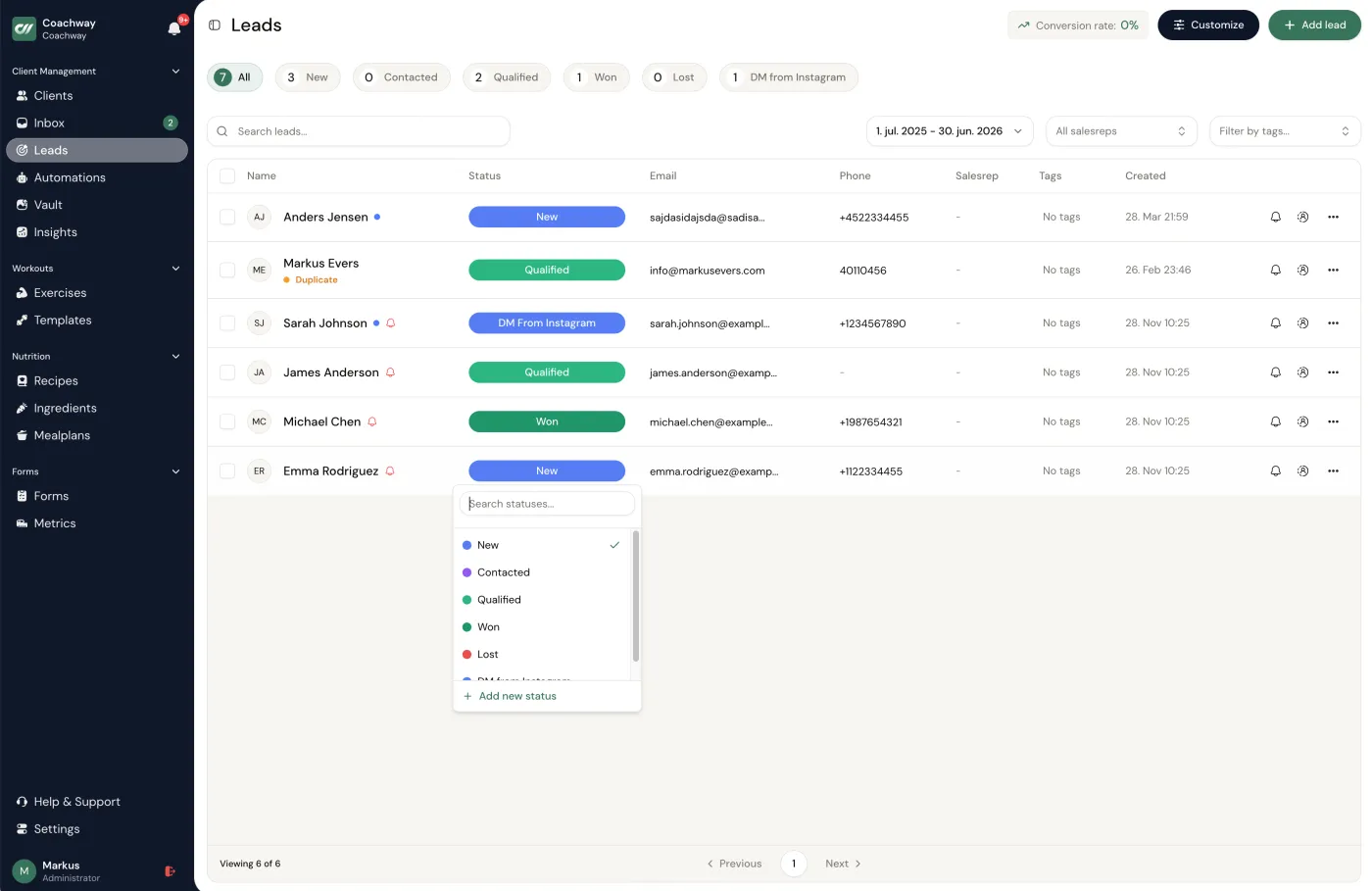
Every channel above ends in the same chain: a form that catches interest, a pipeline that moves a lead from new to won, and a clean handover into onboarding once someone says yes. When that chain is scattered across DMs, a notes app and a payment link, enquiries fall through the gaps - which for a freelancer with no gym backstop means lost income. Coachway keeps the whole chain in one place: an embeddable lead form that captures the full source trail, a visible pipeline with new, contacted, qualified and won stages, and a one-click convert that gives a new client the client app, the onboarding sequence and a subscription billed through your own Stripe account, since Coachway never holds your money. It is built on knowledge from working with 150 online coaches over 6+ years, and it costs EUR 69 a month with your first 5 clients included, EUR 9 per additional client after that, every feature in. The coach dashboard is in English; the client app is available in English, Danish, Norwegian, Swedish, Finnish and German. Start with the 14-day free trial - a card is required to begin and you can cancel under Billing before it renews - or book a demo and see the pipeline first.
Frequently asked questions about getting freelance personal trainer clients.
How do freelance personal trainers get their first clients?
Almost always from the warm list, not from strangers. When you are self-employed there is no gym reception feeding you walk-ins, so the first freelance personal trainer clients come from people who already know you: friends, ex-gym members you trained, colleagues, and anyone who has watched you get in shape or help someone else. The fastest opening move is not a marketing campaign but a round of direct, specific conversations - tell twenty people exactly who you now coach and what result you help them get, and ask them to point you at one person who fits. That produces a handful of first clients within weeks, and those first clients become the case studies and referrals that make the next ones easier. Paid ads and cold content are for later, once the offer is proven on warm demand.
Where do freelance personal trainers find clients without a gym?
You build your own channels instead of borrowing the gym's foot traffic. The four that work for a solo trainer, in order of warmth: your warm list and past contacts; referrals from happy clients and from other professionals who see the same people (physios, nutritionists, running clubs); content that shows your method to a specific audience on one platform you actually enjoy; and a lightweight partnership or two - a local studio, a workplace, a community group - where your ideal client already gathers. Cold paid advertising sits underneath all of that and only earns its place once the offer converts warm traffic reliably. The through-line is that a freelancer has to construct the pipeline a gym would otherwise hand over, which is more work up front but leaves you owning the relationship and the client.
How many clients does a freelance personal trainer need?
Fewer than most people assume, once you move part of the delivery online. An in-person freelancer trading pure hours hits a ceiling fast because every client needs a slot in the day. The moment you add online coaching - a written programme in an app, a weekly check-in, asynchronous form review - one trainer can serve many more clients without adding hours one-for-one, so the client count that makes a full-time income drops. The honest target is not a big number; it is enough of the right clients, priced properly, retained long, that your monthly recurring revenue covers your life with room to spare. That is why retention and pricing matter as much as lead flow: keeping a client for a year is worth far more than winning three who leave in a month.
Do I need a website to get freelance personal training clients?
Not to start, and not as the thing that wins the client. Early freelance clients come from conversations and referrals, and those convert on a discovery call, not on a homepage. What you do need is one clear place to send an interested person and a reliable way to catch their details before the interest fades - a simple lead form, a booking link, or a single page that explains who you help and what happens next. A full website earns its keep later, when content and search start bringing strangers who need to size you up before they message. Build the capture first and the website second: a beautiful site that leaks enquiries into scattered DMs loses more clients than an ugly one with a form that actually follows up.
How long does it take to build a full freelance client base?
Plan in quarters, not weeks. The warm list can produce your first few clients almost immediately, but a full, stable book built on referrals and content usually takes six to twelve months of consistent work, because referrals compound only after you have delivered real results and content only pays off after months of showing up. The trap is treating the slow build as failure and quitting the channels right before they start returning. Set a floor of income from warm outreach and part-time work if you need it, keep the lead flow running every single week rather than in panic bursts when the diary empties, and let the compounding channels mature. Freelancers who last are the ones who kept marketing while they were busy, so there was never a cliff.
Getting clients is one half of going solo; the setup around it is the other. If you are still building the business itself, start with how to become a freelance personal trainer, then wire the channels above into a single lead engine so no enquiry ever leaks. For in-gym and online trainers alike, the five-part version is how to get personal training clients.
Keep reading
all guidesContent batching and repurposing system for coaches (post daily in a few hours a week, 2026)
Content batching is how coaches post consistently without living in the feed. A repeatable system to turn one filming session into a week of posts, and a workflow that protects your coaching time.
Read the guidePassive income and digital products for fitness coaches (what actually works, 2026)
Passive income for coaches is rarely passive, but leverage is real. The digital products that actually work - courses, templates, challenges, memberships - and how to build one without abandoning your 1:1 clients.
Read the guideHow to build a value ladder and high-ticket offer suite for coaching (2026)
A value ladder turns one-off buyers into long-term clients. How to structure low, mid, and high-ticket offers so each rung leads to the next, without discounting your core coaching.
Read the guideFree tools for this: Coaching Offer Builder · Sales Objection Handler · Discovery Call Calculator
See what Coachway can do for your coaching business
Coachway was built on knowledge from working with 150 online coaches over 6+ years, who all hit the same wall - slow platforms, clunky workflows, wasted hours. Start your 14-day free trial and see what we fixed - the whole platform, no charge today, cancel anytime under Billing.