How to become a personal trainer in 2026: 7 steps, what it costs, and the first clients.
Becoming a personal trainer is a certification, a few legal basics and then a long stretch of coaching real people. This guide puts the seven steps in order with the cost and time of each, what working trainers say they got wrong in year one, and when the move to online coaching makes sense. Every figure is from a provider's own price list or a named thread, and the opinions are attributed.
By Markus Evers · Updated September 2026
the short version
To become a personal trainer in 2026, take 7 steps: pick one NCCA-accredited certification, study and pass, sort insurance and the legal basics, get a first job or ten clients, set up the client documents, plan the first year's numbers, and go online once you have coaching hours. Budget roughly USD 500 to 2,000 and three to six months.
How do you become a personal trainer?
You become a personal trainer by earning one accredited certification, getting insured, and then coaching real people until the qualification turns into a skill. In practice that is seven steps over three to six months of study plus a first year of work: certification, exam, insurance and legal basics, first job or first ten clients, the client documents, the first year's numbers, and the eventual move online. The table gives each step its cost, its time and the mistake people make at it.
| Step | What it costs | How long | The mistake |
|---|---|---|---|
| 1. Pick one accredited certification | USD 300 to 1,399 depending on route | 1 to 2 weeks to decide | Collecting three certifications before the first client. One accredited one is the baseline; the rest can wait. |
| 2. Study and pass the exam | Included in the package, or exam fee plus your own books | 3 to 6 months self-study (ACE quotes 3 to 6) | Treating the exam as the finish line. The qualification is the entry ticket, not the skill. |
| 3. Insurance and the legal basics | CPR/AED course plus a liability policy; varies by country | 1 to 2 weeks | Training paying clients before the policy is live. Gyms, insurers and platforms will refuse to work with you without it. |
| 4. First job or first ten clients | Time, not money | 1 to 3 months | Going independent with zero hours coached. The two positions coaches take on this are below. |
| 5. The first-client documents | Free templates on this site | One evening | Taking a client with no PAR-Q, no intake form and no contract, then discovering why they exist. |
| 6. The first year's numbers | Your rate times your sessions, minus costs | One hour with the calculator | Pricing from the gym next door instead of from the arithmetic. |
| 7. Go online when you have hours behind you | A coaching platform from EUR 69 a month | Convention says 3 to 5 years in person; not everyone agrees | Launching online coaching with no coaching hours, or waiting for permission that never comes. |
Certification figures are the providers' listed prices when our cost guide was checked in 2026; providers run frequent sales, so confirm the live number before you enrol.
Which certification do you need?
One NCCA-accredited certification. Employers and insurers treat that accreditation as the baseline credential, and NASM, ACE, ISSA, NSCA-CPT and ACSM-CPT all carry it. The differences are in how you learn and who you want to convince: NASM is built around its OPT model and suits people who like a structured, assessment-driven system; ACE is often described as the most coaching-focused; ISSA is popular with online and self-paced learners because its core exam is open-book and remote; NSCA and ACSM are the academic bodies, cheaper at the exam and heavier on the reading. Our certification comparison ranks them for someone who plans to coach online.
The advice that comes up most often from working trainers is to stop at one. In the r/personaltraining step-by-step guide to getting started, u/Wellness_Movement put it as "more certs is not necessarily better than less", and the 22-year trainer in the 14-lessons thread made the same point from the other end: early on, the job is client acquisition, and a second certificate does not bring a single client. Specialisations earn their cost later, once you know which clients you actually attract.
Two things every route needs before the exam: you must be 18 with a high school diploma or equivalent, and you must hold a current CPR/AED certificate. Neither requires a degree. If you are weighing a health or nutrition credential alongside the training one, the health coach certifications guide covers where those sit and what they cost.
How much does it cost to become a personal trainer?
Most people spend roughly USD 500 to 2,000 all in, and the certification is the biggest line. The self-study packages from NASM, ACE and ISSA list at about USD 999 to 1,399 but discount heavily and often; the exam-only bodies, NSCA and ACSM, charge around USD 300 to 435 for the exam and leave the study materials to you. CPR, insurance and starter tools make up the rest. The table is by route; the full cost breakdown itemises every provider's packages and what you can skip at the start.
| Route | Figure (listed 2026) | What to know |
|---|---|---|
| Self-study certification package (NASM, ACE, ISSA) | USD 999 to 1,399 at list price; frequent sales cut that by up to half | Study materials, practice tests and the exam are bundled. ISSA lists a USD 49 then USD 92 a month payment plan. |
| Exam-only body (NSCA-CPT, ACSM-CPT) | NSCA about USD 300 member, 435 non-member; ACSM 310 member, 410 non-member | You buy your own textbook and practice questions on top, so the all-in figure lands closer to the packages than it looks. |
| CPR/AED certification | A short course, usually under a day | Required by every major certifying body before the exam and by most employers and insurers. |
| Liability insurance | Varies by country and insurer | Most insurers only quote once you hold a recognised credential. See the legal requirements guide for what to ask. |
| First tools | Templates free; a coaching platform from EUR 69 a month once you go online | Spreadsheets and messaging are enough for the first in-person clients. Software matters once clients are remote. |
How do you get your first clients?
You get your first clients either from a gym's floor as an employee or from your own warm network as an independent, and experienced trainers split on which comes first. The position with the most support in the threads we read is employee first: in the 14-year home-studio AMA, u/DanNorthFitness wrote "I always recommend working as an employee somewhere first so you can 1) focus on training people and 2) decide if it's something you want to do long term." The counter-position, from u/FirefighterJoeyy94 in the new-coach mistakes thread, is to "get that experience in the commercial gym and then get the heck outta there", which is less a disagreement than a timeline: get the hours, then leave.
The commercial gym route
Someone else fills your diary while you learn to coach. You give up a share of every session to the gym, and the floor teaches you the two things no course does: how to talk to a nervous beginner, and how to keep a client for a year. Most trainers who took this route say the split was worth it for the first year and not for the third.
The independent route
Your first ten clients come from people who already know you: former teammates, colleagues, friends of friends. It keeps the whole fee, and it means you are learning to sell and to coach in the same month. The playbook for that warm network is in how to get your first coaching client.
The three documents before the first session
Whichever route, do not take a paying client without three documents: a PAR-Q to screen for the conditions that need a doctor's sign-off, a client intake form for goals, history and schedule, and a personal training contract that states what is included, how billing works and how either side ends it. All three are free templates, and the legal requirements guide explains why an insurer or a gym will expect them.
Run the first clients from one system, in person or online.
Clients stay when the basics are visible: they know this week's sessions, they get an answer when a lift felt wrong, and nobody chases a late payment by text. Set those three up the week the first client signs, whatever tool you use, so the tenth client joins a routine instead of a new spreadsheet tab.
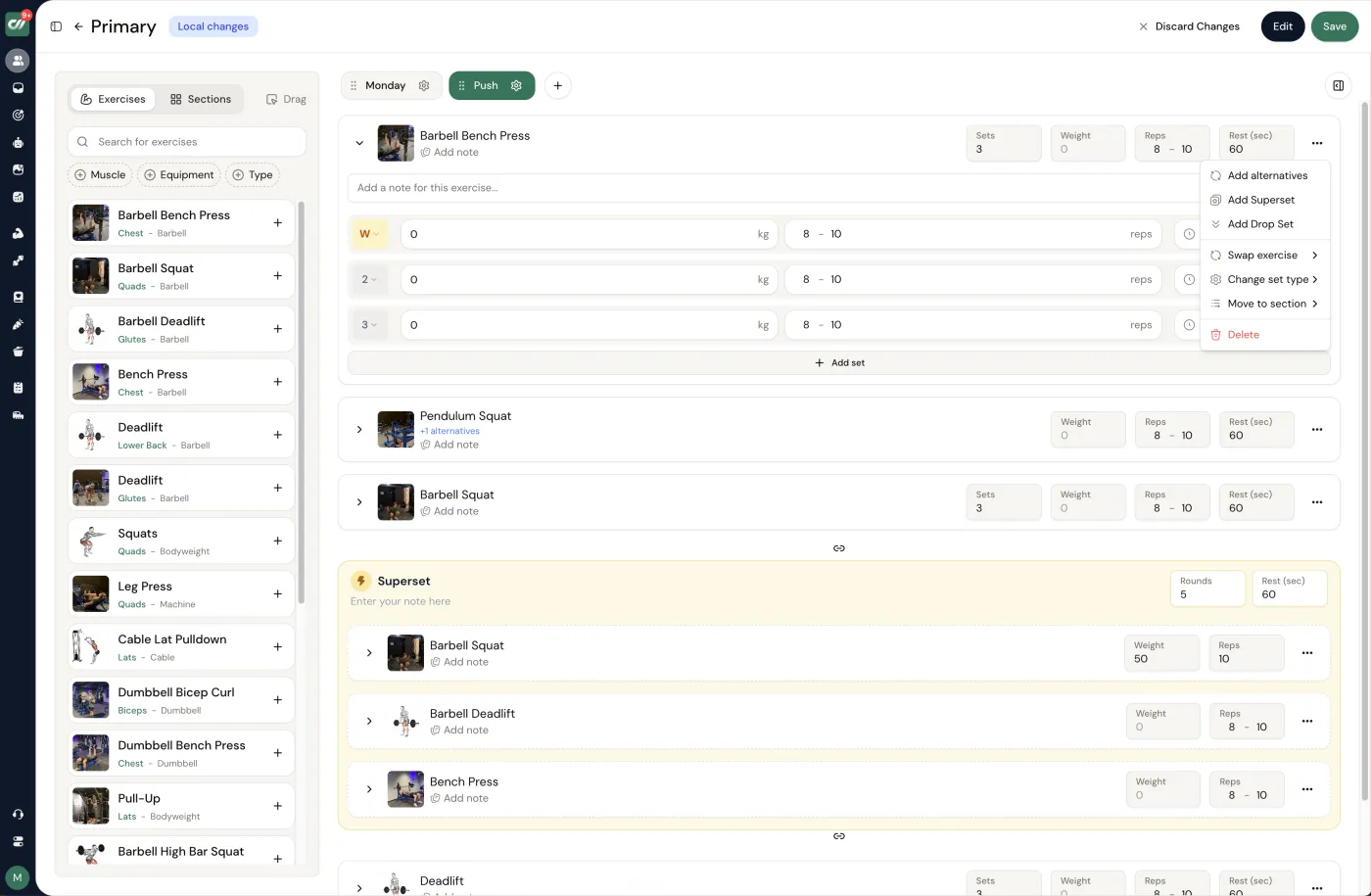
In Coachway you build each client's program in the workout builder from a 1,800+ exercise library with video demos, and the client logs every set in the app on iOS or Android. Weekly check-in forms, in-app chat with voice notes and video messages, and monthly billing through your own Stripe account sit beside it; the subscription takes no share of your coaching revenue, and built-in payments cost 2.4 % per transaction.
What do first-year trainers get wrong?
Five things, according to the trainers who watch new coaches on the floor. The list below is drawn from the r/personaltraining thread on mistakes new coaches make without realising they are costly, plus the 14-lessons thread; the table under it is one trainer's write-up of their first full year, with what to do about each lesson in month one.
- Working on retention before there is anyone to retain. The 22-year trainer in the 14-lessons thread: "Early in your career, you need to focus really hard on client acquisition. You can't focus on retention until you have clients to retain."
- Buying a second certificate instead of a first client. The same theme, from u/Wellness_Movement's step-by-step guide: more certifications is not necessarily better than fewer.
- Programming for the trainer, not the client. The mistakes thread's recurring complaint: new coaches run their own training style on a beginner who needed a walk and a squat pattern.
- Burning out in the first weeks. In the step-by-step thread, u/BigNo780 wrote "I'm 5 weeks in and already burned out." Early-morning and late-evening splits with an empty afternoon are the common cause; set your hours before the diary sets them for you.
- Forgetting the small human things. A 67-year-old client, u/ecoNina, in the 14-lessons thread: "acknowledge their bday, any big milestone, just a text is fine."
| Lesson | The report | What to do in month one |
|---|---|---|
| The qualification is the easy part | The UK trainer who wrote up their first full year called the Level 2 and 3 qualifications "easy" and "sort of fluff", and kept buying books on mobility, pain and habit coaching afterwards. | Pick one book on coaching people, not on anatomy, and read it before your first paid session. |
| Older clients make you a better trainer | The same trainer reported that 75 percent of their clients were over 65 when they started. | Do not filter your first enquiries by age or ambition. The clients who need patience teach the most. |
| Do not give away free taster sessions | The thread's advice was a heavily discounted first session instead of a free one; one commenter put it as still going home with 5 to 10 pounds even when the person does not sign. | Set a first-session price now, before anyone asks, and write it on your booking page. |
| Get a coaching app early | "It will cost you, but most have low costs with low clients", in the first-year thread's words. | You do not need it for your first three in-person clients. Have it chosen before your first remote one. |
Source: r/personaltraining, "Things I've learnt from my first full year as a PT", January 2026, and its comments. One trainer's year, reported as such.
The first year's numbers are simpler than they feel: your rate times your sessions per week times your working weeks, minus the gym split and your costs. Put your own inputs into the personal trainer income calculator before you set a rate, and treat any average you read online as the shape of the market, not a target. The ranges by model, with their sources, are in how much a personal trainer makes.
When should you go online?
The convention among trainers is three to five years in person first, and it is a convention, not a rule. In the r/personaltraining thread "Before you start online coaching", u/Material_Slip_1025 laid out the 3-to-5-years position: online clients cannot be watched, so the coach needs enough in-person reps to read a check-in the way they would read a face. u/Nkklllll argued the opposite way round, that a coach should commit to one model or the other rather than drift between them. Both agree on the underlying point: online coaching is a different job, and it is easier to learn it once the coaching itself is not new.
The practical marker is not a year count but a client count. When you can hold a client for six months in person, keep them progressing through a bad month, and explain a change in one message, the online version of that work is learnable. The move itself, from pricing a monthly relationship to keeping some in-person income during the transition, is the subject of how to become an online fitness coach.
Where does the first online client live?
In a coaching platform, not in a chat app. For the first in-person clients, a spreadsheet and messaging are fine. The moment a client is remote, their program, check-ins, photos, messages and payment need one place, or the first-year trainer in the table above ends up rebuilding it from screenshots. Coachway runs all of that from one tab at EUR 69 per month for up to 5 clients plus EUR 9 per additional client, every feature included, with a 14-day free trial that asks for a card and can be cancelled any time under Billing. Whichever platform you choose, choose it before the first remote client, not after; the app shortlist for a trainer going remote compares the main options.
How do you turn the seven steps into a month-by-month plan with ChatGPT?
Paste the seven steps and your situation, and ask for the order and a month-by-month plan; the prompt makes the model ask one question before it assumes a certification body. The rules that keep a prompt from sounding like AI are in prompt engineering for fitness coaches.
The seven steps, in your order
When to use it: Once you have read the seven steps and know your country, hours, budget and timeline.
What to paste in: The seven-step table from this page and four facts about you: country, hours a week you can study, budget, months you have.
You are helping me plan my route to becoming a personal trainer. I am pasting the seven steps from a guide I trust and my situation: country, hours a week I can study, budget, and how many months I have. Before you write anything, ask me one question: which certification bodies are recognised where I live, if you are not certain. Then give me the seven steps in the order that fits my situation as a month-by-month plan, one line per month, with the cost line from the table next to each step. Use only the figures in the table; do not add prices or timelines of your own. No motivation, no filler, plain sentences.

THE STEPS
[PASTE THE SEVEN-STEP TABLE]

MY SITUATION
Country: [COUNTRY] Study hours a week: [N] Budget: [AMOUNT] Months available: [N]
Frequently asked questions about becoming a personal trainer.
How long does it take to become a personal trainer?
Most people take three to six months from enrolling to passing: ACE quotes three to six months for its self-study packages, and the exam-only bodies depend on how fast you study. Add a couple of weeks for CPR, insurance and the legal basics, and the first three months of coaching hours before you charge full rate.
How much does it cost to become a personal trainer?
Roughly USD 500 to 2,000 all in. Self-study packages from NASM, ACE or ISSA list at about USD 999 to 1,399 but discount heavily; exam-only bodies like NSCA and ACSM charge around USD 300 to 435 plus your own study materials. Add CPR, liability insurance and starter tools. Our cost guide itemises each line.
Do you need a degree to become a personal trainer?
No. The mainstream certifications (NASM, ACE, ISSA, NSCA-CPT, ACSM-CPT) require a high school diploma or equivalent, being 18 and a current CPR/AED certificate, not a degree. A degree matters for strength and conditioning roles with teams and colleges, where the CSCS often expects one.
Can you become a personal trainer online?
Yes. Every major certification can be studied online and several offer remote exams; ISSA is popular with self-paced learners for that reason. What you cannot get online is coaching hours with real people in front of you, which is why most experienced trainers recommend in-person work first, even briefly.
Which personal trainer certification is best?
Any NCCA-accredited one is the baseline employers and insurers look for; NASM, ACE, ISSA, NSCA and ACSM all qualify. Pick on budget, how you learn and the audience you want to convince. A common piece of advice from working trainers is that more certifications is not necessarily better than fewer.
How much do personal trainers make?
It depends on rate, volume and model. As a rough market range, in-person sessions commonly run about EUR 40 to 90 an hour before a gym split, and online coaching is priced per client per month. Run your own numbers in the personal trainer income calculator rather than trusting an average; our guide to how much a personal trainer makes has the ranges by model.
Can you become a personal trainer without working in a gym?
Yes, and some trainers do go straight to independent or online work. The more common advice from experienced trainers is to work as an employee first so you can focus on training people and decide whether you want to do it long term, then leave with the hours behind you.
What is the first step to becoming a personal trainer?
Choose one accredited certification and enrol. Everything else on this page, from insurance to first clients, sits behind that decision, and the cost and timeline are set by which route you pick.
Should a new personal trainer offer free taster sessions?
No, according to the trainers who have tried both. A heavily discounted first session filters for people who value the work and still pays you something when they do not sign; a free session attracts people who wanted a free workout.
Can ChatGPT plan my route to becoming a personal trainer?
It can order the seven steps on this page into a month-by-month plan from your country, study hours, budget and timeline, using the cost and time figures in the table. Make it ask which certification bodies are recognised where you live before it assumes one, and treat its plan as a draft you check against the providers' own pages.
Keep reading
all guidesHow much does it cost to become a personal trainer? (2026)
The real 2026 cost of becoming a personal trainer: verified certification prices, the startup costs beyond the cert, and what you can safely skip at the start.
Read the guideBest personal trainer certifications for online coaching (2026)
A neutral, hedged comparison of NASM, ACE, ISSA, NCSF and NSCA for coaches who want to train clients online: cost, recognition, and who each fits. Then the part cert guides skip - a credential makes you credible, but building the online business is the bigger leap.
Read the guidePersonal Trainer Legal Requirements (2026 Checklist)
A jurisdiction-aware checklist of personal trainer legal requirements: certification, liability insurance, business registration, contracts and waivers, and data/GDPR for online clients - written generally, with a note to verify your local rules.
Read the guideHow to Become an Online Fitness Coach (2026 guide)
The honest path from in-person PT to online coach: why the hours-for-money model caps you, what actually transfers, and the 5 steps to start.
Read the guideFree tools for this: Coaching Profit Calculator · Client Capacity Calculator · Coaching Rate Calculator
Ready-made templates: Client Onboarding Checklist · Coaching Contract Template
See what Coachway can do for your coaching business
Coachway was built on knowledge from working with 150 online coaches over 6+ years, who all hit the same wall - slow platforms, clunky workflows, wasted hours. Start your 14-day free trial and see what we fixed - the whole platform, no charge today, cancel anytime under Billing.