


What is a coaching cohort?
What is a coaching cohort? It is a group of clients who start a coaching program on the same date and move through it together on one fixed timeline, so everyone is on the same week at the same time. Instead of joining whenever they buy, members share a start, a finish and the momentum in between. This page defines the term and shows how a cohort differs from a rolling or evergreen group on structure, momentum and retention.
By Markus Evers · Updated August 2026
definition
A coaching cohort is a group of clients who begin the same coaching program together on a fixed start date and progress through it on one shared timeline, finishing together. The program is built once and delivered to the whole group, while each member still gets individual check-ins. The synchronised schedule is what separates a cohort from an evergreen group.
How is a cohort different from a rolling or evergreen group?
Both deliver one program to many clients, so the difference is not the content but the clock. A cohort synchronizes everyone onto a shared timeline; an evergreen group lets each member run on their own. That single choice changes how the program sells, how the community feels and how well people finish.
| Cohort | Rolling / evergreen group | |
|---|---|---|
| Start | One fixed date for everyone | Whenever a member joins |
| Timeline | Shared, same week for all | Individual, everyone on their own week |
| Community feel | Tight, moving together | Looser, mixed stages |
| Selling | In launch windows | Continuous, any time |
| Best when | You want momentum and completion | You want steady, always-on enrolment |
Most new group programs start as cohorts to build proof and energy, then add an evergreen on-ramp once the program is dialed in. If you are still deciding whether a group is right for you at all, start with what is group coaching.
Why does a coaching cohort improve retention?
The shared timeline is the engine. When a whole cohort starts together and can see each other's progress, no one wants to be the member who quietly falls behind at week three, and that peer momentum keeps people moving through the hard middle weeks. Cohort-based programs are widely reported to finish stronger than open-access ones, which is exactly why coaches reach for a cohort when completion and results matter more than always-on sales.
Shared start
One date sets the pace for everyone, so the group has energy from day one instead of trickling in.
Peer momentum
Members see the cohort progressing together, and that visible pace pulls stragglers along through the middle weeks.
Individual check-ins
A personal weekly reply on top of the shared timeline means no one becomes a face in the crowd.
A cohort still needs the same three parts as any group program: shared programming, a community and individual accountability. For the full build, from structure to keeping members engaged, see how to run online group coaching.
Running a cohort without hand-holding every member
A cohort only stays profitable because the heavy work is built once and reused across the group. In Coachway, the platform we make for online coaches, one program, one meal plan and one set of check-in forms carry the whole cohort, while automations send the predictable reminders and follow-ups so your time goes to personal replies rather than admin. Coachway is EUR 69 per month with your first 5 clients included and EUR 9 for each additional client, every feature included, so the cost of adding a cohort member stays predictable as the group grows. New accounts get a 14-day free trial with EUR 0 charged today.
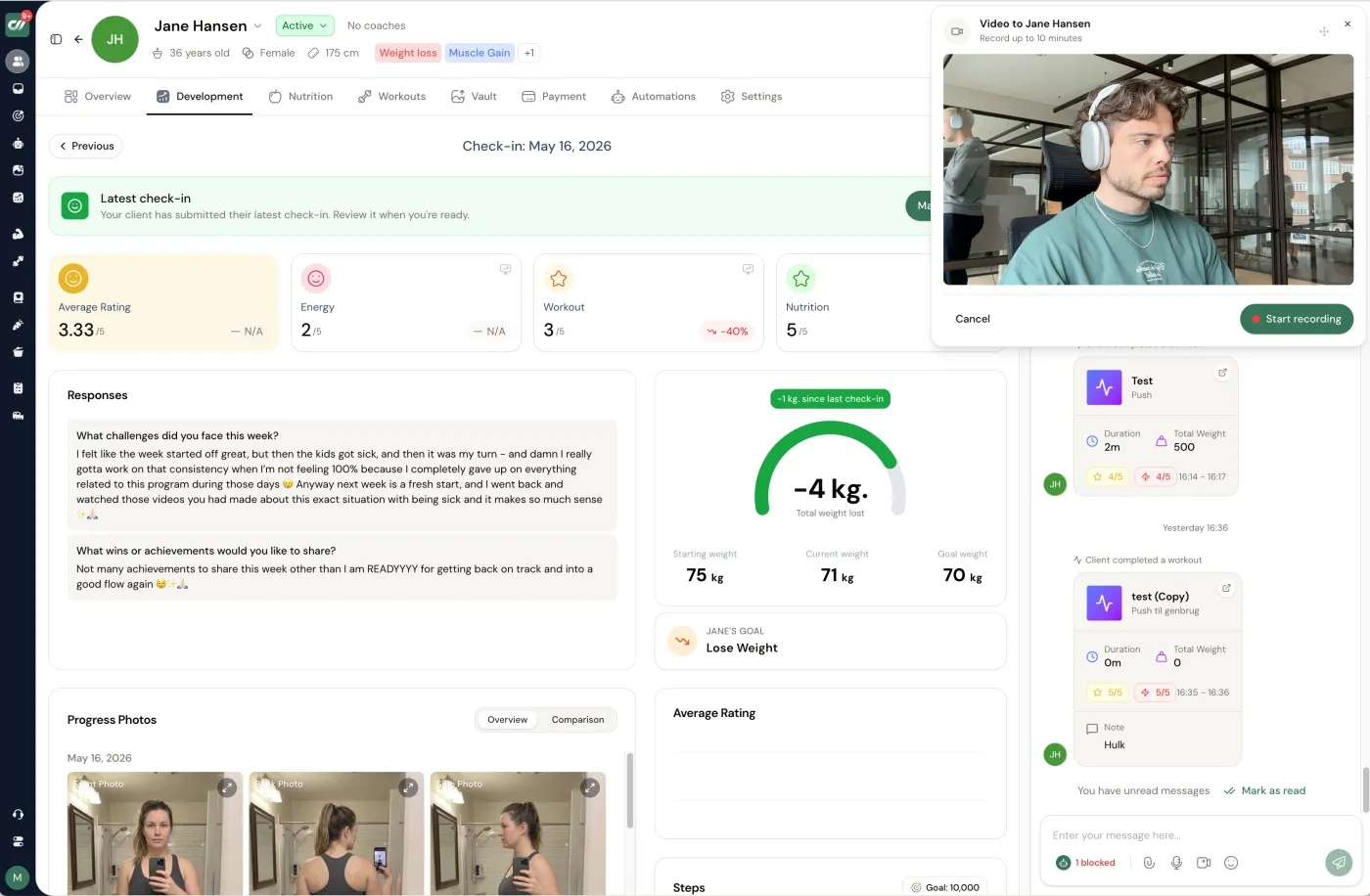
For the full feature checklist a cohort needs, from community to broadcasts to check-ins at scale, see group coaching software, or book a 15-minute demo to see it on your own program.
Coaching cohorts, common questions
What is the difference between a coaching cohort and a rolling or evergreen group?
A cohort starts everyone together on a fixed date and moves through the program on one shared timeline, so members are always on the same week at the same time. A rolling or evergreen group lets people join whenever they buy and start at their own week one, which is easier to sell continuously but leaves everyone at a different stage. Cohorts trade constant enrolment for a tighter, more accountable group.
How long does a coaching cohort usually run?
Most fitness and nutrition cohorts run as a fixed block, commonly 8 to 12 weeks, with a clear start and end date so the program has a shape and a finish line. Some coaches run a shorter 6-week challenge cohort as an entry offer and a longer 12-week transformation cohort as the main program. The point is the fixed window, not the exact number of weeks.
How big should a coaching cohort be?
There is no fixed number, because the program is built once and reused rather than rewritten per member. The real limit is how many weekly check-ins you can review and reply to personally. With one shared program, individual check-in forms and automations handling the predictable reminders, a coach can support a meaningfully larger cohort than a fully bespoke 1-on-1 model allows, while still giving each member a personal reply.
Do coaching cohorts really improve retention?
A shared start date and a visible group create momentum that an evergreen drip cannot: a member who sees the cohort moving forward together is far less likely to be the one who quietly drops off at week three. Cohort-based programs are widely reported to see higher completion than open-access ones, though you should treat that as directional and confirm it against your own numbers.
Can you run more than one cohort at a time?
Yes. Once a program is built, launching a second cohort is mostly a matter of a new start date and a new group space, since the training plan, meal plan and check-in forms are all reusable. Many coaches run staggered cohorts every one or two months, which keeps enrolment predictable while each group still gets the tight, on-the-same-week feel of a fixed cohort.
Once you have decided to run a cohort, the next question is the number. Our online coaching pricing guide covers how to price a cohort place against a 1-on-1 rate.
Keep reading
all guidesWill Harlow on Strength Training Over 50 (Coach Breakdown)
Will Harlow's minimum-effective-dose strength approach for clients over 50, broken down for coaches: a small, consistent dose focused on the movements that preserve independence, programmed scope-aware.
Read the guideEric Cressey on Rotational Power (Coach Breakdown)
Eric Cressey on why hip-to-shoulder separation - not raw strength alone - unlocks power for rotational-sport athletes, broken down for coaches with how to program the sequencing and ballistic work.
Read the guideJoel Jamieson on Conditioning (Coach Breakdown)
Joel Jamieson's energy-system conditioning, broken down for coaches: build the aerobic base first, layer a smaller dose of high-intensity on top, on one repeatable weekly template - not random HIIT.
Read the guideFree tools for this: Client Check-in Builder · Client Onboarding Builder · Coaching Business Health Check
See what Coachway can do for your coaching business
Coachway was built on knowledge from working with 150 online coaches over 6+ years, who all hit the same wall - slow platforms, clunky workflows, wasted hours. Start your 14-day free trial and see what we fixed - the whole platform, no charge today, cancel anytime under Billing.


