


How to coach HYROX athletes - the format, the fatigue, and the plan.
HYROX is a standardised indoor fitness race: eight 1 km runs, each one followed by a functional workout station, done back to back for time. Coaching an athlete for it is not the same as coaching a runner or a CrossFitter. The event rewards a specific blend of aerobic engine, strength endurance, and the ability to run well on legs that are already loaded. This is how to build all three, rehearse the stations, and turn HYROX prep into a clean coaching offer.
By Markus Evers · Updated August 2026
the short version
To coach a HYROX athlete, build two engines in parallel - an aerobic base for the eight kilometres of running and strength endurance for the eight stations - then teach the athlete to run on tired legs and pace the whole race instead of blowing up on the sled. Assess where the client actually is, split the week across running, strength, and station practice under fatigue, rehearse the exact movements in the last block, and taper into race week. HYROX is not CrossFit and it is not a road race, so it should not be programmed like either.
What the format actually demands.
HYROX is the same test every time, which is exactly why you can train for it so precisely. The athlete runs 1 km, does one station, runs 1 km, does the next, and repeats until eight runs and eight stations are done - always in the same order, so there are no surprises on the day, only whether the athlete built the right capacities. Most first-timers finish in the 75 to 100 minute range; elites go well under an hour.
| Order | Station (after each 1 km run) | What it taxes |
|---|---|---|
| 1 | 1000 m SkiErg | Upper-body pull, aerobic power, sets the early pacing tone |
| 2 | 50 m Sled Push | Leg drive under heavy load, the classic early blow-up |
| 3 | 50 m Sled Pull | Grip, back, and the arms right before more running |
| 4 | 80 m Burpee Broad Jumps | Full-body, heart rate spike, technique under fatigue |
| 5 | 1000 m Row | Aerobic, a chance to recover the legs if paced well |
| 6 | 200 m Farmers Carry | Grip endurance, trunk, forearms already fatigued |
| 7 | 100 m Sandbag Lunges | Quads and glutes, wrecks the legs before the last runs |
| 8 | 100 Wall Balls | The finisher - legs, shoulders, and grit on empty |
Exact weights and target heights differ by division and by gender, and the standards can be updated, so always program to the specific division your client is entering rather than a number you half-remember. Whatever the weights, four demands show up in almost every race: compromised running, sled work, grip endurance, and the wall balls at the end when the athlete has nothing left. Build for those and you have built for the event.
One thing the results sheet never shows: the roxzone, the transition space between each run and station. Time leaks there. Teaching a client to move with purpose through transitions and start the next run controlled rather than sprinting is free speed that costs nothing in fitness. HYROX also sits neatly inside the broader idea of hybrid coaching, where strength and endurance are trained as one system rather than two rival goals.
How to assess a new HYROX client.
Before you write a single session, find out which engine is behind. Almost every new HYROX client leans one way: strong but cannot run, or runs well but cannot move load. Your first block attacks the weaker engine while maintaining the stronger one, so the assessment is the plan.
The running side
A recent 5 km time and an easy pace tell you the aerobic base. A running pace calculator turns that into training paces, and a race time predictor gives a rough finish estimate to set expectations. Then check how pace holds after a hard effort, not just when fresh.
The strength side
Can the client push and pull a loaded sled without stalling? Hold a heavy farmers carry for distance? Complete a block of wall balls and lunges without form falling apart? These are strength-endurance checks, not one-rep maxes - you are grading how long good movement lasts, not peak force.
The fatigue response
Run 1 km, do 50 wall balls, run 1 km again and watch the second run. The drop-off is the most useful number you will collect, because it measures the exact quality HYROX punishes: running on legs that are already cooked.
History and logistics
Training age, injury history, equipment access, weekly hours, and the race date. A client with a sled and rower at home gets a different plan from one in a commercial gym. Match the program to the life, not the ideal.
Anchor the whole block to a real race date and work backwards. If a heart-rate approach fits the athlete, a heart rate zone calculator gives you clean zones to keep easy days genuinely easy and hard days honestly hard, which is where most self-coached HYROX athletes go wrong.
The programming split: three jobs, one week.
A HYROX week serves three jobs at once - build the aerobic engine, build strength endurance, and rehearse the event under fatigue. On four to five training days, a workable default looks like this, adjusted around the client's weaker engine and available time.
Running, roughly half the week. One easy aerobic run for volume, one threshold or interval session for race pace, and crucially some compromised running - short runs sandwiched between station work so the legs learn to turn over while loaded. Fresh running alone does not transfer to a race where running is never fresh. Keep the easy runs genuinely easy and the hard sessions genuinely hard - the polarized split in our Stephen Seiler breakdown - so the aerobic base builds instead of blurring into the grey zone.
Strength, held not chased. Two sessions built on the patterns the event uses: squats, hinges, lunges, carries, and pressing or pulling for the ski and sled. You are training strength endurance and durability, not a powerlifting peak, so the intent is to keep good movement alive deep into fatigue.
Station practice under fatigue. One or two sessions that stitch runs and stations together the way the race does - part-simulations early in the block, closer to full run-throughs as race day nears. This is where the athlete learns pacing, transitions, and exactly how the sled feels after a kilometre of running.
Periodise it in blocks. The first phase leans on base building - more easy volume, more general strength - and the final three to four weeks tilt hard toward specificity: full or near-full simulations, race-pace running, and the exact station standards for the client's division. The taper trims volume while keeping a little intensity so the athlete arrives fresh but not flat.
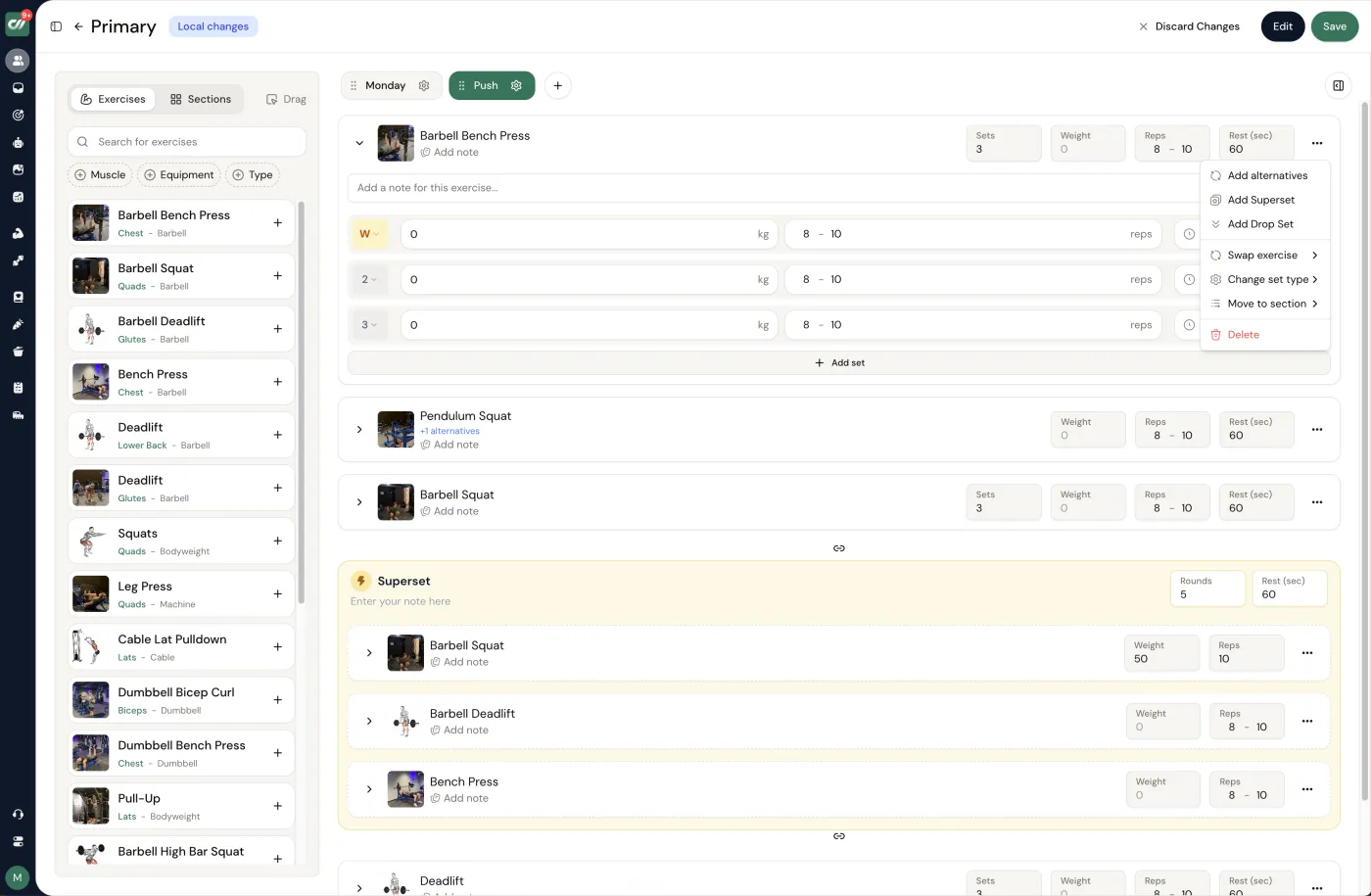
Delivering that split cleanly is a software job as much as a coaching one. Building the run-and-station sessions, holding the strength progressions, and pushing the whole week to the client's phone is what a workout builder and client app are for. If you are weighing the tooling specifically for this, the companion guide on HYROX coaching software goes deeper on what to look for. For the wider picture beyond HYROX, our guide to strength and conditioning software covers what to look for across your athlete programming. Coaches arriving from a CrossFit box can also read the quick answer on remote programming for CrossFit and strength coaches.
The two ways coaches get HYROX wrong.
Almost every mistake collapses into one of two framing errors. A coach either treats HYROX as CrossFit or treats it as a running race. Both leave a real gap on race day, and both are easy to make if you come from one world and not the other.
Treating it like CrossFit
HYROX has no muscle-ups, no barbell cycling, no skill lottery - the same eight stations in the same order. So the varied high-skill work that defines CrossFit programming is mostly wasted here. Coaches from that background tend to over-cook intensity and under-build the running engine, which is where races are won and lost.
Treating it like a road race
Endurance coaches sometimes bury a client in mileage and neglect load entirely. Then the athlete meets the sled and farmers carry with no strength endurance and stalls, bleeding minutes on the exact stations pure runners fear. A HYROX athlete who cannot move the sled has trained the wrong half of the event.
The quieter errors sit underneath those two: never practising compromised running, ignoring grip until it fails on the pull and the carry, going out too hard on the SkiErg and first sled, and treating the roxzone as rest. Name these for the client early and they stop being surprises.
Doubles vs singles, and getting race week right.
Which division a client enters changes the day more than beginners expect, and the last seven days can add or cost minutes on their own. Both are coaching decisions, not afterthoughts.
Doubles vs singles
In doubles, two athletes share each station while both still run all eight kilometres, so station load is roughly halved and pacing becomes a shared tactic - who takes which reps, how you split the sled. It is the friendlier first race. Singles is the full individual test with every rep on one set of shoulders, best once a client knows the format. Pro divisions raise the weights again and suit experienced athletes only.
Race week
Cut volume, keep a couple of short sharp efforts so the legs stay awake, and rehearse the opening pace once more. Walk the client through their plan station by station: target splits, where to hold back, the grip strategy for the pull and carry, and how to attack the wall balls in manageable sets. A calm, specific plan beats a nervous all-out start every time.
The pacing headline is worth repeating until it sticks: the race is won in the back half. An athlete who starts controlled and still has legs for the sandbag lunges and wall balls will pass a field of people who sprinted the SkiErg and paid for it across the last three runs.
How coaches package HYROX prep.
HYROX has a feature most coaching niches lack: a hard finish line on a calendar. That makes it ideal to sell as a time-boxed block rather than an open-ended subscription, since the client already knows the date they are training for.
Sell the block, not the month
A 12-week or 16-week race prep with programming, weekly check-ins, and a race-week taper is easy to say yes to because it has a beginning and an end. The finish line does the selling, and the review at the end is a natural point to re-sign for a new goal. Price it for the outcome, not the workout count - the mechanics are in setting your pricing.
Tooling that does not punish growth
A shared prep block for a small squad can run alongside your individual clients. Coachway is EUR 69 / month for up to 5 clients, then EUR 9 per additional client, every feature included, with a 14-day trial (card required). See the full pricing if you are costing out a race-prep offer.
Frequently asked questions about coaching HYROX athletes.
Is coaching a HYROX athlete the same as CrossFit programming?
No. CrossFit rewards varied, high-skill movements and short intense workouts. HYROX is the same eight stations in the same order every time, wrapped around eight kilometres of running, so it rewards a strong aerobic engine, strength endurance, and pacing over roughly 60 to 100 minutes. If you program a HYROX client like a CrossFitter you tend to over-index on skill and intensity and under-build the running. If you program them like a runner you leave them unable to move the sled. The event sits in between, and the plan has to as well.
How long does it take to prepare a client for their first HYROX?
For a client who already trains, plan for roughly 8 to 16 weeks depending on their starting point. Someone with a solid running base but little strength endurance needs sled and grip work built up carefully. Someone strong who never runs needs aerobic volume introduced gradually so the legs adapt. The first block is about building the two engines; the last 3 to 4 weeks are about rehearsing the exact stations under fatigue and dialling in pacing.
Should a new HYROX client start with doubles or singles?
For a first-timer, doubles is often the friendlier entry point. In doubles, two athletes share each workout station while both still run all eight kilometres, so the station load is roughly halved and the day feels less like a solo grind. Singles is the full individual test and suits athletes who want a clean personal benchmark. Many coaches use a doubles race to introduce the format, then move the client to singles once they know what the roxzone and the fatigue actually feel like.
How much of a HYROX plan should be running?
Running is half the event by distance, so it deserves close to half the plan, but the important part is what kind of running. Steady aerobic volume builds the base, and threshold or interval work sharpens race pace, but the piece most beginners skip is compromised running: running immediately after a station while the legs are already loaded. A plan that only trains fresh running leaves the athlete surprised on race day, because HYROX running never happens fresh.
How should a coach price HYROX race prep?
Most coaches package it as a time-boxed block tied to a target race rather than an open-ended monthly plan, for example a 12-week or 16-week prep with programming, weekly check-ins, and a race-week taper. Pricing follows the same logic as any coaching offer: charge for the outcome and the attention, not the number of workouts. A defined block with a clear finish line is easier to sell than an endless subscription, and it gives both of you a natural point to review results and re-sign. See setting your pricing for the mechanics.
Keep reading
all guidesWhat is hybrid coaching? In-person plus online, defined
Hybrid coaching blends in-person sessions with app-based online delivery between them: the client trains face to face on a set cadence while the plan, check-ins and messaging run through an app. A clear definition, how the two halves fit, and where it sits between in-person and fully online.
Read the guideCrossFit Coaching Software (2026 Guide for Box Coaches)
CrossFit coaching software for remote and hybrid box coaches: how to program WODs and strength, track benchmarks and PRs with per-set logging, build community, and run the client app and payments in one place - plus an honest read on the wider field.
Read the guideHow to set pricing as an online fitness coach
The A times B times C revenue equation, the 6-9-12 month package structure, and the extension call that adds 30 to 50 percent to client lifetime value. Built from the Coachway team playbook.
Read the guideFree tools for this: Interval Walking Calculator · Rucking Calorie Calculator · Sweat Rate Calculator for Hydration Planning
See what Coachway can do for your coaching business
Coachway was built on knowledge from working with 150 online coaches over 6+ years, who all hit the same wall - slow platforms, clunky workflows, wasted hours. Start your 14-day free trial and see what we fixed - the whole platform, no charge today, cancel anytime under Billing.


