


What is hybrid coaching?
What is hybrid coaching? It is a model that blends in-person sessions with app-based online delivery between them. The client still trains with the coach face to face on a set cadence, and everything in between runs through a coaching app. It is the middle ground between fully in-person personal training and fully online coaching, and it is where most gym-floor trainers land first when they start moving their business online. This page defines the model, explains how the two halves fit together, and shows where it sits against the two pure formats.
By Markus Evers · Updated September 2026
definition
Hybrid coaching is a coaching model that blends in-person sessions with app-based online delivery between them. The client still trains with the coach face to face on a set cadence (weekly, fortnightly or monthly) and everything in between, the program, check-ins, messaging, nutrition and tracking, runs through a coaching app. Most gym-floor trainers land here first when moving online.
How the in-person and online halves fit together
Hybrid is not two disconnected services sold as one. The point is that each half does the job it is best at, and the app is what holds the week together between the sessions in the room.
The in-person session
The face-to-face time on a set cadence goes to what only happens in the room: coaching technique, assessing movement, and the hands-on trust that keeps a client coming back.
The app between sessions
The plan the client follows on their own, plus check-ins, messaging, nutrition and progress tracking, so the days between sessions are guided instead of guessed at.
The accountability loop
A check-in on a set cadence with photos, measurements and notes closes the loop, so the next in-person session starts from data rather than from memory.
The delivery spine between sessions is the same as any remote coaching, just anchored to a live session. If you are working out how to rebuild the feedback loop the gym floor gave you for free, how to do client check-ins online covers the cadence in full.
Where hybrid sits between in-person and fully online
Hybrid is defined by what it keeps and what it hands to the app. In-person training keeps every hour live; fully online coaching hands every hour to the app; hybrid keeps the sessions that matter most and delivers the rest online. Reading the three formats side by side is the fastest way to see why so many trainers settle in the middle.
| In-person training | Hybrid coaching | Fully online coaching | |
|---|---|---|---|
| Live sessions | Every session in the room | A set cadence in the room | None, or occasional video calls |
| Between sessions | Little to no structured support | Plan, check-ins and messaging in an app | The whole service runs in the app |
| Scalability | Capped by hours in the room | Higher, fewer live hours per client | Highest, no live hours to fill |
| Best when | The client needs hands-on every session | The client wants live time plus daily guidance | The client is independent and remote |
For the fuller trade-off between the two pure formats, online personal training vs in-person training weighs accountability, cost and results on both sides, and online coaching business models puts hybrid next to one-to-one and group as a business decision.
Why gym-floor trainers land on hybrid first
Going straight from a full in-person book to a fully online one means rebuilding your whole delivery and your whole income at the same time. Hybrid removes that bet. You keep the in-person sessions that pay the rent, move two or three willing clients to a hybrid arrangement, and learn what breaks in the online half while the live half is still earning. Plenty of coaches never leave: a deliberate hybrid mix suits how they want to work, so it is a legitimate long-term home rather than only a stepping stone. Running the app side well is what makes the arrangement hold together, which is where a single coaching platform earns its place. If you are still choosing one, which coaching app to use when you move online has a short answer. The order in which to move clients across, one this month and one a month after, is the hybrid bridge, five steps.
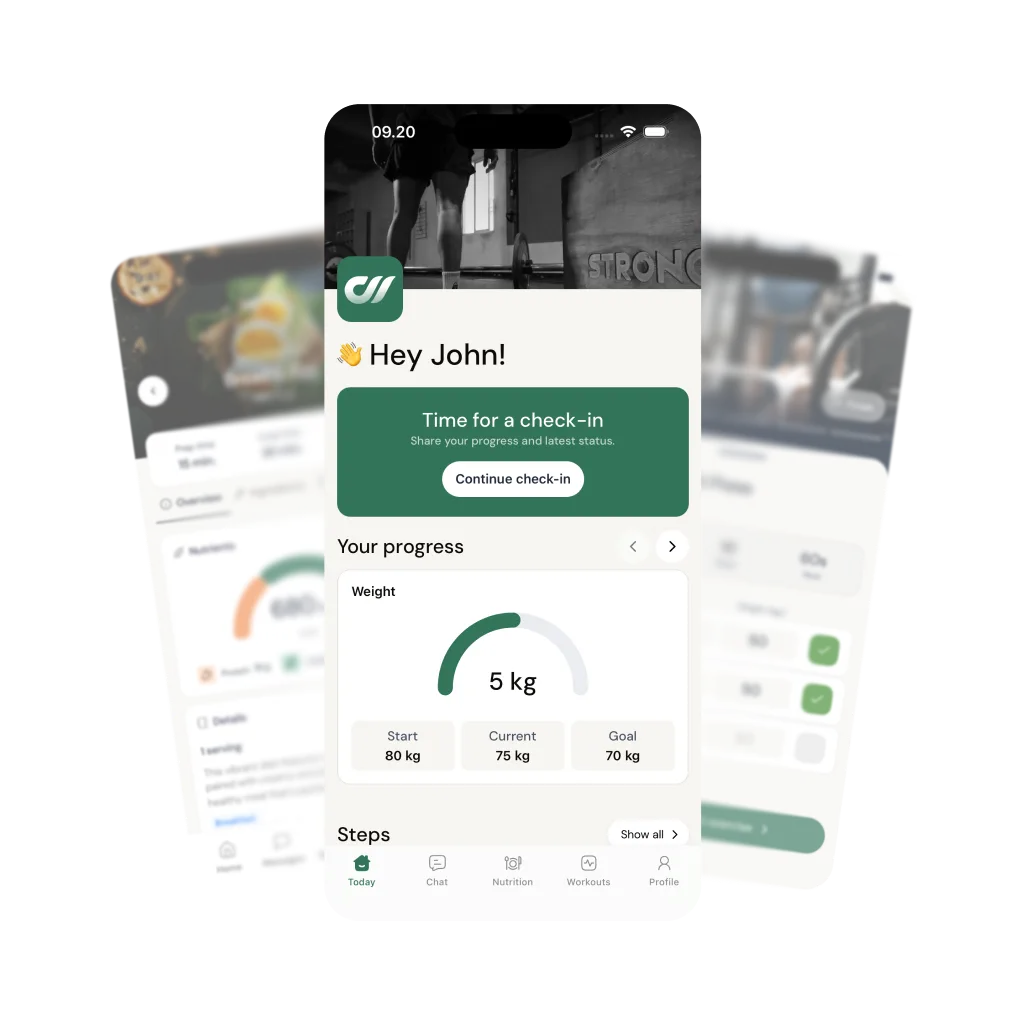
In Coachway, the platform we make for online coaches, the plan, check-ins, messaging, nutrition and progress tracking a hybrid client uses between sessions all live in one client app on iOS and Android, in the client's own language, and the same review lands on one tab for the coach, so the next in-person session starts from real data. Coachway is EUR 69 per month with your first 5 clients included and EUR 9 for each additional client, every feature included, so the online half of a hybrid practice costs the same whether you run five clients or fifty. The step-by-step version of this move is in how to transition from in-person to online personal training, or book a 15-minute demo to see the client app on your own clients.
Hybrid coaching, common questions
What is hybrid coaching?
Hybrid coaching is a coaching model that blends in-person sessions with app-based online delivery between them. The client trains with the coach face to face on a set cadence, and the program, check-ins, messaging and progress tracking in between run through a coaching app. It sits between fully in-person training and fully online coaching, and it is where most gym-floor trainers land first when they start moving online.
How is hybrid coaching different from fully online coaching?
The difference is the live session. Fully online coaching replaces the face-to-face hour entirely with remote delivery, so contact happens through the app, video calls and check-ins. Hybrid keeps a real in-person session on a set cadence and uses the app to carry the plan, accountability and messaging between those sessions. Hybrid trades some scalability for the hands-on coaching and observation that only happen in the room.
Why do in-person trainers usually start with hybrid?
Because it keeps the sessions that pay the bills while the online side is built underneath them. A trainer can move two or three willing clients to a hybrid arrangement, learn what breaks, and refine the online delivery without betting the rent on an unproven fully online offer. Many coaches run a deliberate hybrid mix for years because it suits how they want to work, not only as a stepping stone.
What do you actually deliver between the in-person sessions?
The same delivery spine as remote coaching: a training and nutrition plan the client follows on their own, a check-in on a set cadence with photos, measurements and notes, and direct messaging so questions get answered before the next session. The in-person time then goes to the things that need the room, like coaching technique, assessing movement and building the relationship.
Does hybrid coaching cost the client more than online?
Usually, because the client is paying for the coach's in-person time on top of the online delivery, and that live time is the real cost driver. There is no single market rate, but a hybrid arrangement typically sits above a fully online subscription with the same coach and below full one-to-one in-person training. Coaches usually charge a monthly subscription so income stays predictable regardless of how the sessions fall in a given month.
Keep reading
all guidesMicronutrients for Coaches: Vitamins & Minerals
What micronutrients are vs macros, why vitamins and minerals matter for training clients, a food-first approach, common gaps, and when to refer to a doctor or dietitian.
Read the guideDietary Fiber for Clients: A Coach Guide
What dietary fiber is, soluble vs insoluble, how much clients need (~14 g per 1,000 kcal), the best food sources, and how coaches use fiber to drive satiety and diet adherence.
Read the guideEating Out While Dieting: A Coach's Playbook
Eating out is not the enemy of a diet - poor structure around it is. The playbook for helping clients enjoy a restaurant meal and keep progress: check the menu first, lead with protein, watch liquid calories, estimate portions, 80/20.
Read the guideFree tools for this: Client Onboarding Builder · Coaching Business Health Check · Client Check-in Reader
See what Coachway can do for your coaching business
Coachway was built on knowledge from working with 150 online coaches over 6+ years, who all hit the same wall - slow platforms, clunky workflows, wasted hours. Start your 14-day free trial and see what we fixed - the whole platform, no charge today, cancel anytime under Billing.


