


Personal training business software - the layer beyond the workout.
Personal training business software is the operating layer beneath the training itself: the billing, client records, retention and reporting that keep a coaching business running once the workouts are written. It is the difference between delivering good sessions and running a good business - and for most trainers it is where a spreadsheet-plus-Stripe-plus-WhatsApp setup quietly starts to leak. This guide maps the four layers that actually matter, where the patchwork breaks, and when one all-in-one platform earns its place.
By Markus Evers · Updated August 2026
the short version
Personal training business software is everything the workout app is not: billing, client records, retention and reporting - the operation around the programming. Workout software answers what a client does in the gym; business software answers how the business gets run. Most solo trainers start with a spreadsheet, a Stripe link and a chat thread, which works until the manual joins between those tools cost more than the software would - usually somewhere past ten to twenty clients. The four layers to buy for are billing, a client CRM, structured retention, and reporting with a lead pipeline. You can assemble them as a stack of single-purpose tools or run them as one all-in-one platform; the honest comparison is total cost of ownership, tools plus the hours spent joining them.
What is personal training business software, really?
The phrase gets used loosely, so it helps to separate two things that often ship in the same product. Workout software is the training layer: the exercise library, the programming, the video demos, the client app someone trains from - what a dedicated online personal training platform is built to deliver. Personal training business software is the operating layer around it: how money is collected, where each client's history lives, how you spot the person who is drifting before they cancel, and what the month actually earned. A trainer can be excellent at the first and quietly drowning in the second, because the hard part of coaching at any real volume is rarely the programming - it is everything that surrounds a client from the moment they say yes to the moment they renew.
That surrounding layer is the same whether you deliver in person, online, or both. The bill still has to go out, the failed card still has to be recovered, the record still has to be findable, and the check-in still has to happen. What changes is only how you assemble it. Many trainers build it accidentally out of whatever tools they already had - a notes app, a bank of chat threads, a payment link - and never call it "business software" at all. Naming it is the first useful step, because once you can see the operation as a system, you can decide deliberately whether to keep stitching tools together or to run the whole thing in one place. The rest of this guide is about making that decision on evidence rather than by drift.
What does personal training business software actually need to do?
Strip away the marketing and the operation reduces to four jobs. Judge any tool, or any stack, on how well it does these - not on how long the feature list is.
1. Billing that collects without you chasing.
The single biggest silent leak in a coaching business is money that was owed and never collected - a failed card nobody followed up, a subscription that lapsed unnoticed, an invoice that went out late. Good billing means recurring subscriptions, planned invoices and payment plans with automatic reminders and failed-card retries, so revenue does not depend on you remembering. The question that matters most here is whose account gets paid: with your own Stripe account the money settles directly to you and nobody holds it in between. If you want the fuller picture, the payment and billing software comparison lays out who pays whom.
2. A client CRM you can see the whole book in.
A coaching business is a book of relationships, and a book you cannot see, you cannot manage. The CRM layer is one record per client - status, tags, current plan, last contact - laid out in a table rather than reconstructed from memory or scrolled out of a chat thread. It is what lets you answer "who has not checked in this week" or "who is coming up for renewal" in seconds instead of an afternoon. This is the layer trainers most often improvise with a spreadsheet, and it is the first one to buckle as the book grows. A dedicated client management setup is often what a coach is really reaching for when they say they have outgrown their app.
3. Retention you can act on before someone cancels.
Acquiring a client is expensive; keeping one is where the margin actually lives, so the software's retention job is to surface the warning signs early. Structured check-ins - this week's answers next to progress photos, measurements and the training log on one view - turn a vague sense that someone is fading into a specific, actionable read. The person who stops logging, whose ratings slide, who goes quiet for two weeks: those signals are worth catching while there is still time to intervene, not discovering them in a cancellation email. When the signals are scattered across a chat app, a tracking app and your own memory, they arrive too late to use.
4. Reporting and a pipeline that tell you where you stand.
Running a business blind is a choice, and the reporting layer is how you stop making it. On the front end that means a lead pipeline - new, contacted, qualified, won - so prospects move through visible stages instead of dying in your inbox. On the back end it means a clear read on what the month earned, who is at risk, and whether the business is growing or treading water. None of this needs to be elaborate; it needs to be visible and current. A coach who can see their pipeline and their numbers makes different, better decisions than one who is guessing, and the gap compounds every month you scale. If growth is the goal, the reporting layer is what makes scaling deliberate rather than chaotic.
Do I still need it if I run a spreadsheet, Stripe and WhatsApp?
For a handful of clients, honestly, no - the improvised stack works, and buying software before you need it is its own kind of waste. The reason to move is not that the spreadsheet is bad; it is that the joins between tools are manual, and manual joins multiply with every client you add. A name gets copied from the chat into the sheet. A subscription gets built in Stripe by hand. A failed card gets chased from an email you nearly missed. A client's history gets reconstructed by scrolling a thread. Each of these is small on its own, which is exactly why the cost hides - it never shows up as a broken thing, only as hours quietly consumed and the occasional warm client who slipped through a gap between two apps that do not talk to each other.
The tipping point is a total-cost-of-ownership question, not a feature question. Add up what the separate tools cost - a CRM, a billing tool, a scheduling app, a workout builder - and then add the harder number underneath it: the hours every week spent moving data between them and the revenue lost when something falls through. For most trainers that crossover lands somewhere between ten and twenty clients, the point where the admin of holding the book starts eating the time you would rather spend coaching or selling. Below it, keep the stack. Above it, the case for consolidating into one platform stops being about tidiness and starts being about capacity - how many clients you can actually hold before the joins own your week. It is the same logic behind costing a coaching software stack honestly rather than line by line.
All-in-one platform, or a stack of separate tools?
Once the four layers are the real product you are buying, the choice narrows to how they are delivered. A stack lets you pick a best-in-class tool for each job and pay for exactly what you use, at the cost of owning every join between them yourself. An all-in-one platform delivers the layers already connected - the billing knows about the client, the client record carries the check-ins, the pipeline hands a won lead straight into onboarding - at the cost of accepting one vendor's take on each job. Neither is universally right; the deciding factor is usually how much of your week you can afford to spend as an integrator.
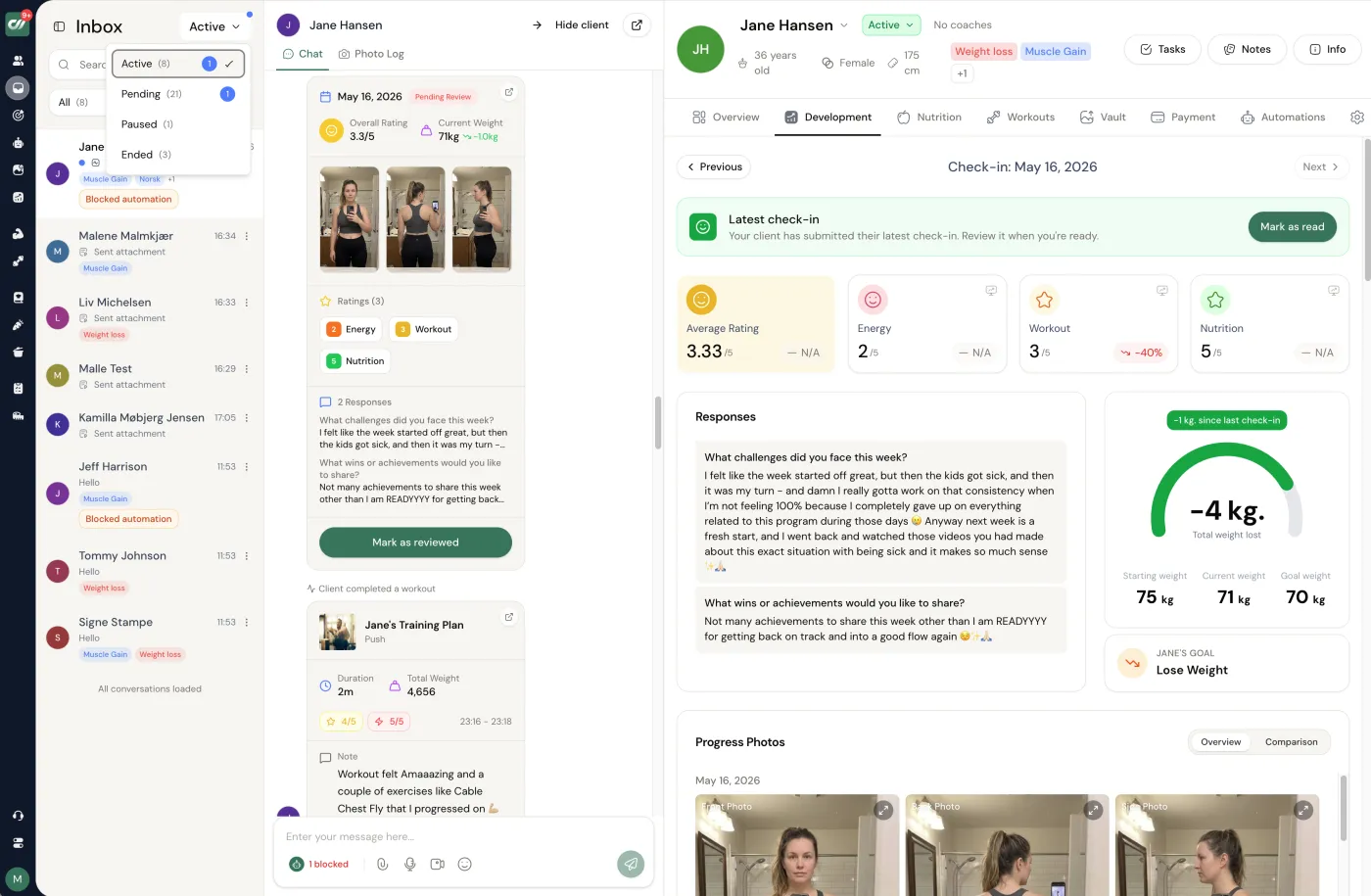
Coachway is the all-in-one end of that choice, built specifically for online coaches. The client CRM, structured check-ins, an embeddable lead pipeline that captures the full source trail, and billing all live on one screen - a Power Panel that puts the client list, the conversation and the live client file together, so nothing has to be reconstructed from a thread. Billing runs through your own Stripe account, so Coachway never holds your money; optional built-in payments carry a 2.4% per-transaction fee if you use them, and you can run your own Stripe checkout with no platform fee if you prefer. Pricing is one plan, not tiers: EUR 69 a month with your first five clients included, then EUR 9 for each additional client, with every feature in the plan. It is built on knowledge from working with 150 online coaches over 6+ years, which is why the layers are shaped around how coaches actually run a book rather than a generic CRM. The 14-day free trial starts with a card held securely by Stripe and cancels under Billing before it renews - or book a demo and see the whole operation on one screen first.
Frequently asked questions about personal training business software.
What is personal training business software?
Personal training business software is the operating layer beneath the training itself: the billing, client records, retention and reporting that keep a coaching business running once the workouts are written. Workout software answers what a client does in the gym; business software answers how the business around that client is run - how payments are collected, where each person's history lives, how you know who is drifting before they cancel, and what the month actually earned. Most solo trainers start with a workout app plus a payment link and a chat thread, then discover that the hard part of coaching at any scale is not the programming, it is everything that surrounds it. Business software is the name for that surrounding layer, whether it is stitched together from separate tools or delivered as one platform.
What is the difference between personal training business software and workout software?
Workout software builds and delivers programming: exercises, sets, video demos and a client app to train from. Personal training business software runs the operation around that programming: recurring billing and failed-card recovery, a client record with tags and status, check-ins and retention signals, a lead pipeline, and the reporting that tells you how the business is doing. The two overlap because the best platforms include both, but they answer different questions. A workout builder is judged on how good the training experience is; business software is judged on whether money gets collected, whether nobody falls through a gap, and whether you can run more clients without adding more admin. A coach can outgrow a pure workout app long before they outgrow their programming skill, simply because the business layer around it never scaled.
Do I still need business software if I already use a spreadsheet, Stripe and WhatsApp?
That stack works until it does not, and the failure is quiet. A spreadsheet, a raw Stripe dashboard and a chat app can carry a handful of clients, but each new client multiplies the manual joins between them: you copy a name from the chat into the sheet, set up a subscription in Stripe by hand, chase a failed card from an email you nearly missed, and reconstruct someone's history by scrolling a thread. Nothing is technically broken, so the cost hides - it shows up as hours lost to admin, as a churned client whose warning signs were spread across three tools, and as a ceiling on how many people you can hold before the joins consume your week. Business software earns its place when the manual joins between tools start costing more than the software would, which for most trainers is somewhere between ten and twenty clients.
What should personal training business software include?
Four layers do most of the work. Billing: recurring subscriptions, planned invoices, payment plans and automatic reminders, ideally settling into your own Stripe account so nobody holds your money for you. Client CRM: one record per client with status, tags, plans and last-contact date, so the whole book is visible in a table rather than reconstructed from memory. Retention: structured check-ins and the signals that flag a drifting client before they cancel, not after. Reporting and pipeline: a lead pipeline from new to won, and a clear read on what the month earned and who is at risk. Programming and a client app sit alongside these, but the four business layers are what separates a coaching business from a coach with a workout app. Anything beyond those - automations, forms, a branded app - is welcome, but it is the surrounding operation you are really buying.
How much does personal training business software cost?
It depends heavily on whether payments are included and whose Stripe account gets paid, so compare on model rather than headline price. A stack of single-purpose tools looks cheap line by line and adds up fast once you count the CRM, the billing tool, the scheduling app and the workout builder separately - and you still pay in the manual work of joining them. An all-in-one platform charges one subscription for the whole operation. Coachway, for example, is EUR 69 a month with your first five clients included and EUR 9 per additional client, with every feature in one plan and no tiers. The honest way to compare is total cost of ownership: add up the tool subscriptions plus the hours the joins cost you, and weigh that against a single platform where the layers are already connected.
The business layer is really four jobs joined together: billing that collects, a client record you can see the whole book in, retention you can act on, and reporting that makes scaling deliberate. Whether you stitch those from tools or run them in one platform, cost them by total ownership, not headline price.
Keep reading
all guidesGymkee review 2026: pricing, the AI copilot, strengths and gaps
Tiers from USD 34 to 349 a month, the Dwayne AI copilot and its credit caps, deep nutrition tools, 12 languages without the Nordics, and the white-label conditions.
Read the guideHevy Coach review 2026: pricing, strengths, gaps and alternatives
Bracket pricing from USD 25 a month, the clean logging-first client experience, what G2 reviewers praise and criticize, the deliberate gaps, and who it genuinely fits.
Read the guideQuickCoach review 2026: the free tier, the Pro price, and what happened
The genuinely free 20-client tier, Pro pricing around USD 30-39 a month, the Hale Health acquisition after the near-shutdown, the structural gaps, and the honest alternatives.
Read the guideSee what Coachway can do for your coaching business
Coachway was built on knowledge from working with 150 online coaches over 6+ years, who all hit the same wall - slow platforms, clunky workflows, wasted hours. Start your 14-day free trial and see what we fixed - the whole platform, no charge today, cancel anytime under Billing.


