Online personal training vs in-person training: which is right for you.
Neither format wins on every measure, and anyone who tells you otherwise is selling the one they offer. In-person has real advantages this guide will not pretend away. Online has its own, and for a coach it removes the ceiling that one-to-one hours put on income. Here is the honest comparison - for the client choosing what to buy, and for the coach choosing what to build.
By Markus Evers · Updated July 2026
the short version
In-person training wins on live form correction and the show-up accountability of a booked session, which makes it the safer first step for nervous beginners and people returning from injury. Online training wins on flexibility, lower monthly cost, and daily structure between sessions, which suits self-directed and intermediate clients - and for the coach, it removes the hours-for-money income ceiling that in-person can never escape. For many people, hybrid is the honest best of both. Choose by who the client actually is, not by which format is trendy.
How does online personal training work?
Online personal training delivers coaching through an app instead of a gym floor. Your coach builds a custom training program, often with a meal plan, you follow it at your own gym or at home, log workouts and progress in the app, and check in weekly with photos, measurements, and questions - with messaging in between whenever you need it.
In practice the rhythm looks like this: an intake form and goal conversation up front, a program with video demonstrations for every exercise, workouts logged as you complete them, and a weekly check-in the coach reviews and responds to - adjusting the plan as your results come in. The coach is not beside you for the hour; they are across your whole week. That trade is exactly what the rest of this guide weighs.
Start with where each format genuinely wins.
There are excellent in-person trainers and excellent online coaches, and there are poor ones in both. The format is not what decides results - the care, the plan, and the consistency are. But the two formats do have different strengths, and being honest about them is the only way to choose well.
Where in-person genuinely wins
- Live form correction in the moment, before a bad rep becomes a habit or an injury.
- Show-up accountability - a booked time, place, and person removes the decision to train at all.
- A spotter and hands-on cueing on heavy or technical lifts.
- Face-to-face energy that some people simply need to stay in the room.
Where online genuinely wins
- Train anywhere, on your own schedule, instead of around a trainer's gym hours.
- Lower monthly cost, because you are not paying for a room or a single hour of someone's time.
- Structure every day of the week, not just the hour the trainer is present.
- Access to the right specialist for your goal, even if they live in another city.
Notice the symmetry. In-person owns the live, in-the-room moments. Online owns the days between them. That single distinction is what most of the rest of this decision comes down to.
Accountability: two different kinds, not more vs less.
This is where the comparison usually gets unfair, so it is worth getting right. In-person and online do not offer more or less accountability - they offer different kinds, and which one a person needs depends entirely on the person.
In-person: show-up accountability
A booked session is a commitment to a time, a place, and a person who is waiting. That removes the daily decision of whether to train, and for someone who struggles to start at all, that physical expectation is genuinely powerful. The catch is that it only covers the hour itself. What happens the other six days, and at the dinner table, is invisible.
Online: continuous accountability
No one is physically waiting, which is weaker for the person who only trains under direct supervision. But the coverage is wider: a logged workout, a weekly check-in, progress photos, and a coach who notices when you go quiet keep you accountable across the whole week, not just one hour of it. For a self-directed client, that daily structure often beats a single supervised session.
The honest read: if someone genuinely will not train unless a person is physically expecting them, in-person accountability is the right tool, at least to begin. If they will follow a plan and report back honestly, online accountability covers far more of their actual week. Engineering that continuous accountability is its own skill, covered in how to retain online coaching clients and the day-to-day rhythm in how to do client check-ins as an online coach.
Cost: you are buying two different things.
Online is usually cheaper, but the more useful framing is that the two prices buy different things. An in-person hour buys a person beside you for sixty minutes. An online month buys a plan, daily structure, and a coach you stay in contact with throughout - not a body in the room.
What in-person costs
Several industry sources reported in 2026 that a one-hour in-person session commonly runs somewhere around 50 to 120 US dollars, climbing well past that with premium trainers in major cities. Train a few times a week and the monthly figure adds up quickly, because every session is the trainer's time sold once.
What online costs
The same sources reported structured online coaching packages commonly landing somewhere around 100 to 400 US dollars a month for the whole program, with video form checks and closer support at the higher end. It is lower per month because there is no room to rent and the coach is not selling one isolated hour.
Those figures are reported ranges, not guarantees, and they vary by market and service level. The point is the structure, not the exact number: in-person is priced per hour of presence, online is priced per month of guidance. We break down how much an online fitness coach costs per month tier by tier in a separate guide. For the coach, that same structural difference is what changes the entire economics of the business, which is the next section.
Why online breaks the hours-for-money ceiling.
If you are a coach deciding what to offer, this is the part that matters most. In-person training has a hard ceiling baked into it, and no amount of effort moves it. Online does not - which is the real reason so many trainers add or switch to it, and it has nothing to do with coaching worse.
In-person caps you at hours times rate
Your income is your hourly rate multiplied by the hours you can physically stand on a gym floor, and there are only so many of those in a week before the body and the calendar run out. You can raise the rate, but the hours are fixed and the commute and overhead are real. That ceiling is the single biggest reason capable in-person trainers stall.
Online decouples income from the clock
One well-built program can serve many clients. Check-ins are reviewed on your schedule, not booked into a calendar slot each. You can grow the client base without adding a commute or a square metre of rent. The work is still real, but it stops being one hour sold once - which is what lets income grow past the wall a pure in-person model puts in front of you.
The honest trade-off
Online is not effortless income. More clients means more programs to write, more check-ins to review, and more relationships to keep warm - and without systems, that workload becomes its own ceiling. The difference is that the online ceiling is a workflow problem you can solve with better tooling, while the in-person ceiling is fixed by the number of hours in a day.
For the full picture of what changes when you make the move, see how to become an online fitness coach, and for the plain math on what online coaches actually earn, how much do online fitness coaches make. Both are honest about where the income really comes from and where it does not.
The tooling that makes online feel as personal as in-person.
Online only loses to in-person when it feels like a PDF and silence. The gap closes when the experience is structured, branded, and genuinely attentive across the week - which is a tooling question as much as a coaching one. The right setup is what lets one coach deliver an in-person level of care to a client base they could never fit on a gym floor.
A real plan in a branded app
Training and nutrition delivered inside a branded client app under your logo and colours from first open, with exercise videos so the client can check their own form between any in-person touchpoints.
Structured weekly check-ins
Photos, measurements, daily steps, and an honest weekly form give you the data an in-person trainer reads off the floor in real time - just spread across the week instead of one hour. This is the online answer to losing the live moment.
Every client on one screen
The Power Panel puts a client's status, latest check-in, and message thread side by side, so you can review and reply - voice notes included - without switching tabs. That speed is what makes a large client base feel personal.
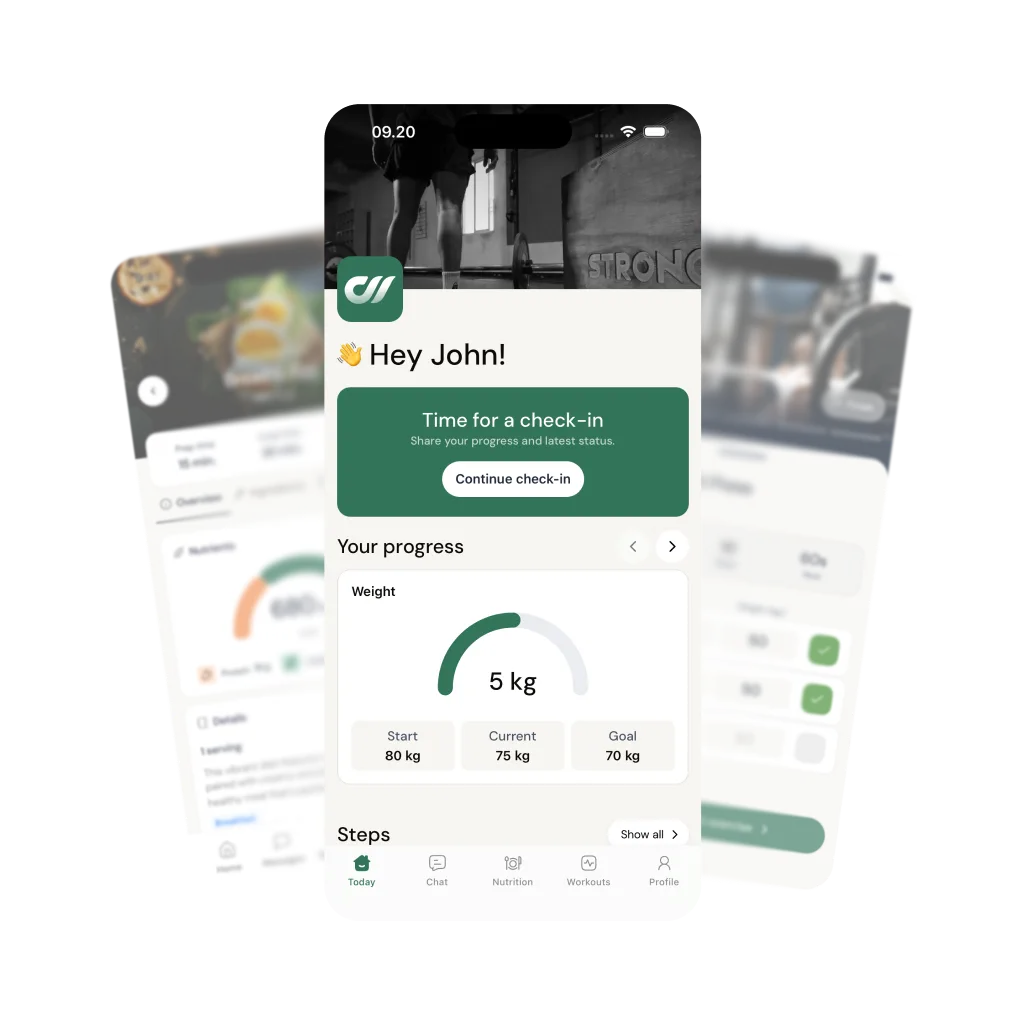
This is the whole case for an all-in-one online personal training platform over a patchwork of WhatsApp, spreadsheets, and a separate workout app: forms, automations, payments in your own Stripe, and a branded app pulling in one direction. Coachway runs on predictable per-client pricing that scales with your client count, starting at EUR 69 per month for up to 5 clients and EUR 9 per extra client. The plain numbers are on pricing. A video form check is still a video, not a hand on the bar - so the honest move for the lifts that truly need eyes-on is the hybrid in the next section.
Who each format actually suits.
Forget which is better in the abstract. The only useful question is who the client in front of you actually is. The format follows the person, not the other way round.
Lean in-person if the client is
- A true beginner who needs the main lifts taught hands-on.
- Returning from injury, where live correction protects them.
- Someone who only trains when a person is physically waiting.
- Local, with the budget for the per-session cost, and energised by face-to-face contact.
Lean online if the client is
- Past the basics and can train safely on their own.
- Busy or travelling, and needs to train on their own schedule.
- Cost-conscious, and wants whole-week guidance over one hour.
- Looking for a specific specialist who is not in their town.
A coach who runs a help-first conversation rather than a pitch will spot which of these a prospect is within minutes, and will sometimes say in-person first is the right call - even if it is not what they sell. That honesty is the point of a good discovery call: prescribe only what the person actually needs.
Hybrid: the honest best of both for many people.
You do not have to pick a side. Hybrid coaching pairs occasional in-person sessions with ongoing online programming and check-ins, so the client gets live form correction and face-to-face contact some of the time, and the structure, flexibility, and lower per-month cost of online the rest of the time. For a lot of people, that genuinely is the best answer.
Why it works for the client
The in-person sessions handle the things online cannot - learning a new lift, fixing a stubborn form issue, the occasional face-to-face reset. The online side handles everything between: the plan, the daily structure, the check-ins, the messaging. The client gets eyes-on where it matters without paying for a trainer beside them every single session.
Why it works for the coach
Hybrid is the cleanest way to move off pure in-person without dropping income overnight. You build the online side - the app, the programs, the check-in rhythm - while the in-person sessions still pay the bills, then let the online client base grow at its own pace. Two revenue streams, neither one carrying the whole business while you transition.
It is not automatically right for everyone. Pure online suits a fully remote, self-directed client and scales furthest for the coach; pure in-person suits someone who needs presence every session. But for the broad middle, hybrid quietly resolves most of the trade-offs this guide has laid out. If you are a coach planning the move, the step-by-step is in how to make a full-time living as an online fitness coach.
Frequently asked questions about online vs in-person training.
Does online personal training work?
Yes, for the right person. Results depend mostly on what happens between sessions, and a well-built plan with weekly check-ins and honest logging covers exactly that, which is why self-directed and intermediate clients routinely match in-person outcomes online. It works less well for true beginners who need hands-on form correction, and for people who only train when someone is physically waiting for them - both often do better starting in person and moving online once the basics are solid.
Is online personal training as effective as in-person training?
For results, what you do between sessions matters more than whether a coach is in the room. A consistent, well-built plan plus honest weekly check-ins can match in-person outcomes for most people, especially those who already know the basics. In-person keeps its edge in two real places: live form correction in the moment and the show-up accountability of a booked session. So the honest answer is that online is as effective for the self-directed and the intermediate, while a nervous beginner, someone returning from injury, or anyone who only trains when a person is physically waiting will often get there faster in person, at least to start.
Is online personal training cheaper than in-person?
Usually, yes, because there is no gym floor to rent and the coach is not selling a single hour of their time. Several industry sources reported in 2026 that in-person sessions commonly run roughly 50 to 120 US dollars an hour, while structured online coaching packages often land somewhere around 100 to 400 US dollars a month for the whole program rather than one session. The trade is that the in-person hour buys you a person beside you for sixty minutes, while the online month buys you a plan, daily structure, and a coach you message and check in with throughout, not a body in the room.
Should a beginner choose online or in-person personal training?
If a true beginner can afford it and learns better with hands-on correction, a short block of in-person sessions to learn the main lifts safely is hard to beat. The most common honest recommendation across the field is not online or in-person but in-person first, then online: build the movement basics with someone watching, then move to online coaching once you can train independently and just need a smart plan and accountability. Plenty of beginners do start online successfully when the coach uses video form checks and a careful onboarding, but the in-person head start is a real advantage, not a marketing line.
Why do coaches move from in-person to online training?
Because in-person training has a hard income ceiling. Your earnings are your hourly rate multiplied by the hours you can physically stand on a gym floor, and there are only so many of those before you burn out. Online coaching breaks that link: one well-built program can serve many clients, check-ins are reviewed on your schedule, and you can raise your client count without adding an hour of commute or a square metre of rent. Coaches rarely move online to coach worse. They move so the business can grow past the wall that one-to-one hours put in front of them.
What is hybrid coaching and is it better than either one?
Hybrid coaching combines occasional in-person sessions with ongoing online programming and check-ins, so the client gets live form correction and face-to-face contact some of the time and the structure, flexibility, and lower per-month cost of online coaching the rest of the time. For many people it genuinely is the best of both, and for a coach it is the cleanest way to transition off pure in-person without dropping income overnight, because you build the online side while the in-person side still pays the bills. It is not automatically better for everyone. Pure online suits a remote, self-directed client and scales further for the coach, and pure in-person suits someone who needs presence every session.
Keep reading
all guidesPT Distinction review: features, pricing, pros and cons
An honest review of PT Distinction for online fitness coaches: what it is, its verified USD pricing (Basic 19.90 to Master 89.90), the 1-month free trial, deep customization strengths, the MyFitnessPal-based nutrition and branded-app-from-Pro trade-offs, who it suits, and Coachway as the European, nutrition-strong alternative.
Read the guideMy PT Hub review (2026): an honest look
My PT Hub is a low-cost, UK-built personal-training platform with an unlimited-client mid tier and a generous 30-day trial. It covers workouts, nutrition, messaging, and payments in one place, but a branded client app and several features sit behind paid add-ons, and the interface is English-first. An honest look at what it is, who it suits, what it really costs, and where a fitness-built EU platform fits instead.
Read the guidePeriodization for online coaches: a guide
A practical guide to training periodization: linear vs undulating vs block, mesocycle and microcycle structure, deloads, and delivering periodized plans online.
Read the guideSee what Coachway can do for your coaching business
Coachway was built on knowledge from working with 150 online coaches over 6+ years, who all hit the same wall - slow platforms, clunky workflows, wasted hours. Start your 14-day free trial and see what we fixed - the whole platform, no charge today, cancel anytime under Billing.