How many hours does online coaching actually take?
Search this question and you get salary surveys and "is coaching worth it" listicles - nobody publishes the actual time breakdown, because the honest answer is ranges with reasons. Here it is: what the work costs in hours at each stage, the per-client weekly math, the four buckets your week really falls into, and the places the hours quietly leak. Written for the coach deciding whether this business fits their life, not for a job board.
By Markus Evers · Updated August 2026
the short version
As ranges, because anything else would be a lie: a side-hustle coach with up to 10 clients runs 8-15 hours a week; a full-time coach with 15-30 clients works 25-45; past 30 high-touch clients, delivery alone can fill a week. Plan 30-60 minutes per client per week once they are onboarded, plus a fixed overhead of content, sales and admin that exists at every client count. And the widest variable is not client count - it is systems. Two coaches with the same 25 clients can be living two completely different weeks.
The four buckets every coaching week falls into.
Coaches who feel overworked usually cannot say where the hours went, because the work hides in four different shapes. Name them and the week becomes manageable.
1. Client delivery - scales with every client
Check-in reviews and replies, program updates, the messages in between, onboarding new clients. This is the bucket that grows with your client list: plan 30-60 minutes per client per week for high-touch 1:1, and 2-3 hours for an onboarding week. It is also the only bucket clients can feel - which matters later.
2. Content and marketing - fixed overhead
The content engine that fills the pipeline: 3-8 hours a week batched, more if you are unbatched and improvising daily. This bucket exists whether you have 3 clients or 30 - which is exactly why the early months feel so lopsided: full marketing overhead, few paying clients.
3. Sales conversations - lumpy, not constant
DM conversations, discovery calls, follow-ups. Wildly variable: an hour some weeks, six in a launch week. The efficiency lever is qualification - one good discovery call with the right person beats five with the wrong ones, and a lead form does the sorting before your calendar pays for it.
4. Admin - the bucket that lies
Payments and failed-payment chasing, invoices, scheduling, re-finding context across apps, rebuilding spreadsheets. Coaches report this as "an hour or two" and live something closer to five, because it arrives as confetti - two minutes here, six there - and confetti never makes it into anyone's estimate. This is the first bucket to attack, because no client ever paid for it.
Realistic weekly hours at each stage of the business.
| Stage | Typical week | What dominates | The honest note |
|---|---|---|---|
| Side-hustle, 0-10 clients | 8-15 hours | Content and sales - the overhead outweighs the delivery. | Sustainable next to a job IF check-ins are batched and reply windows exist. The danger is not hours, it is unbounded evenings. |
| Full-time, 15-30 clients | 25-45 hours | Delivery takes over: roughly half the week goes on clients. | The stage where systems decide everything - the same client list is a 28-hour week with templates and batching, or a 50-hour week without. |
| At capacity, 30+ high-touch | 40-60 hours | Delivery alone can fill a working week before any marketing happens. | The fork: raise prices, systemize harder, or change the model. Doing none of the three is how coaches burn out at their revenue peak. |
| Leveraged - groups, memberships, templates | Varies widely | Content and community replace some 1:1 delivery; hours decouple from client count. | The only stage where revenue can grow faster than hours - and it comes with its own new bucket: building the product. |
These ranges assume high-touch 1:1 coaching with weekly check-ins. Async-heavy or lower-touch models sit under them; daily-contact premium models sit above. And if you split your week between a gym floor and online clients, you are the industry's new normal, not an edge case - in ABC Trainerize's 2026 industry report, roughly half of trainers named hybrid their main delivery model, against about a third fully online. The companion question - how many clients those hours can serve - has its own ranges-with-reasons answer in how many clients can an online coach handle.
Where the hours quietly leak - and the order to fix it.
The gap between the 28-hour coach and the 50-hour coach at the same client count is almost never coaching quality. It is four leaks, and they compound. Blank-page programming: building every program from scratch when 80% of your clients need variations of the same structures - a template library you adjust per client cuts this bucket in half without any client noticing. Scattered context: the conversation in one app, the program in another, payments in a third, so every client touch starts with two minutes of re-finding where things stand - multiplied by every touch, every day. Unbatched check-ins: reviewing them as they trickle in costs a context-switch each time; two set review blocks a week cost less and produce better replies. Manual mechanical messages: welcome sequences, reminders, "your check-in is due", inactivity nudges - work that should be automated precisely so the personal messages can stay personal.
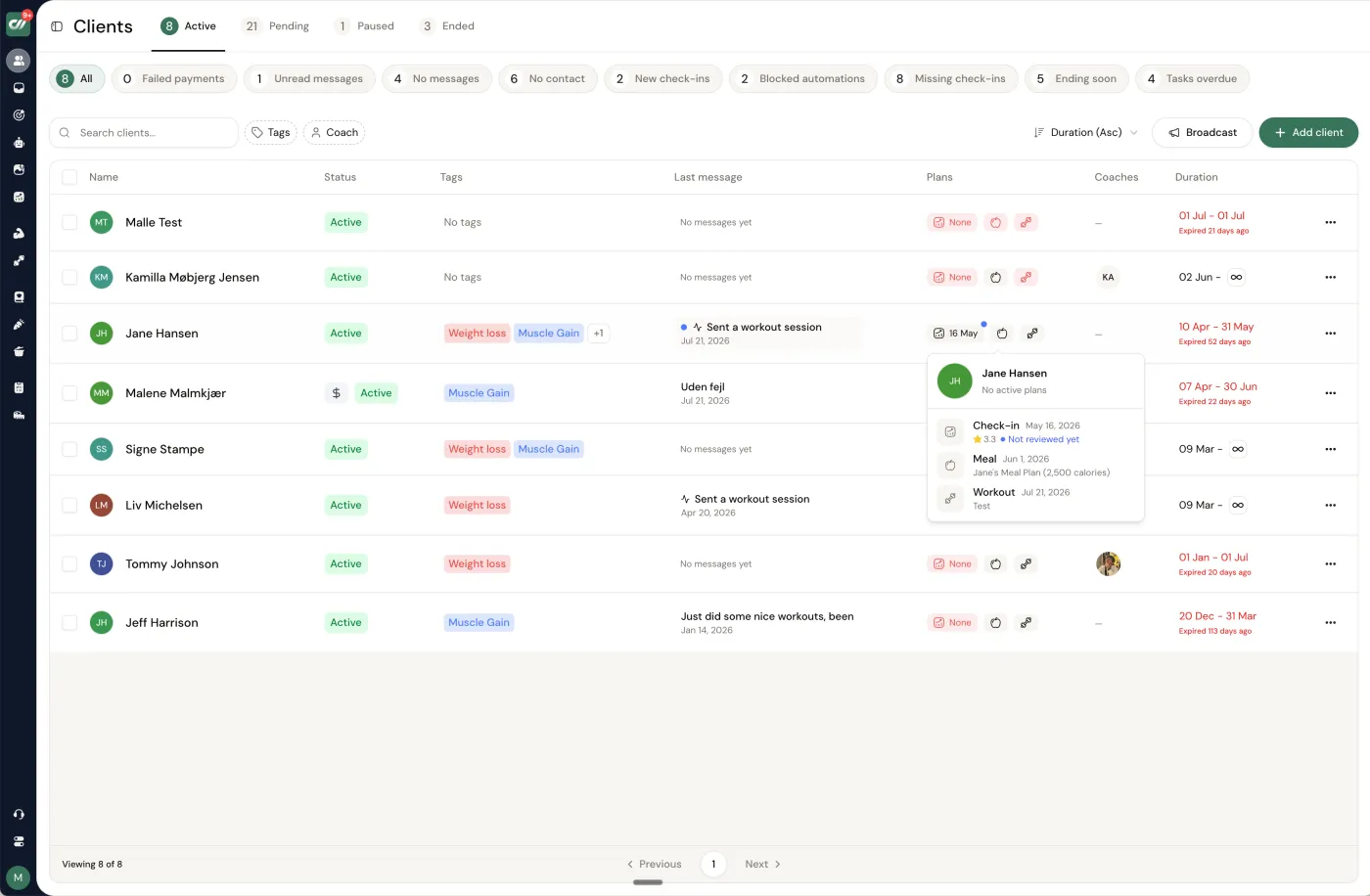
Fix them in that order and most coaches find the week that felt like 50 hours was a 30-hour job wearing a bad system. This is also the honest version of the Coachway pitch, so we will say it plainly: the platform exists to close leaks two through four - the whole client, from conversation to program to payment, in one tab. Built on knowledge from working with 150 online coaches over 6+ years, EUR 69 a month including your first 5 clients and EUR 9 per additional client. It will not write your content or coach your clients; it gives you back the hours that were going to neither.
Frequently asked questions about coaching hours.
How many hours a week does online fitness coaching take?
It depends on client count and systems far more than on effort, so honest answers come as ranges. A side-hustle coach with up to 10 clients typically runs 8-15 hours a week on top of a job. A full-time coach with 15-30 clients usually works 25-45 hours, roughly half of it client delivery and half content, sales and admin. At 30+ high-touch clients the delivery alone can fill a working week, which is why coaches at that stage either build systems, raise prices, or burn out. The spread between an efficient coach and a chaotic one at the same client count is easily a factor of two - the hours are decided by how the work is organized, not just how much of it there is.
Can I run an online coaching business alongside a full-time job?
Yes - most successful online coaches started exactly that way, and up to roughly 10 clients it is sustainable if the delivery is systemized. The realistic budget is 8-15 hours a week: check-in reviews batched into one or two sittings, programs built from your own templates rather than from scratch, content batched weekly, and clear client expectations about reply windows so the business does not colonize every evening. The trap is not the coaching hours, it is the unbounded ones - a coach who answers messages the moment they arrive is working many more hours than they count. Decide your windows before you take your first client, not after.
How many hours per week does one online coaching client take?
For high-touch 1:1 coaching, a realistic planning figure is 30-60 minutes per client per week once onboarding is done: a proper check-in review and reply, program adjustments, and the messages in between. Onboarding weeks cost more - often 2-3 hours for the intake, the first program and the setup. What moves the number most is repetition: coaches who build every program from a blank page and answer every question from scratch sit at the top of the range or above it, while coaches who work from their own template library and structured check-ins sit near the bottom without the clients feeling any less seen. Multiply your true per-client minutes by your client count before you set your prices - many coaches discover they are earning less per hour than at the job they left.
Why am I working more hours online than I did training people in person?
Because in-person work has walls around it and online work does not. A gym session starts and ends; a chat thread never does. Most coaches who feel this are not overworked by coaching - they are overworked by fragmentation: client conversations in one app, programming in another, payments in a third, check-ins in a spreadsheet, and the whole day spent switching between them and re-finding context. The fixes are boundaries and consolidation: defined reply windows, batched check-in reviews on set days, templates for everything you write twice, and running the whole client workflow in one place instead of six. The coaching itself rarely needs to shrink; the friction around it does.
How do I cut my coaching hours without clients feeling it?
Cut the invisible work, never the visible attention. Clients feel the check-in reply, the program that fits their week, the message that shows you noticed - they do not feel whether the program took you 90 minutes or 20 to assemble. So: build from your own template library and adjust per client instead of starting blank; batch check-ins into set review blocks; automate the mechanical messages - onboarding sequences, reminders, inactivity alerts - so nothing personal is faked but nothing mechanical is manual; and set reply windows you actually keep. Done in that order, most coaches reclaim hours per week while the client experience gets more consistent, not less personal.
The hours question has two siblings: how many clients one coach can handle, and - once the week is full - how to take time off without the business unraveling.
Keep reading
all guidesPersonal Trainer Legal Requirements (2026 Checklist)
A jurisdiction-aware checklist of personal trainer legal requirements: certification, liability insurance, business registration, contracts and waivers, and data/GDPR for online clients - written generally, with a note to verify your local rules.
Read the guidePersonal trainer tax deductions: write-offs every online coach should track (2026)
Personal trainer tax deductions are the ordinary business costs an online coach can subtract from income before tax. The categories coaches commonly deduct, how partial-use costs work, and the record habits that make tax season painless. General information, not tax advice.
Read the guidePersonal trainer LLC vs sole proprietor vs S-corp: choosing a business structure (2026)
Most coaches start as a sole proprietor, form an LLC for liability separation, and consider an S-corp election only once profit justifies it. Plain-language trade-offs to take to an accountant. General information, not legal or tax advice.
Read the guideSee what Coachway can do for your coaching business
Coachway was built on knowledge from working with 150 online coaches over 6+ years, who all hit the same wall - slow platforms, clunky workflows, wasted hours. Start your 14-day free trial and see what we fixed - the whole platform, no charge today, cancel anytime under Billing.