The best personal trainer certifications for coaching online.
NASM, ACE, ISSA, NCSF, NSCA. They are education bodies, not rivals, so this is a straight, hedged comparison of cost, recognition, and who each one fits. Then the part most cert guides skip: a credential makes you credible, but it does not hand you clients. The bigger leap is building the online business.
By Markus Evers · Updated July 2026
the short version
The best personal trainer certifications for online coaching are NASM and ACE (the two most widely recognised NCCA-accredited options), ISSA (popular with self-paced, remote learners thanks to its open-book core exam), NSCA's CSCS (the most prestigious, but it requires a bachelor's degree), and NCSF (a budget-friendly NCCA-accredited route). No single option wins for everyone - pick on budget, how you like to study, and who you need to convince. Whichever you choose, the harder, more valuable work is everything after the cert: finding clients, keeping them, and running a clean coaching business.
Do you actually need a certification to coach online?
In most countries there is no law that says you must hold a personal training certification to coach clients online. But "not legally required" and "not needed" are very different things. A recognised, accredited certification does three concrete things for an online coach: it builds trust with people who will never meet you in a gym, it is usually a prerequisite for proper liability insurance, and it gives you the programming knowledge to keep remote clients safe when you cannot watch every rep.
So treat a cert as table stakes for credibility, not as the finish line. If you are weighing whether coaching online is even right for you, start with how to become an online fitness coach. It walks the full path from credential to first paying client.
The five major certifications, fairly compared.
Costs below are from each organisation's own materials and third-party reviews around June 2026. Certification prices change constantly with promotions and bundles, so always confirm the live price on the certifying body's own site before you buy.
National Academy of Sports Medicine.
The cert most people name first, and a safe default for credibility. NASM-CPT is NCCA-accredited and built around its OPT (Optimum Performance Training) model, which leans heavily on assessment and corrective exercise. The closed-book proctored exam is widely considered one of the more demanding, which is part of why employers respect it. Per third-party reviews around June 2026, study bundles commonly run from several hundred dollars up to roughly USD 1,000+, and there are renewal CEUs to keep it active. Verify the current package on nasm.org.
Best for: coaches who want maximum recognition and like a structured, assessment-driven system.
American Council on Exercise.
NASM's closest peer in recognition, and genuinely a better fit for some coaches. ACE is NCCA-accredited and is often described as a strong all-rounder with a behaviour-change and health-coaching emphasis, which maps neatly onto online coaching where adherence is the whole game. Per acefitness.org around June 2026, the standard study packages run roughly USD 675 to USD 945 with the exam available as an add-on, and combined certification bundles run higher again. Confirm the live price before buying.
Best for: coaches who care about habits, behaviour change and the health-coaching angle.
International Sports Sciences Association.
The favourite of online and self-paced learners, and where ISSA genuinely wins. Its core CPT exam is open-book and taken remotely, which is why pass rates on that route are high and why it slots so well around a full-time job. ISSA is DEAC-accredited, and per issaonline.com it also offers an NCCPT-administered, NCCA-accredited exam route for those who specifically need NCCA. It bundles aggressively (CPT plus nutrition or online-coaching add-ons), with self-study packages often advertised around USD 1,000 to USD 1,600 before frequent promotions. The honest trade-off: many reviewers consider it less in-depth than NASM. Check issaonline.com for current pricing and which accreditation each package carries.
Best for: self-paced learners who want a remote, open-book route and bundled add-ons.
National Council on Strength and Fitness.
The value pick, and a legitimate one. NCSF is NCCA-accredited and known for a strong focus on exercise prescription and programming, yet it is often the cheapest accredited route on promotion. Per third-party reviews around June 2026, the standalone exam can be a few hundred dollars and home-study packages frequently sit under USD 900, sometimes discounted further. It is less of a household name than NASM or ACE, so if your audience explicitly looks for those brands it carries a little less marketing weight, even though the accreditation standard is the same. Verify current pricing on ncsf.org.
Best for: budget-conscious coaches who want NCCA accreditation without the premium price.
National Strength and Conditioning Association.
The prestige tier, with a catch. NSCA's NSCA-CPT is NCCA-accredited and, per nsca.com, was the first personal training certification to earn NCCA accreditation; it has no degree requirement (exam fees were listed around USD 300 for members and USD 435 for non-members at the time of writing). Its flagship CSCS, the gold standard for strength and conditioning, requires at least a bachelor's degree, and per nsca.com US candidates will need a degree from a CASCE-accredited program from 1 January 2030. CSCS is overkill for most general online coaches but unmatched if you work with athletes. Confirm current fees and prerequisites on nsca.com.
Best for: degree-holders and anyone coaching athletes or strength-and-conditioning clients online.
All five hold respected accreditation. There is no wrong choice here, only a wrong fit for your budget, learning style and audience.
NASM now has a GLP-1 course.
Per nasm.org, NASM offers a continuing-education course, Understanding Weight Loss Medications (GLP-1s / GIPs), updated in 2026. It is a course rather than a full certification, and it covers how these medications work, their risks and side-effect management, nutrition and physical-activity strategy, and supporting clients who later transition off the medication. Per nasm.org, roughly 1 in 8 American adults now use a GLP-1 medication, so a growing share of clients arrive already on one.
This is increasingly relevant online, where a growing share of clients sign up already on a GLP-1 and need training and nutrition adjusted around it. If that is your world, read our practical guide on how to coach clients on GLP-1 medications alongside whatever course you take.
A reality check from the field.
Marketing pages all say the same thing. Here is the more candid view from reviewers and trainers, lightly paraphrased and attributed to the source.
"NASM is a nationally recognised certification. It is the gold standard for most people who want to get into training."
Trainer quoted in MindBodyGreen's ISSA vs NASM review, 2026
"ISSA is open book, so having to sit for the exam a second time is unlikely."
Trainer quoted in MindBodyGreen's ISSA vs NASM review, 2026
"Most employers, like the big-box gyms, are looking for the accredited certification." The brand matters less than whether it is NCCA-accredited.
Paraphrased from NETA's certification comparison, 2026
"A lot of people are just trying to be fitness influencers now. For those people, certifications may not be worth it. It depends on your goals."
Paraphrased from a Fortune Education ISSA review, 2026
Many reviewers agree ISSA is not as in-depth as NASM, and is therefore less challenging to pass; NASM requires deeper knowledge to get through the closed-book exam.
Paraphrased from PTPioneer's ISSA vs NASM comparison, 2026
The certificate often just gets you the first training job or adds credibility to a solo practice; it is rarely what wins or keeps clients on its own.
Paraphrased from a Fortune Education certification overview, 2026
Quotes are paraphrased for length and attributed to their source. Verify any specific claim on the certifying body's own site.
The cert makes you credible. It does not make you a business.
Here is the honest truth no certifying body will tell you, because it is not their job to: passing the exam is the easy half. We have watched newly certified coaches with perfect knowledge stall for months because no one taught them how to find clients, price the offer, or run the day-to-day without drowning in WhatsApp threads and spreadsheets. The credential is the entry ticket. The business is the work.
start here
How to become an online fitness coach.
The full path from credential to first paying client: niche, offer, pricing, and the tools that hold it together.
the hard part
How to get online coaching clients.
Where clients actually come from when you are starting out, and the content and outreach that fills your client base.
budget the tools
What online coaching software costs.
Beyond the cert, the recurring cost that matters: the platform you run check-ins, programs and payments on.
do the math
Coach income calculator.
See what a given client count and price actually earns you, so the cert investment has a clear payback.
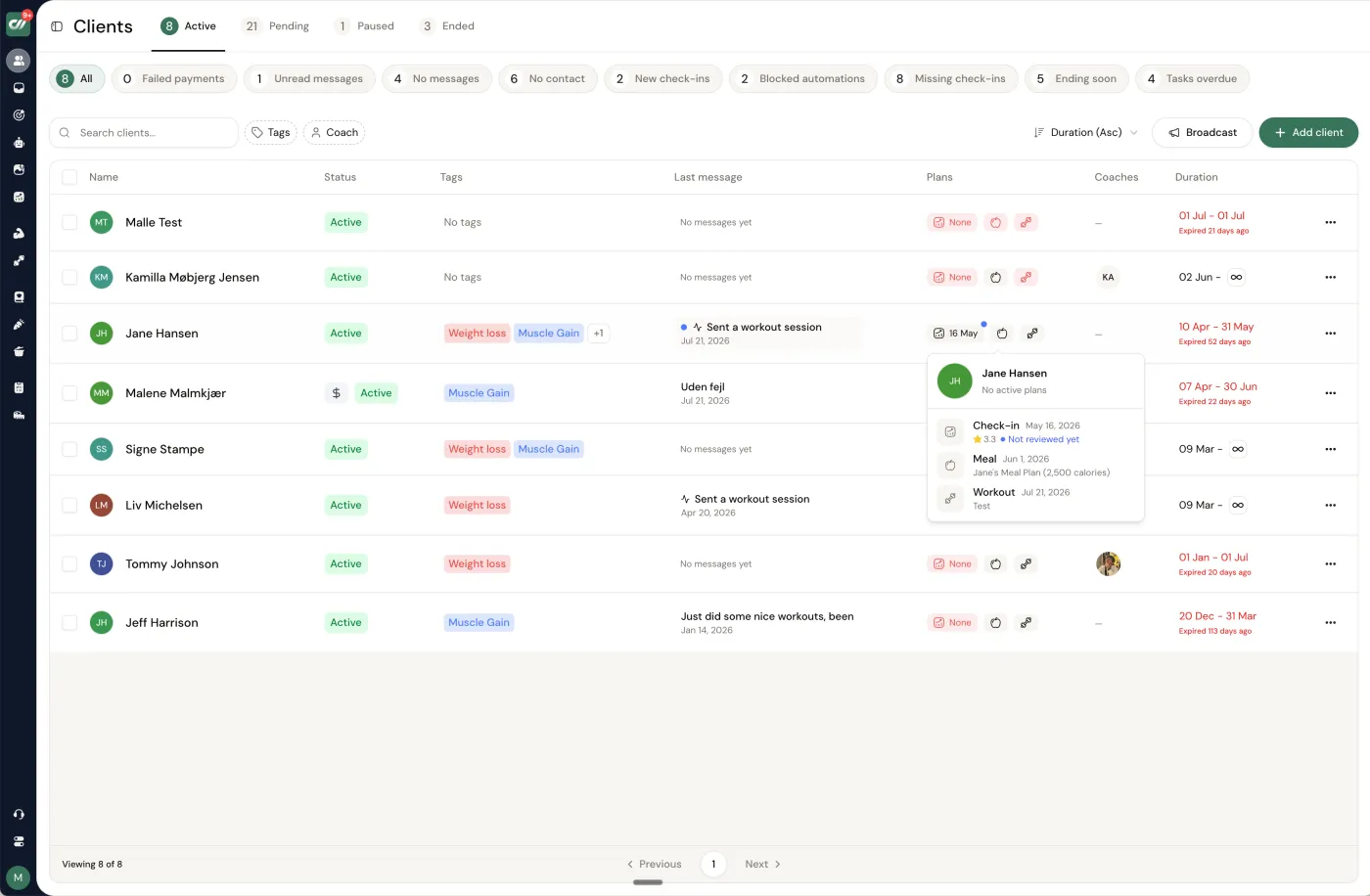
Coachway is the platform coaches run that business on once the cert is done: one screen for chat, check-ins, programs, meal plans and progress photos, automated onboarding, and predictable per-client pricing. You keep your own Stripe, so payments flow directly to you. See the full feature set or the pricing.
Frequently asked questions about personal trainer certifications.
Do I need a certification to coach fitness online?
In most countries there is no legal requirement to hold a personal training certification to coach online, but it matters in practice. A recognised, accredited cert builds trust with clients, is often required for liability insurance, and gives you the knowledge to program safely. If you plan to charge money and take on clients you have never met in person, a cert is strongly recommended even where it is not legally mandatory.
Which personal trainer certification is best for online coaching?
There is no single best certification. NASM and ACE are the two most widely recognised NCCA-accredited options and are safe defaults for credibility. ISSA is popular with online and self-paced learners because its core exam is open-book and remote. NSCA's CSCS carries the most prestige but requires a bachelor's degree. NCSF is a budget-friendly NCCA-accredited route. Pick based on your budget, how you learn, and the audience you want to convince.
Is NASM or ACE better?
Both are NCCA-accredited and well respected by employers. NASM is built around its OPT model and corrective-exercise lean, which suits trainers who like a structured assessment-driven system. ACE is often described as a strong all-rounder with a behaviour-change and health-coaching emphasis. For online coaching either is a defensible choice. The bigger differentiator at the time of writing is price and study format, so compare the current packages on each org's own site.
How much does a personal trainer certification cost?
At the time of writing, entry self-study packages typically run from roughly USD 300 to USD 1,000, with premium bundles from NASM, ACE and ISSA reaching USD 1,500 or more. NCSF is often the cheapest NCCA-accredited route on promotion. Standalone exam fees are lower than full study bundles. Prices change constantly with promotions, so always verify the live price on the certifying body's own site before you buy.
Does NASM have a GLP-1 course?
Yes. NASM offers a continuing-education course called Understanding Weight Loss Medications (GLP-1s / GIPs), updated in 2026. Per nasm.org, it is a course rather than a full certification and covers how these medications work, their risks and side-effect management, nutrition and physical-activity strategy, and supporting clients who transition off them. It is relevant for online coaches because a growing share of clients arrive already on these medications. See our guide on coaching clients on GLP-1.
Can I coach online without any qualification at all?
Technically yes in many places, but it is a poor idea. Without a credential you cannot get proper liability insurance in most markets, clients have less reason to trust you, and you may program in ways that put clients at risk. Even an accessible accredited cert closes those gaps. The harder and more valuable work then becomes the business: finding clients, retaining them, and running a professional workflow.
Keep reading
all guidesInstagram content ideas for fitness coaches - what actually works right now
You do not need 250 random content ideas - you need to know which job each post does. Reel ideas that get you discovered by the client you want, carousel ideas that build trust, story content that converts, and the mid-2026 mechanics that decide reach: shareable beats likeable, carousels are back, trial reels let you test hooks on non-followers, and a comment keyword turns a good post into a conversation.
Read the guideFree trial vs paid trial for online coaching - should you offer either?
Every answer to this question was written for software companies, and coaching is not software: a SaaS trial costs server cents, a coaching trial costs your hours. What each trial model signals, who it attracts, when a free trial genuinely fits (memberships and self-service offers), why a paid trial is really a starter block, and the discovery-call-plus-guarantee play that beats both for 1:1 coaches.
Read the guideNew Year marketing for online fitness coaches - the window opens in October
Every coach knows January is the biggest month of the year. Fewer act on the uncomfortable half of that fact: the January client chooses their coach in November. The month-by-month runway from August to February - offer design, content ramp, waitlist, booked start dates, excellent onboarding, and the February second wave most coaches ignore - plus why resolution clients churn and how to sell the version that stays.
Read the guideSee what Coachway can do for your coaching business
Coachway was built on knowledge from working with 150 online coaches over 6+ years, who all hit the same wall - slow platforms, clunky workflows, wasted hours. Start your 14-day free trial and see what we fixed - the whole platform, no charge today, cancel anytime under Billing.