Skip to content
glossary · operate

What is recurring billing for coaches?

Recurring billing for coaches is the automated subscription that charges a coaching client every cycle without manual invoicing. This page defines the term, shows how it differs from one-off and manual payments, explains why it steadies a coach's monthly income, and points to the payment software that runs it.

By Markus Evers · Updated August 2026

the short answer

Recurring billing for coaches is an automated subscription that charges a coaching client the same amount on the same date every cycle - weekly, four-weekly or monthly - without anyone sending an invoice. The client saves a card once at signup, agrees to a schedule, and the payment then runs on its own until it is cancelled. It is the standard way established online coaches collect money, because it makes revenue predictable and removes the monthly job of chasing payments. The alternative - invoicing each client by hand - leaks income the moment you have more than a handful of clients.
why it matters

Why does recurring billing steady a coach's income?

The single hardest thing about running an online coaching business is not getting clients - it is not knowing what next month looks like. When every payment depends on a new sale or a client remembering to pay an invoice, income swings from a good month to an empty one, and it is impossible to plan around. Recurring billing removes that uncertainty. Because the charge repeats automatically, you begin each month already knowing most of your revenue.

The maths makes the point. Ten clients on a EUR 200 monthly subscription is EUR 2,000 booked before you do a single thing, and it repeats next month without a new sale. A card that fails gets retried and flagged rather than silently disappearing. That predictability is what lets a coach reinvest, take on the right number of clients, and stop treating the last week of every month as a scramble to get paid. It is also why the metric that matters most in coaching - client lifetime value - only compounds when billing keeps a client enrolled instead of resetting to zero.

subscriptions vs one-off

Recurring billing vs one-off and manual invoicing.

Coaches collect money in three broad ways. Recurring billing is the automated subscription; a one-off charge takes the whole amount once; manual invoicing means sending a bill each cycle and waiting. The table sets them side by side on the two things that actually decide your month - how predictable the income is, and how much admin it costs you.

Model How it works Income shape Admin cost
Recurring subscription billing Card saved once, charged automatically on a set date each cycle. Predictable - you know the number before the month starts. Near zero once it runs; failed cards retry on their own.
One-off / package upfront Client pays the whole block once, for example 12 weeks paid in full. Lumpy - a big month followed by nothing until the next sale. Low per sale, but you re-sell every client every cycle.
Manual invoicing You send an invoice each month and wait for a bank transfer or card payment. Unreliable - depends on the client remembering and paying on time. High - chasing late payers is the biggest hidden tax on a coaching week.

One-off billing has its place - a fixed program with a clear end, or a client who genuinely wants to pay once and be done. But for ongoing coaching, recurring billing wins on both counts, and it pairs naturally with a coaching package sold as a monthly commitment rather than a block of sessions.

how it works

How does recurring billing actually work?

Underneath the label, recurring billing is three moving parts working together. Get all three in place and payments run without you thinking about them. Miss any one - especially the retry step - and a subscription can quietly stop paying while the client keeps coaching.

  • A saved card - the client enters their card once at signup and it is stored securely with a processor such as Stripe. Nothing about recurring billing works until the card is on file, which is why the strongest coaches collect it in the same step as the sale, while motivation is highest.
  • A fixed schedule - the amount and the interval are set once: the same figure charged on the same date every week, four weeks, or month. The client agrees to the cadence up front, so no one has to send an invoice or ask for money again.
  • Automatic retries - cards expire and get declined, so a proper billing setup retries a failed charge and warns the client before the payment is quietly lost. This dunning step is what separates recurring billing from a card that simply stops working one month.

Where you set all of this up matters. For a full walk-through of collecting money as a coach, see how to take payments as an online coach, and to compare the tools that run recurring billing, our guide to the best payment and billing software for personal trainers lays out whose account gets paid and where each tool works.

billing beside the coaching

What recurring billing looks like inside a coaching platform.

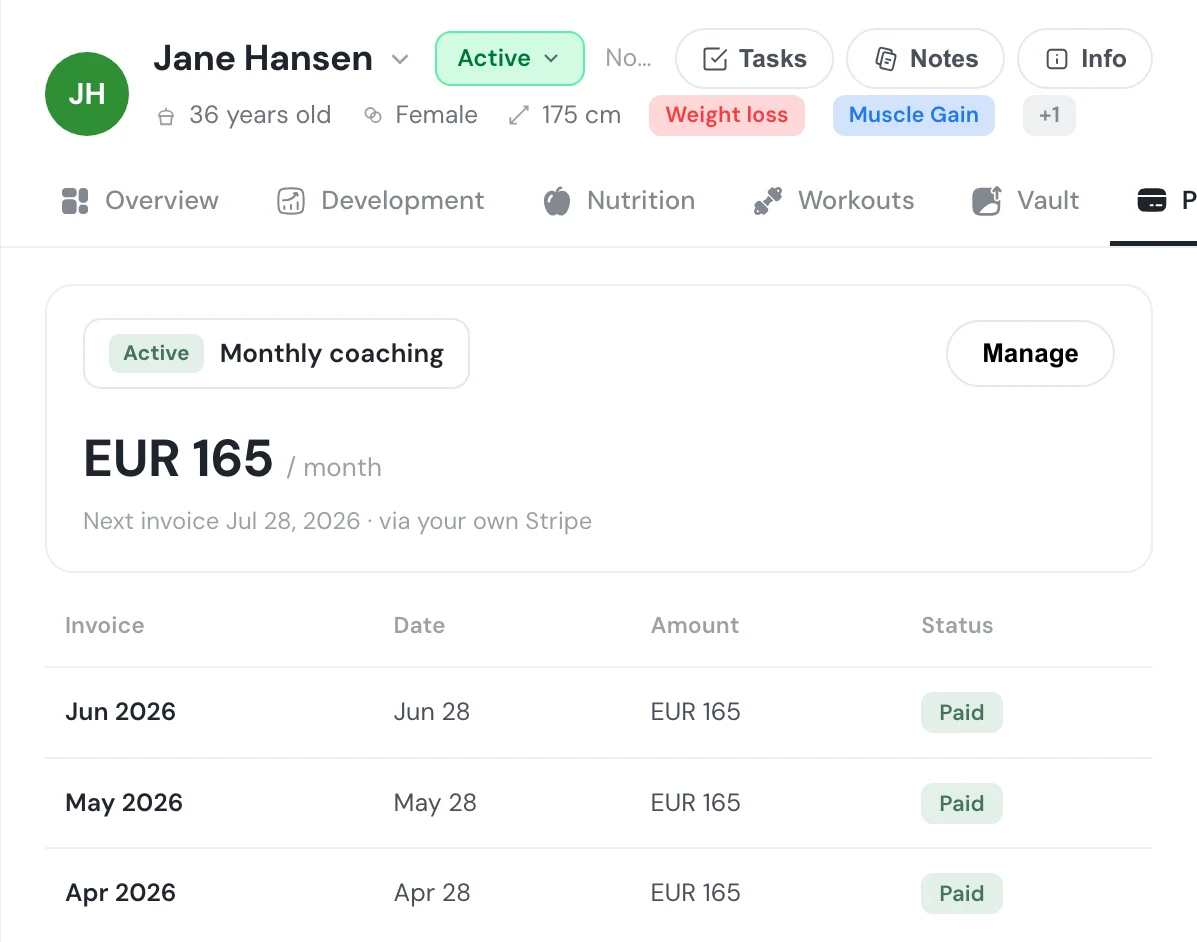
A standalone checkout link runs recurring billing fine, but the payment then lives away from where you actually coach, so a lapsed card is easy to miss. When billing sits on the client record itself, a failed charge shows up next to the person you are already working with - which is the whole point of the retry-and-notify step above.

Inside Coachway Coachway payments - a client on a EUR 165 monthly coaching subscription, the next invoice date, and the paid invoice history, all billed through the coach's own Stripe account
A client on a monthly subscription with the next invoice date and paid history in view - the recurring billing running beside the coaching, not off in a separate tool. See how payments work

This is the part coaches build with Coachway. You can set per-client amounts, currencies and billing intervals, run subscriptions or payment plans, and let automatic reminders and retries handle failed cards. Payments settle in your own Stripe account - Coachway never holds your money - so a subscription charged today pays out to you. Optional built-in payments carry a 2.4% per-transaction fee, or you can run your own Stripe checkout. Every feature, including recurring billing, is on one plan at EUR 69 per month for your first 5 clients, plus EUR 9 per additional client, with a 14-day trial. See the full Coachway pricing or book a demo to see billing against your own offer.

questions coaches ask

Frequently asked questions.

What is recurring billing for coaches?

Recurring billing for coaches is an automated subscription that charges a coaching client the same amount on the same date every cycle, without anyone sending an invoice. The client saves a card once at signup, agrees to a schedule such as monthly, and the payment then runs on its own. It is the standard way established online coaches collect money because it makes income predictable and removes the monthly job of chasing payments.

What is the difference between recurring billing and a one-off payment?

A one-off payment charges the client a single time - for example a 12-week block paid in full at signup - and then stops until you sell them again. Recurring billing charges automatically on a repeating schedule until someone cancels. One-off suits a fixed program with a clear end; recurring suits ongoing coaching, because it keeps clients enrolled and revenue steady instead of resetting to zero every cycle.

Do I need Stripe to set up recurring billing?

You need a payment processor that handles subscriptions, and Stripe is the most common choice because it stores cards securely, charges them on schedule, retries failed payments and pays out to your bank automatically. You are not locked to Stripe - other processors do the same job - but you do need one, because recurring billing is really just an automated instruction to a card processor rather than something you run by hand.

How does recurring billing stabilise a coach’s income?

Because the charge repeats without a new sale, you start each month already knowing most of your revenue. Ten clients on a EUR 200 monthly subscription is EUR 2,000 booked before you do anything, and a failed card gets retried instead of silently disappearing. That predictability is what lets a coach plan, reinvest and take on the right number of clients rather than riding the highs and lows of one-off sales.

What happens when a client’s card fails on a recurring charge?

A good billing setup does not just give up. It retries the charge over a few days, emails the client to update the card, and flags the account for you so you can follow up before the client quietly stops paying. Failed cards are one of the biggest silent causes of churn in online coaching, so the retry-and-notify step matters as much as the first charge does.

Should I use in-app recurring billing or an external checkout?

Both work. An external checkout link is quick to set up and fine at low volume, but the payment lives outside the tool where you coach, so a lapsed card is easy to miss. In-app recurring billing ties the subscription to the client record, so a failed payment shows up next to the client you are already working with. As you grow, keeping billing beside the coaching is what stops revenue leaking without you noticing.

Once recurring billing is running, the next things to get right are the setup itself and the failed-payment edge cases. Start with how to take payments as an online coach, keep how to handle late payments close for when a card fails, and compare the tools in the best payment and billing software guide.

See what Coachway can do for your coaching business

Coachway was built on knowledge from working with 150 online coaches over 6+ years, who all hit the same wall - slow platforms, clunky workflows, wasted hours. Start your 14-day free trial and see what we fixed - the whole platform, no charge today, cancel anytime under Billing.

No charge today - cancel anytime under Billing
Built for efficiency 6 languages DenmarkNorwaySwedenFinlandGermanyUnited Kingdom
The coaching platform you've been waiting for
