


What is a coaching niche? The audience and outcome you own.
If you have been told to "pick a niche" and nodded along without being sure what a coaching niche actually is, this is the plain-English answer. A coaching niche is the specific slice of the market you become known for: a defined audience and the outcome you help them reach. This page defines what a coaching niche is, why niching down raises your prices and referrals, and how it differs from your certification or training style - so you can choose one with confidence.
By Markus Evers · Updated September 2026
definition
A coaching niche is the specific audience plus outcome you become known for: the overlap between who you serve (busy men over 40, new mums, first-marathon runners) and the one result you reliably help them reach. It is a position in the market, not a certification or a training style, and it lets you stop competing on price.
What is the difference between a niche, your certification, and your training style?
Most coaches confuse three separate things, and the mix-up is why "pick a niche" feels so slippery. Your certification is a qualification. Your training style is a method. Your niche is a market position. You can hold the exact same certification and coach in the exact same style as a hundred other people and still own a niche none of them do - because the niche lives in who you point everything at, not in what letters follow your name.
The audience: who it is for.
The named group of people you serve, specific enough that they recognise themselves. "People who want to get fit" is not an audience; "shift workers who train at odd hours" is. The tighter the description, the more a stranger scrolling past feels you are talking directly to them. This is the half most coaches get half-right - they name a demographic but stop before naming a real, felt problem.
The outcome: what you get them.
The one transformation you become known for delivering to that audience - fat loss around a demanding job, a first pull-up, strength that survives menopause, a marathon finish without injury. The outcome is what turns an audience into a niche. It is also what makes your content easy to write and your offer easy to price, because everything you say points at the same finish line.
The positioning: why it is you.
The reason this audience trusts you, specifically, with this outcome - your own story, your evidence, the way you talk. Positioning is what stops your niche from being a category anyone could claim and makes it a lane only you run in. It is also the part that has to be honest: a niche you can keep being for years beats a persona you have to perform, because clients who signed up for a character and met the real you tend not to stay.
Why does a coaching niche raise your prices and your referrals?
The whole case for niching comes down to competition. A general coach competes with every other general coach, so the buyer compares hourly rates and the price drifts down. A specialist competes with almost no one: when you are clearly the coach for one specific problem, the client is not weighing your rate against the next person's, they are thinking that you understand exactly what is wrong with them. That perceived fit is what carries a premium, and it is why narrowing usually pays better than broadening. It also shapes every stage of growing a coaching business from 5 to 50 clients, because your content, referrals and pricing all point at the same person.
Referrals follow the same logic. A happy client inside a tight niche knows other people with the identical problem - the same demanding job, the same postpartum window, the same sport - and sends them straight to you, because you are the obvious name to pass on. A broad coach gets a vague "she's good" that goes nowhere; a niched coach gets "you have to talk to the coach who fixed my back for lifting." That is why a narrow audience often grows a business faster, not slower, and why choosing a niche is really the first move in attracting the right clients rather than chasing every lead. If you want examples of positions that sell and stay in scope, the guide to profitable coaching niches lists a dozen, and how to choose your coaching niche walks through picking one that matches the real you.
How does a coaching niche show up once the right clients start arriving?
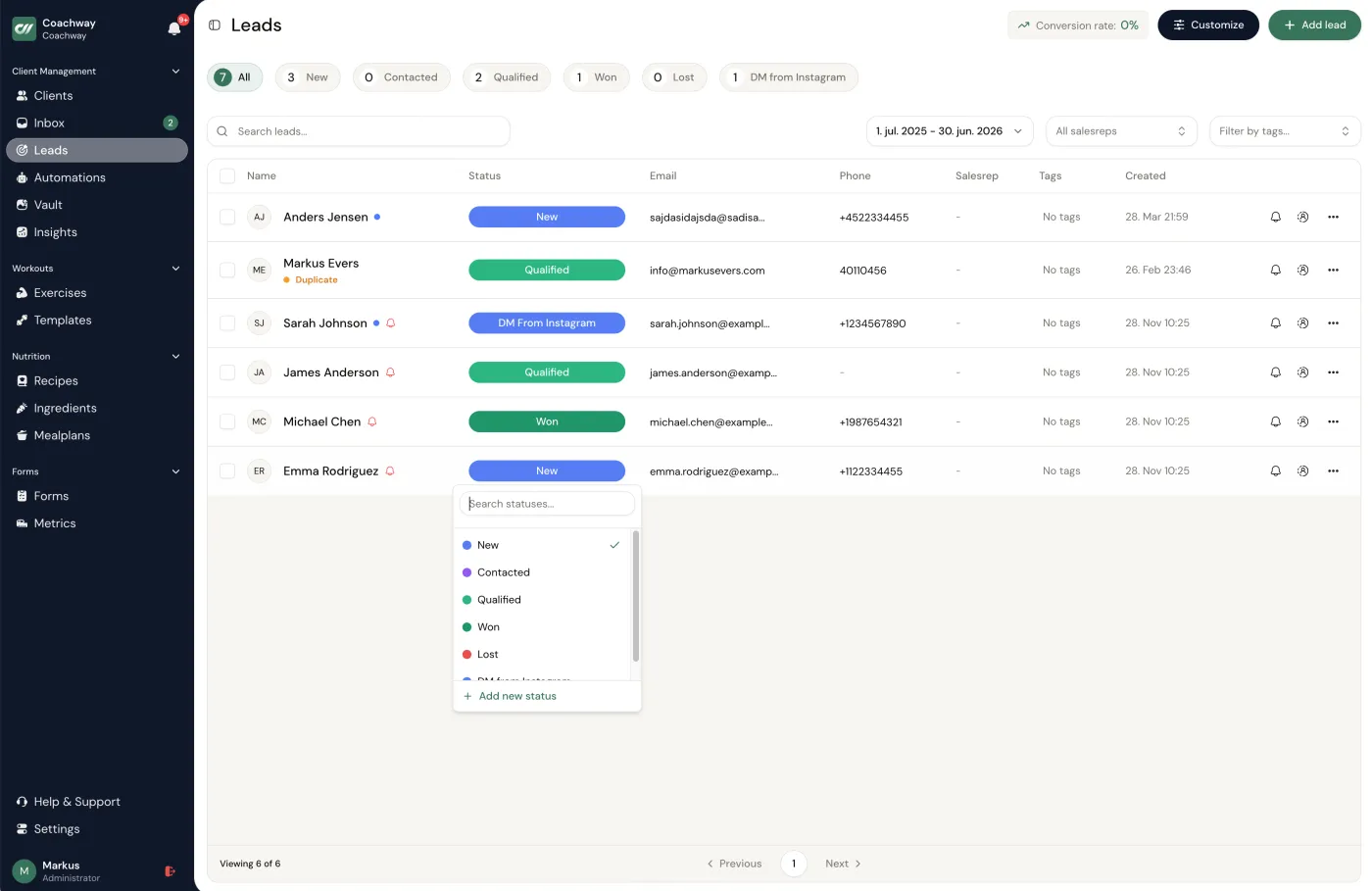
A niche only pays off when the right people can find you and become clients without friction - and when the enquiries do start landing, a scattered setup of DMs, notes and half-remembered conversations is what lets good leads go cold. A purpose-built platform keeps the pipeline in one place. Coachway, which we make, gives you an embeddable lead form that captures the full source trail and drops each enquiry into pipeline stages - new, contacted, qualified, won - so you can see at a glance who your niche is actually pulling in, and convert a won lead into a client in one click with the client app, onboarding sequence and billing already attached. It is built on knowledge from working with 150 online coaches over 6+ years, and it costs EUR 69 a month including your first 5 clients, then EUR 9 per additional client, every feature included. The 14-day free trial starts with a card held by Stripe and cancels under Billing before it renews - or book a demo to see the pipeline first.
Frequently asked questions about coaching niches.
What is a coaching niche?
A coaching niche is the specific audience plus outcome you become known for - the overlap between who you serve (busy men over 40, new mums, runners chasing a first marathon) and the one result you reliably help them reach. It is not your certification or your training style; it is a position in the market that tells a stranger, in one line, that you are the coach for people like them. A clear niche is what lets a general fitness coach stop competing with everyone on price and become the obvious choice for one group, which is why niched coaches usually charge more and earn more referrals than coaches who try to help everybody.
What is the difference between a coaching niche and a target audience?
A target audience is only half of a niche. The audience is the who - the group you want to reach. A niche adds two more things: the specific outcome you help that audience reach, and the positioning that makes you their obvious choice. Two coaches can share the same audience of women in their forties and still hold different niches, one focused on strength after menopause and one on fat loss around a busy job. The audience tells you who is in the room; the niche tells them why you, specifically, are the coach for their exact problem.
Does a coaching niche really let me charge more?
Yes, and the reason is competition. A general coach competes with every other general coach and ends up competing on price. A specialist competes with almost no one, because the client is no longer comparing hourly rates - they are thinking that you clearly understand exactly what is wrong with them. That perceived fit is what justifies a premium. The same effect drives referrals: a happy client in a tight niche knows other people with the same problem and sends them straight to you, so a narrow niche often grows faster than a broad one, not slower.
Can I change my coaching niche later?
A niche is a direction, not a tattoo. You commit to a starting point, publish into it for a few weeks, and watch who actually responds and books. If the wrong people show up or nobody bites, you adjust - and often the audience redirects you to a better niche than the one you planned. The mistake is not picking imperfectly; it is staying broad and waiting for a clarity that only ever arrives once you have committed to something specific and seen how the market answers.
Once the definition is clear, the work is choosing well and then pointing everything at it: how to choose your coaching niche, a shortlist of niches that sell and stay in scope, and the content that turns a niche into actual coaching clients.
Keep reading
all guidesHow to film exercise videos for online coaching (2026)
You do not need a studio or a camera operator to film exercise demos that clients actually use. This guide covers the phone-tripod-light kit, the angles that reveal form, why short loopable clips win, how to build a reusable library, and how to deliver every clip inside the client app instead of a buried chat link.
Read the guideOnline Coaching Mistakes to Avoid: The 8 That Cost You Clients (2026)
Most online coaches don't fail because they're bad coaches - they fail on a handful of avoidable business mistakes. Here are the 8 we see most often (vague niche, underpricing, tool chaos, weak onboarding, drifting check-ins, no accountability, selling features not outcomes, platform-hopping) and the honest fix for each.
Read the guideHow to build a personal brand as an online fitness coach (2026)
A personal brand is the reason the right client picks you over the next coach in their feed. This mini-pillar guide breaks it into five pillars: a clear niche and point of view, consistent content, a recognizable voice and look, social proof stacked in public, and a branded client experience that continues past the sale.
Read the guideFree tools for this: Email List Value Calculator for Coaches · Free Trial Conversion Calculator · Coaching Offer Builder
See what Coachway can do for your coaching business
Coachway was built on knowledge from working with 150 online coaches over 6+ years, who all hit the same wall - slow platforms, clunky workflows, wasted hours. Start your 14-day free trial and see what we fixed - the whole platform, no charge today, cancel anytime under Billing.


