


New Year marketing for online fitness coaches - the window opens in October.
Every coach knows January is the biggest month of the year. Fewer act on the uncomfortable half of that fact: the January client chooses their coach in November. This is the month-by-month runway - what to decide in early autumn, build in October, nurture in November, book in December, deliver in January, and catch in February - plus the honest part about resolution churn and how to sell the version of the offer that survives it.
By Markus Evers · Updated August 2026
the short version
Work backwards from January 1. Trust takes months of content, so the content ramp starts in October. A waitlist takes weeks to fill, so it opens in October too. Decisions happen in November and December, so that is when proof, offers and booked start dates do their work - not a discount, a designed start. January is for delivering an excellent first two weeks, because onboarding is where resolution churn is decided. And keep powder dry for February: when the do-it-alone crowd hits the motivation cliff, a second wave arrives that wants exactly what a coach sells.
Why the January client is won in November.
Three clocks run ahead of the calendar, and each one pushes the real work earlier. The buyer's clock: the person who signs up in January spends late autumn deciding that next year will be different - browsing, following, comparing, quietly building a shortlist. By the time they message a coach in the first week of January, the shortlist usually has one name on it. The trust clock: a stranger does not buy coaching from three posts; they buy it from months of watching you be consistent, specific and honest. Content published in October is what makes a January message feel safe to send. The logistics clock: waitlists take weeks to fill, offers take iterations to sharpen, and December attention is expensive, distracted and half on holiday. None of this work fits into the first week of January, which is why the coaches who "have a great January" almost always had a great October.
One more shift worth building into the offer itself: the resolution buyer is changing. Industry data points the same direction coaches feel anecdotally - in NASM's January 2026 survey of more than 600 fitness professionals, longevity and healthy aging was the fastest-growing client goal, with 62% of trainers reporting it more often. The January prospect increasingly wants "a year that changes how I live", not a six-week shred - which happens to be exactly the offer shape that survives February. Sell that.
Month by month, August to February.
August - September: design the offer, gather the proof.
Decide what January's offer actually is before you market anything: who it is for, what it includes, what it costs, and how long it runs - in months, not weeks, because the January buyer you want is buying a changed year. Get the pricing architecture right now, while there is no pressure. Then collect the proof you will spend the autumn publishing: client stories with written consent, progress data, testimonials. Proof gathered in September is ammunition for November.
October: open the waitlist, start the content ramp.
The public phase begins. Content shifts to the themes your January buyer is privately chewing on - why this attempt fails every year, what a system looks like, what a realistic first month is - published consistently, per the content playbook. Open a January waitlist with a simple lead form and give people a real reason to join it early: first pick of limited start dates, a bonus onboarding call, priority over the January crowd. A waitlist is not hype theatre; it is how a capacity-limited coach queues demand honestly.
November: nurture, prove, and start conversations.
This is decision month for the deliberate buyer, so November is proof season: the client stories, the honest how-it-works content, the day-in-the-life of being coached by you. Talk to the waitlist like humans - a short personal note beats a broadcast - and open discovery calls for January starts. People who commit in November with a January start date are your strongest cohort of the whole season: deliberate, planned, and immune to the January 2 impulse-crash.
December: book start dates, help people survive the season.
Do not fight the holidays - serve them. Holiday-survival content (training in a chaotic week, eating at parties without a meltdown, the maintenance mindset) genuinely helps, and it quietly demonstrates that you coach real life, which is the exact doubt your January buyer holds. Commercially, December has one job: convert waitlist and conversations into booked January start dates, so January 2 arrives with a calendar instead of a scramble. A chosen start date is itself a commitment device - the client has already begun.
January: deliver the first two weeks like they decide the year - because they do.
The rush arrives; your job flips from marketing to delivery. Onboarding is the retention moment: fast setup, the program landing quickly, an early win engineered into week one, and a real check-in reply in the first days. Say the quiet part to every new client out loud - motivation will dip in a few weeks, and the plan is built for it - so the dip, when it comes, confirms your credibility instead of ending the relationship. The retention playbook starts on day one, not when someone goes quiet.
February: catch the second wave everyone else ignores.
Two to three weeks into the year, the do-it-alone crowd hits the motivation cliff, and a different buyer appears: someone whose solo resolution just failed and who now understands, from fresh personal evidence, why structure and accountability are worth paying for. Most coaches have stopped marketing by then, which is exactly why the wave is catchable. February content speaks straight to it - "still going, or already stalled?" - without gloating, and offers the system they were missing. Some of the best long-term clients of the year sign in February, precisely because they did not buy on impulse.
Resolution clients churn. Design the offer so yours do not.
The dirty secret of January is that its clients are the year's fastest to leave - not because January people are flawed, but because most coaches sell them a January-shaped product. A short sprint bought on a motivation spike expires with the spike. Three design choices break the pattern. Package in months: sell the six-to-twelve-month block priced around the outcome, because that is the horizon real change lives on - and the horizon the longevity-minded January buyer is increasingly asking for anyway. Price the commitment, not the impulse: no January discounts; if you want an easier yes, remove risk with a guarantee and a designed first week rather than removing price - the full reasoning is in the trial-and-discount decision guide. Forecast the dip in the sales conversation: a client told in December that week three will feel flat treats week three as part of the plan. A client promised unbroken momentum treats week three as proof it failed.
The January rush is a systems test. Take it in October, not live.
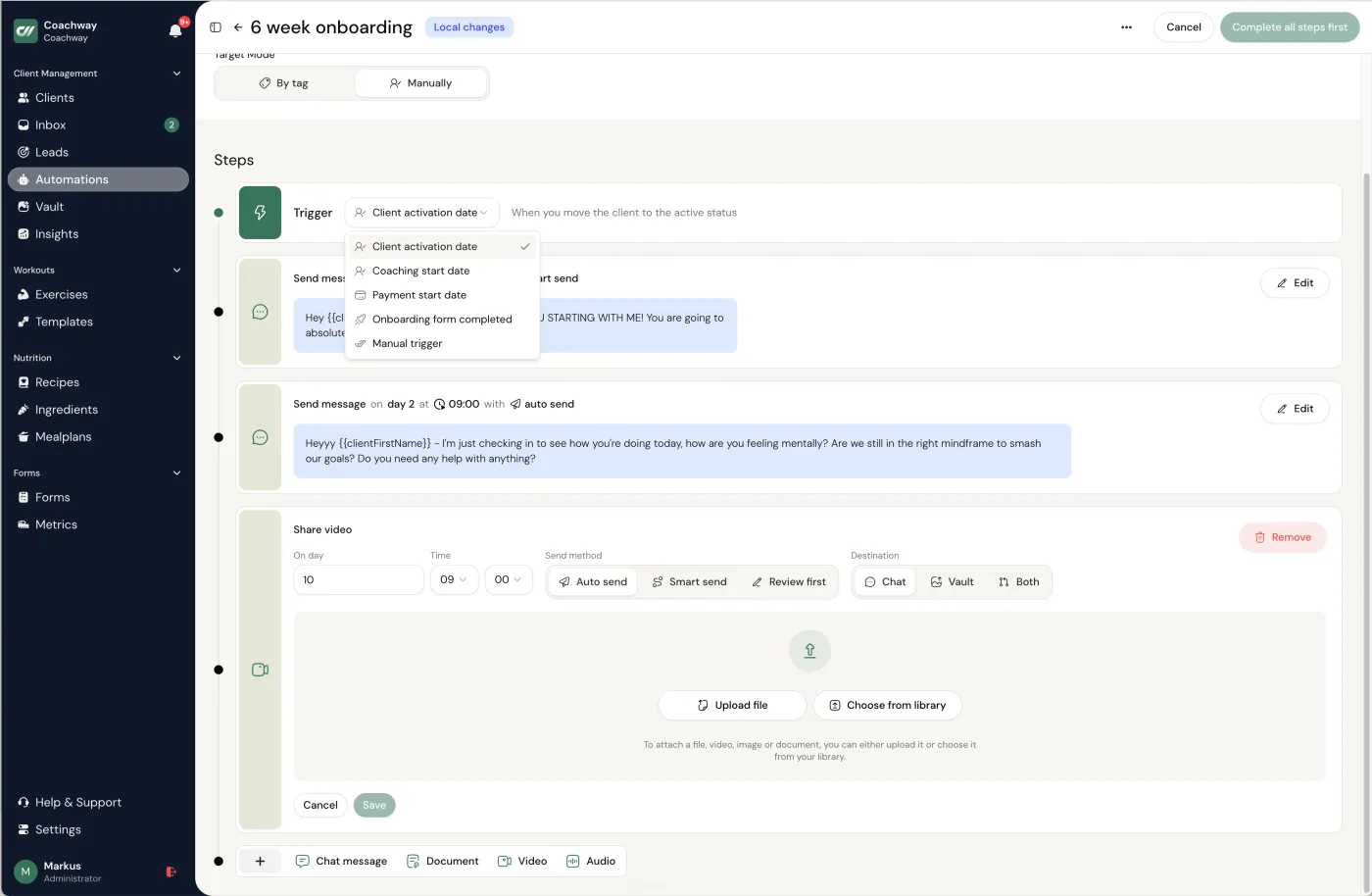
Whatever platform you run, pressure-test it before the season: the lead form the waitlist feeds, the payment links for the January packages, the onboarding sequence that greets every new client, the check-in cadence that will carry the January cohort. In Coachway that whole chain lives in one place - lead forms into a visible pipeline, offers and payments through your own Stripe, onboarding automations that welcome and remind without faking a human, and the client work itself in the same tab. Built on knowledge from working with 150 online coaches over 6+ years, EUR 69 a month including your first 5 clients and EUR 9 per additional client. Set it up in the quiet season; January is a bad month for plumbing.
Frequently asked questions about New Year marketing for coaches.
When should a fitness coach start New Year marketing?
October, and the offer design even earlier. The January buyer does not appear on January 1 - they spend late autumn quietly deciding that next year will be different, and they sign with whoever earned their trust during those months. Trust takes weeks of consistent content to build, a waitlist takes weeks to fill, and December attention is expensive and distracted. So the working runway is: offer locked by early October, content and waitlist building through October and November, start dates being booked in December, and January spent delivering and converting rather than scrambling. A coach who starts marketing on January 2 is competing for people who already chose someone in November.
Should I discount my coaching in January?
No - January is the one month you least need to. Demand is at its annual peak, which is exactly when discounting makes the least sense, and a discount attracts the most impulsive segment of an already impulsive season: people buying a feeling on January 2 who are gone by February. If you want to lower the barrier, lower the risk instead of the price - a clear guarantee, a strong onboarding week, and a start date they choose. The coaches who regret January are rarely the ones who charged full price; they are the ones who filled up with discounted sprint-buyers and spent March replacing them.
How do I keep New Year clients past February?
Sell the long version to begin with, then make the first two weeks excellent. Resolution churn is mostly a selling problem: a client who bought a January sprint quits when January motivation fades, but a client who bought a six-month change with a plan for the dip treats the dip as expected terrain. So package in months, not weeks; say out loud during the sales conversation that motivation will fall and that the plan is built for it; and invest heavily in onboarding - fast setup, an early win in week one, a real check-in reply in the first days. The mid-January motivation cliff arrives on schedule every year. Coaches who plan for it keep the client; coaches who are surprised by it write it off as a flaky client.
What should I post in the months before January?
Content that meets people where autumn actually finds them: skeptical of grand promises and short on time. October and November content should build the case that change is a system rather than a burst of willpower - real client stories with context, how you handle busy weeks and holidays, what a realistic first month looks like. December flips practical: holiday-survival content that genuinely helps people through the season positions you as the coach who lives in the real world, and it is the season your January buyers are watching most closely. Save the direct offer content for when the waitlist opens and when start dates are booking - an audience warmed by three months of useful content does not need to be shouted at in January.
Is January actually the best time to get coaching clients?
It is the biggest demand spike and the fastest churn, at the same time - which is why the honest answer is that January is the best month to harvest and the worst month to start planting. Treat it as the visible tip of a season that runs October through February. And do not sleep on February: two to three weeks into the new year, the first-rush crowd hits the motivation cliff, and a second group appears - people whose gym-alone resolution just failed and who now want structure and accountability instead of another app. That second wave converts to coaching remarkably well, because they have just run the experiment of doing it without you.
The autumn runway runs on two engines this guide only points at: the content system that builds the trust, and the lead generation that catches it.
Keep reading
all guidesHow to build a client referral program for your coaching business (2026)
Referrals are the cheapest, highest-trust clients you can get. How to build a structured referral program: when to ask, what to offer, how to make it easy, and how to track it without it feeling salesy.
Read the guideBest strength and conditioning coach certifications (a coach's guide, 2026)
The strength and conditioning certifications worth holding, compared fairly: who each suits, what they cover, and how they fit an online coaching career. General information, not professional advice.
Read the guideHow to become a running coach: certifications and how to coach runners online (2026)
How to become a running coach: the certifications worth holding, how to program for runners, and how to coach them online. The path from qualified to coaching real runners. General information, not professional advice.
Read the guideSee what Coachway can do for your coaching business
Coachway was built on knowledge from working with 150 online coaches over 6+ years, who all hit the same wall - slow platforms, clunky workflows, wasted hours. Start your 14-day free trial and see what we fixed - the whole platform, no charge today, cancel anytime under Billing.


